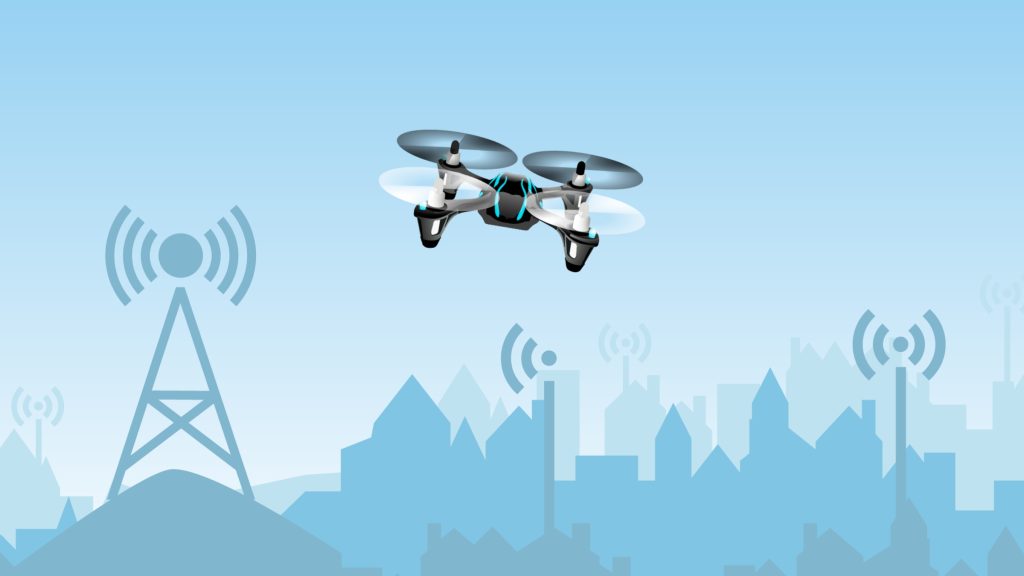
Commercial drone adoption is creating new revenue opportunities for telecom operators as demand grows for secure connectivity, data processing, airspace management, and drones as a service, allowing mobile network providers (MNOs) to use existing networks and enterprise expertise to build higher-value services worldwide.
Commercial drones are now becoming one of the few markets where operators already own many of the assets needed to compete, including nationwide networks, trusted infrastructure, enterprise relationships, and regulatory experience.
The Unmanned Aerial Systems (UAS) industry is growing, but the biggest opportunity may no longer be selling connectivity alone but providing complete services that combine networks, data, cloud platforms, and operational support.
UAS drone services used for commercial operations give MNOs a chance to move beyond basic connectivity into secure data, monitoring, and managed service platforms.
Drone Growth Opens New Telecom Business Opportunities
Commercial drone service providers continue to expand as advances in AI, with lower hardware costs and improving regulations making large-scale deployments more practical.
At the same time, industries such as energy, agriculture, public safety, logistics, and infrastructure are increasing their use of drones for inspections, monitoring, and emergency response.
Unlike many previous digital services, drone service providers rely heavily on assets telecom operators already manage.
Drones as a service fleet require reliable connectivity, secure data transmission, real-time communications, cloud processing, and wide network coverage. These requirements place operators in a strong position to move beyond traditional connectivity services.
Industry analysts expect commercial drones to become increasingly autonomous as AI improves navigation, obstacle detection, and mission planning.
Meanwhile, Beyond Visual Line of Sight (BVLOS) operations are gradually becoming more common, allowing drones to fly beyond the operator’s direct line of sight and making long-distance inspections and monitoring commercially viable.
Rather than manufacturing drones, operators can focus on the supporting drones as a service technology that allows fleets to operate safely at scale.
These include connectivity, edge computing, cloud services, fleet management, and commercial drone data analytics.
Drones As a Service Is the Next Growth Market for Telco
The drones as a service opportunity also comes as telcos continue to face pressure on traditional revenues. As mobile and broadband services become more commoditized, operators are looking for businesses where they can build long-term value instead of competing only on price.
Some European operators have already started moving in that direction, with British Telecom (BT) offering drone connectivity services. Spain’s Telefónica combines connectivity with airspace management capabilities, while France’s Orange has introduced drone service companies detection services for customers operating critical infrastructure and sensitive facilities.
Early deployments are helping these drone service companies build technical experience, customer relationships, and partnerships before the wider market becomes more competitive.
Industry observers also note that operators may gradually progress from providing connectivity to delivering integrated platforms and eventually complete drone services for enterprise customers. This approach creates additional revenue opportunities while reducing dependence on traditional telecom services.
Security, Partnerships Drive the Next Phase of Drone Services
Drones as a service also increase demand for monitoring and airspace security.
During the 2024 Paris Olympic Games, French authorities intercepted several unauthorized drones every day around competition venues. More recently, unidentified drones were detected above France’s Île Longue naval base, highlighting the growing need for continuous monitoring around strategic locations.
Orange has responded by developing Orange Drone 360, a service that continuously monitors low-altitude airspace using sensors installed on tower infrastructure. Instead of selling equipment, the operator delivers the capability as a managed service.
As Director of Orange’s Direction Défense & Sécurité division, Nassima Auvray, explained, the solution is “based on our own infrastructure – that is to say, our TowerCo, our connectivity, our trusted cloud.”
The broader industry is also calling for closer cooperation between cellular connected drones aviation and telecom sectors before national regulations become too different.
A coalition including Ericsson, Nokia, Viasat, NextNav, and the United Kingdom’s National Cyber Security Centre argues that mobile networks should become part of future airspace safety systems. Besides connectivity, telecom infrastructure can support secure identity, positioning, authentication, and trusted data for autonomous aviation.
The drone market is scaling far faster than many of today’s airspace and identification frameworks were originally designed for.” He added that early cooperation could help “build globally scalable foundations before national approaches diverge too far,” Barney Stinton, who leads aviation market development at GSMA Fusion.
For telecom operators, that message extends beyond aviation policy. As best industrial drones become part of everyday operations, value is expected to move toward secure platforms, managed services, and operational intelligence rather than connectivity alone.
Operators that invest early in partnerships, cloud capabilities, regulatory engagement, and enterprise solutions could establish stronger positions in a growing ecosystem.
While drone service companies that continue relying mainly on traditional connectivity services may find fewer opportunities for future revenue growth.
Inside Telecom provides you with an extensive list of content covering all aspects of the tech industry. Keep an eye on our Telecom sections to stay informed and up-to-date with our daily articles.