
Over the last five years, consumer broadband spending has grown at a 4% CAGR, largely driven by more households connecting to the internet rather than operators earning more money from each subscriber. In fact, ARPU has been stagnating or even declining across regions as competition puts pressure on prices. At the same time, the expansion of fibre networks has made high-speed broadband widely available, with speeds that often exceed the needs of most households. Operators continue to invest in fibre to replace ageing copper infrastructure, while Fixed Wireless Access (FWA) offers an alternative for reaching customers in areas where deploying fibre is less feasible. As faster connections become more accessible, speed alone is becoming a less effective way for operators to differentiate their services and increase revenue.
While operators have focused on delivering faster broadband speeds, home networks have become increasingly complex. More devices are connected simultaneously, and Wi-Fi is now expected to provide reliable coverage throughout the entire home, even supporting outdoor devices such as smart security cameras and doorbells. As a result, subscribers can have more than enough bandwidth and still experience buffering, poor coverage or dropped video calls. For many households, the real challenge is no longer broadband speed, but how effectively their home network and Wi-Fi performs.
Operators therefore need to place greater emphasis on managing the home network as part of their broadband strategies. A further wave of broadband growth will increasingly depend on how effectively they manage the home connectivity experience, including the software, equipment and support processes behind it.
Mesh and Wi-Fi 7 can improve home coverage
As households connect more devices and expect reliable Wi-Fi throughout their homes, a single gateway is not always enough to provide consistent coverage. Mesh access points can help extend connectivity into areas where the main router’s signal is weak, improving the experience across larger homes and outdoor spaces.
Wi-Fi 7 offers further improvements in mesh networks, particularly in homes with multiple users and high connectivity demands. Features such as Multi-Link Operation (MLO) allow compatible devices to use multiple frequency bands, improving reliability and network performance. Adoption has increased since its introduction in 2023, reaching 22% of total deployments in 2025. However, many households still use Wi-Fi 5 or Wi-Fi 6, and consumers often struggle to recognise the benefits of upgrading.
With Wi-Fi 8 already on the horizon, operators need to consider whether each new technology upgrade delivers meaningful improvements for subscribers. Mesh networks can help extend coverage, while newer Wi-Fi standards improve network performance. However, hardware alone cannot guarantee a better experience. How effectively the home network is managed is just as important.
Managing the service beyond the gateway
With broadband speeds already meeting the needs of most households, subscribers are increasingly judging their broadband service by the quality of their Wi-Fi experience. Even with multiple access points performance can be affected by interference, poor device connections, and competing demands on the network.
Software gives operators greater visibility into these conditions and more ways to be proactive before the issues appear to the customer. Remote diagnostics can help identify problems without sending a truck roll on site, while automated provisioning can simplify the deployment and management of equipment. Wi-Fi management can steer devices between bands and adjust network behaviour as conditions change.
The commercial implications go beyond customer satisfaction. Resolving a problem remotely can reduce customer support costs, minimise the lifecycle of the hardware in order for the equipment to last longer, and offer better visibility on whether a hardware update is necessary. These cost reductions can make investing in home network management worthwhile, even if they don’t directly lead to new revenue growth.
Software changes the procurement decision
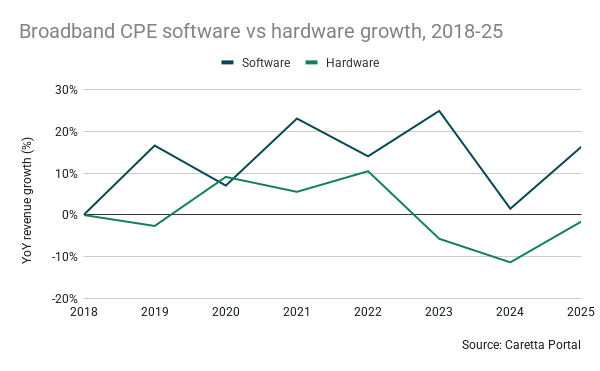
Operator spending on broadband customer premises equipment (CPE) software increased from $270M in 2021 to $455M in 2025. Over the same period, overall CPE hardware revenue fell from $16B to $14B in 2025.
The decline in hardware revenue is largely driven by stagnant subscriber growth, intense price competition among equipment vendors, and longer device lifecycles. As broadband access and Wi-Fi technologies mature, operators can keep the same hardware for longer, while software updates can further extend its lifespan and reduce the need for frequent replacements. On the software side, the revenue growth reflects the value of device management and managed Wi-Fi: capabilities that give operators greater control over equipment and the subscriber experience, which are less expensive to procure.
Having more control over their home network software also gives operators greater flexibility when choosing hardware suppliers. Open frameworks such as RDK-B, OpenWrt and prpl can separate software from the underlying hardware. This can lead to vendor independence, which will increase the competition between OEMs and drive down hardware procurement pricing.
For hardware suppliers, this shift brings new challenges. Hardware is still essential, but growing price competition and longer device lifespans make it harder to generate revenue from equipment sales alone. Software creates new opportunities for suppliers to provide ongoing value through the features and services operators use throughout a device’s lifetime.
AI raises the importance of software readiness
AI offers further opportunities to automate network management. Rather than simply monitoring network conditions, AI can help identify and address problems before subscribers notice them. It can be used to analyse signal quality, interference, latency and device health, while prioritising traffic according to demand. A video call, for example, can take precedence over a background software update.
There are challenges in utilising AI for home network management. Many operators still lack a consistent software platform across their installed devices, making it difficult to introduce AI functions at scale. Some network adjustments, such as Wi-Fi channel switching, require low latency that cloud-based processing may not always provide. Analysing home network data also raises privacy concerns, while continuously running AI across millions of devices could lead to significant cloud processing costs.
Embedding neural processing units (NPUs) in gateways could help address some of these challenges. Processing AI locally can reduce cloud infrastructure and processing costs while enabling faster Wi-Fi adjustments, traffic prioritisation and anomaly detection, even when cloud connectivity is interrupted. AI can also help manage power consumption by adjusting Wi-Fi activity based on usage patterns, potentially extending equipment life.
As more suppliers integrate NPUs into gateways, the initial hardware price premium is likely to decrease. Over time, these capabilities may become standard, making it harder for vendors to differentiate through hardware alone. The longer-term opportunity lies in the software that manages AI functions on the gateway, allowing suppliers to offer more value throughout the device’s lifetime.
For operators, the priority is to build a home network environment that can be managed and improved over time. More reliable Wi-Fi, fewer support interventions, lower operating costs and longer equipment life provide clear ways to measure the benefits. They also offer a way to improve broadband services when additional speed alone is becoming harder to sell.
Inside Telecom provides you with an extensive list of content covering all aspects of the tech industry. Keep an eye on our Opinion to stay informed and up-to-date with our daily articles.
