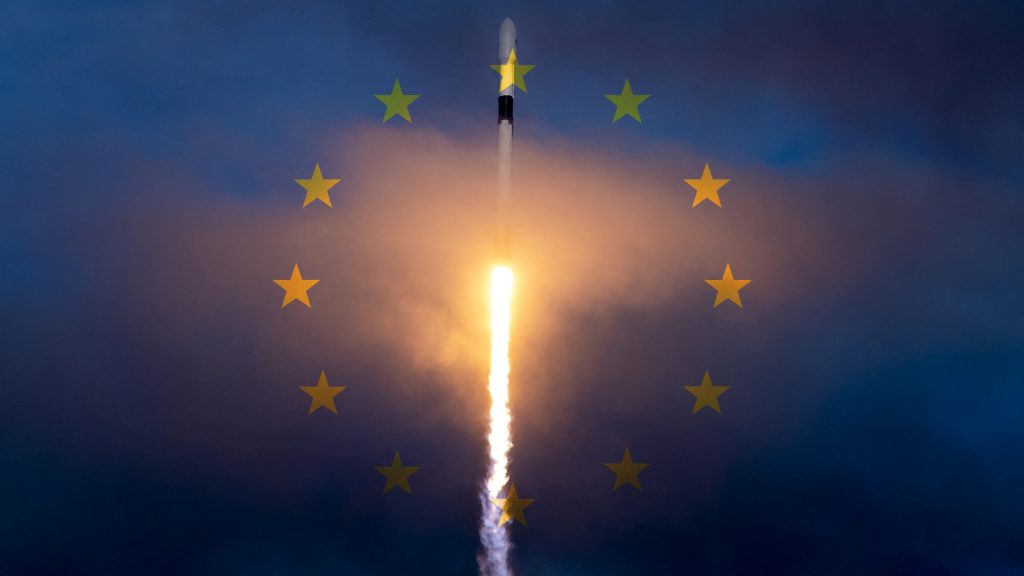
On November 24, Belgium’s King Philippe inaugurated the Aerospace lab Belgium Megafactory in Marcinelle, opening Europe’s largest satellite manufacturing facility as the EU works to reduce its dependence on foreign space communications infrastructure.
According to the Belgian Royal Palace, with a surface area of 20,000 square meters, the factory has the capacity to produce up to 500 satellites annually, making it the largest satellite production site in Europe and the third-largest worldwide.
Behind the investment lies a growing European concern over who owns and operates the technology on which governments, businesses, and security services increasingly depend.
On November 30, Aerospacelab will also be changing its name, becoming Ectro – a reference to ectropy, the opposite of entropy, chosen partly to end persistent misspellings of the original.
“We grew faster than our ambition, thanks to our clients and partners,” said Benoît Deper, founder and CEO of Aerospacelab.
Europe Wants to Build Its Own Satellites
For years, Europe has relied partly on international providers for satellite connectivity. However, recent geopolitical tensions have given European governments more reasons to invest in domestic infrastructure when communications involve sensitive military and governmental information.
The opening of Aerospace lab Belgium follows a major commercial agreement announced on September 10, when satellite operator Eutelsat, leading the low Earth orbit component for the SpaceRISE consortium, selected the Belgian company to build 264 spacecraft under a contract worth $2.6 billion (€2.4 billion).
The spacecraft account for 264 of the 348 satellites planned under the IRIS² EU secure satellite constellation, Europe’s answer to the growing concentration of satellite connectivity among international providers. Airbus is building the first 66 low Earth orbit platforms for delivery in 2029, OHB is building all 18 medium Earth orbit platforms, and Thales Alenia Space is supplying the governmental communications payloads.
The project is intended to support governmental communications while extending connectivity to commercial users and underserved regions.
The manufacturing model behind it is what makes the Belgian investment interesting. For European satellite manufacturers, moving towards standardized spacecraft platforms could make it considerably cheaper to accommodate different missions using similar hardware.
Inside the Aerospace Megafactory, around 7,000 square meters are allocated to production, with another 4,000 dedicated to cleanrooms. Even small particles can damage sensitive optical equipment during assembly, making contamination control an important part of spacecraft manufacturing.
Although Aerospace lab Belgium has officially opened, production is expected to begin by the end of 2028, leaving the company with substantial preparations ahead. Teams move in from January, and production will ramp up gradually, with the first IRIS² launches expected in 2030.
The expansion of satellite production Europe also has implications for Belgium’s engineering workforce. The Marcinelle site is designed for around 500 people, and the company, which is recruiting more than 30 staff a month, expects to pass 1,250 employees by end of 2027.
Beyond manufacturing, educational institutions such as the Europe space center Belgium in Transinne help generate interest in technical careers at a time when spacecraft development increasingly requires expertise in telecommunications, electronics, and software engineering.
Other satellite manufacturers in Europe are pursuing similar industrial expansion. in September, Open Cosmos, operating from the UK, Spain, Portugal, and Greece, raised $328 million (€300 million) and plans a 192-satellitet communications constellation, called ConnectedCosmos.
With four operational factories, its existing satellite production sites already give the company the combined capacity to manufacture one spacecraft daily, demonstrating how quickly Europe’s commercial space industry is developing.
Who Will Protect Europe’s Satellites?
Building hundreds of satellites is one challenge but keeping them operational once they leave Earth is another. Europe’s industrial expansion comes at a time when space is becoming increasingly crowded, particularly in low Earth orbit (LEO).
According to the European Space Agency’s (ESA) 2026 space environment report, more than 4,000 payloads placed into orbit during 2025, delivered by more than 300 launches. Surveillance networks had catalogued close to 45,000 objects by the end of that year, while modelling estimates a further 1.5 million debris fragments between one and ten centimeters across.
For Aerospace lab Belgium, these conditions raise questions about how future spacecraft accommodate technologies that help operators monitor their surroundings. An ambitious European satellite network serving governments and businesses cannot afford frequent disruptions caused by collisions or interference from other spacecraft.
“The frequency of SSA observations is key,” wrote Kammy Brun, managing director of Simera Sense France, in Geopolitical Monitor. Simera Sense sells optical payloads for space situational awareness (SSA) designed to be carried abroad other operators’ satellites, so its executives argue for a carried aboard other operators’ satellites, so its executives argue for a capability the company supplies.
SSA offers European satellite manufacturers an opportunity to incorporate surveillance equipment into spacecraft already scheduled for launch, rather than financing separate satellites for monitoring purposes.
Installing optical sensors aboard existing communications satellites would allow operators to collect observations from several orbital positions, potentially improving the accuracy of collision predictions.
For the IRIS2 EU secure satellite constellation, such capabilities could eventually become as important as the technologies protecting communications against cyberattacks.
A secure network model for satellite communication must account for the physical survival of the equipment carrying encrypted information.
As satellite production Europe expands, incorporating surveillance equipment during manufacturing could become more economically practical than addressing orbital security independently.
Meanwhile, the connection between Europe space exploration and commercial telecommunications is becoming increasingly apparent, extending even to educational facilities such as the Europe space center Belgium.
“Now, it must also get better at monitoring them once they reach orbit,” wrote Brun, discussing Europe’s manufacturing progress.
The investment in Aerospace lab Belgium gives Europe greater control over how its satellites are built. Whether that translates into lasting technological independence will also depend on its ability to protect them throughout their operational lives.
Inside Telecom provides you with an extensive list of content covering all aspects of the tech industry. Keep an eye on our Telecom sections to stay informed and up-to-date with our daily articles.
