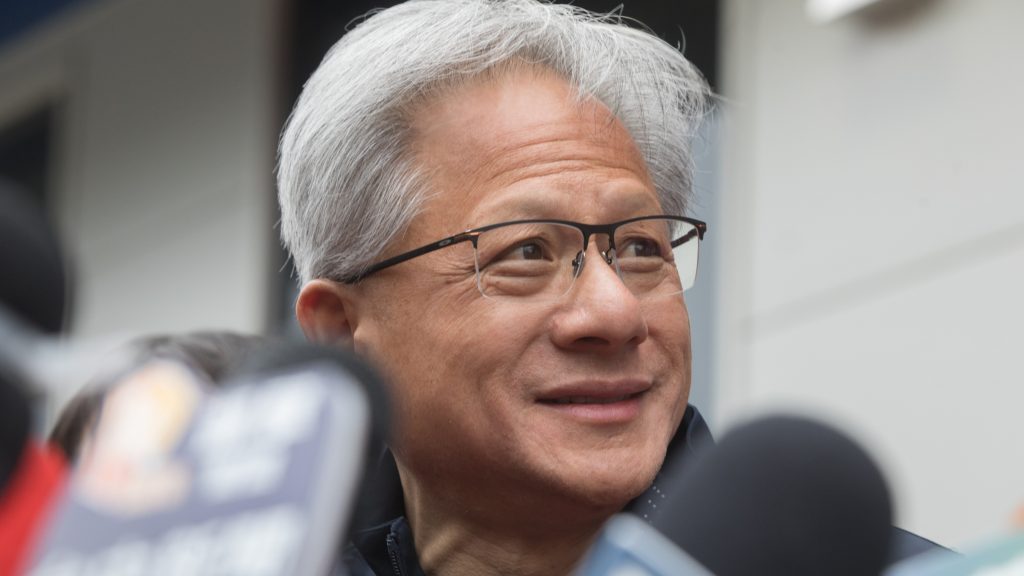
On November 12, Nvidia’s Board of Directors announced that Jensen Huang had resigned as president, chief executive, and director, effective immediately, ending a tenure of 33 years in which he built graphics-card company into one of the most valuable corporations on earth. The current Nvidia stock volatility added pressure to the former chief’s technological and political ambitions.
The departure comes at a sensitive moment for Nvidia, whose influence has expanded from manufacturing graphics processors to supplying the infrastructure behind AI. With Huang having directed that expansion for more than three decades, his resignation raises questions about whether the company’s technological advantage can survive without the person who built much of its strategy.
Nvidia’s AI Empire Under a Leadership Test
Colette Kress, the chief financial officer (CFO) since 2013, will serve as interim CEO while keeping her old job. Harvey C. Jones, a former CEO of Synopsis, became the board’s first-ever chair – a title that did not exist at Nvidia until the day its founder left.
The Jensen Huang scandal has consequently turned Nvidia’s succession planning into an immediate concern, although the company’s future depends on more than who occupies its executive offices. According to Nvidia Newsroom blog, the board said it is “initiating a search for a permanent” successor and “will consider internal and external candidates.”
The language of the announcement was that of continuity, that’s purely focused customer commitments, product roadmap, operations, all to proceed “without interruptions.” Giant companies tend to promise uninterrupted operations at moments when interruption is the only thing anyone can see.
Path to Disaster and Nvidia Stock Volatility
The path to November 12, began on November 8. On that day, Nvidia’s board opened an independent investigation, overseen by independent directors and outside counsel, after the New York Times and Axios first reported that Huang had been the target of a Chinese foreign intelligence effort.
Nvidia’s Board of Directors said they had no reason to believe national security, or company secrets had been compromised. The same day, Nvidia’s former chief admitted in a message to employees that he had been unfaithful to his wife.
Until then, Nvidia had contested the underlying reporting. Huang’s apology was unusually unadorned for a man whose public persona runs to leather jackets and keynote theatrics, and it said, in effect, that there was no excuse for what he had done.
The woman, whom the New York Times identified, is Alice Huang, also known as Huang Le, (not relative to Jensen Huang) is a former Chinese investment management firm’s executive at a Chinese AI company.
According to The Guardian, Alice “was the chief executive of a Singapore-based datacenter company” Megaspeed “reportedly suspected of evading US export controls and routing Nvidia chips to China.” The affair would have been a private catastrophe for any company, but at Nvidia it was a geopolitical one. Nvidia’s chips are the thing Washington is trying to keep out of Beijing’s hands, and the man who decides how hard to lobby against those restrictions had, it emerged, been compromised in precisely the direction that mattered.
Nvidia’s board has stressed that it found no evidence that any secrets left the building. In national security matters, however, the absence of evidence isn’t always the comfort it sounds like, and the media optics did a good deal of the work that the facts had not.
The Nvidia stock volatility had already been surfacing. The chip giant had already lost more than a trillion dollars in market value over the preceding month, amid a broader slide in AI stocks.
33 Years Making Nvidia Inevitable
According to Semafor analysis, Huang transformed Nvidia by backing technologies long before their commercial potential was apparent, building an ecosystem competitors have spent years trying to challenge.
Introducing CUDA in 2006 let developers use graphics processors for general computing, so when AI eventually gained momentum, Nvidia already had software and hardware researchers could build around. Huang carried that approach into networking, developing NVLink to connect processors and acquiring Israeli company Mellanox Technologies for $6.9 billion in 2019.
The chip maker later agreed to expand into cloud infrastructure and agreed to buy Hugging Face for $12.9 billion in September, strengthening its position across the technologies used to develop and deploy AI.
For investors, Nvidia stock volatility now carriers a different concern because those bets were closely associated with Huang’s judgment, and his willingness to commit billions before new products had established commercial markets.
The Jensen Huang affair has brought that dependence while Nvidia’s expansion demands coordination across chip development, data centers, and major customers. Kress has been CFO since 2013, but managing finances differs from directing the technical bets that built the company’s position. As far as the world knows, only Jensen can do that.
“Colette has helped lead NVIDIA through a period of extraordinary growth and has deep understanding of our business, customers, operations, and financial position,” Jones said in the company’s announcement.
The Nvidia scandal today leaves shareholders asking how much of its success belongs to the ecosystem and how much to Huang personally. The distinction holds a deeper perspective, as Nvidia China AI competition intensifies, with Chinese developers building domestic alternatives while American semiconductor manufacturers face tightening export rules.
Federal Government Invokes National Security Probe Nvidia
Beyond the leadership transition, Nvidia China trade tensions are now difficult to separate from the allegations surrounding Huang, whose relationship with a business executive reportedly suspected of Chinese intelligence links has drawn attention from American investigators.
According to the New York Times reporting last month, US intelligence agencies had concluded the Jensen Huang affair with Alice Huang. Megaspeed, reported to have been preparing to buy around $2 billion of Nvidia’s AI technology, has faced separate scrutiny over possible unauthorized transfers of advanced American chips to China, with the Department of Commerce officials examining whether it helped Chinese companies circumvent export restrictions.
Megaspeed chairman and CEO, Tan Pong, said the Singapore-based company takes its export control obligations “extremely seriously” and has cooperated with the Commerce Department’s Bureau of Industry and Security hiring a US law firm to audit where its chips went.
Singapore has opened its own inquiry too.
No charges have been brought and no government body has published any findings. As for the allegations about the Nvidia China connection, investigators have not publicly established that Nvidia’s Huang knowingly disclosed confidential information, or assisted Chinese intelligence.
On Sunday, President Donald Trump said the FBI was investigating the Nvidia China connection. In parallel, Beijing has denied attempting to compromise Nvidia’s former CEO, Huang. The controversy has also spilled into the White House, with intensified scrutiny of what officials in Trump’s administration knew about the Jesen Huang affair while engaging with him on semiconductor export policy.
The debate over Nvidia national security sharpened because Huang had challenged limits on Nvidia on selling advanced processors to China, arguing American sales would Chinese developers dependent on US technology instead of pushing Beijing toward alternatives.
Huang’s stance placed him against supporters of tighter Nvidia chips export control, who say restricting access is necessary to slow Beijing’s military progress.
According to Semafor, critics have treated the controversy as a chance to challenge the influence Huang exercised over Washington’s semiconductor policy, giving the Jensen Huang scandal a new dimension beyond Nvidia. Yet the discussion surrounding Jensen Huang scandals also requires separating unproven personal allegations from documented concerns about how sensitive technologies reach restricted markets.
For policymakers, Nvidia China trade tensions concern more than one executive, since American restrictions decide which countries reach the computing systems behind advanced AI. The Nvidia chips export control discussion, whether you agree or not, moves between guarding technological advantages and preserving US influence.
Huang’s departure may change how that argument develops, with Nvidia stock volatility surfacing uncertainty over whether his successor keeps lobbying for Chinese market access or takes a more cautious line toward Washington. The core foundation of the claim that Nvidia prioritizes national security over commercial export growth opportunities now faces examination, as its next leadership balances regulatory duty against growth strategy.
Nvidia stock volatility cannot be explained by the investigation. Investors were already questioning the spending required to build AI infrastructure and whether technology companies could generate enough revenue to justify it.
“We will continue advancing the work that has made NVIDIA a leader in accelerated computing and AI, and execute on the opportunities ahead,” said Kress.
For Big Tech, Nvidia stock volatility is the immediate concern, while the leadership transition exposes a deeper one facing the AI industry. Companies supplying critical technology must answer not only to shareholders and customers, but to governments worried about how their products influence global competition.
What happens next is mostly a matter of arithmetic and nerve. Nvidia reports third-quarter (Q3) earning on Tuesday, November 17, a date the company says it is keeping, with a CFO running the show and a founder who’s no longer in the room.
Kress has the credibility of someone who has watched the numbers for 13 years. Whether she, or whoever follows her, can supply what Nvidia’s co-founder, Jensen Huang supplied, the sense that the whole improbable enterprise was held together by one man, one visionary’s conviction is the question the search committee will spend months on.
Nvidia that spent three decades being defined by its founder, now has to find out what it is without him.
