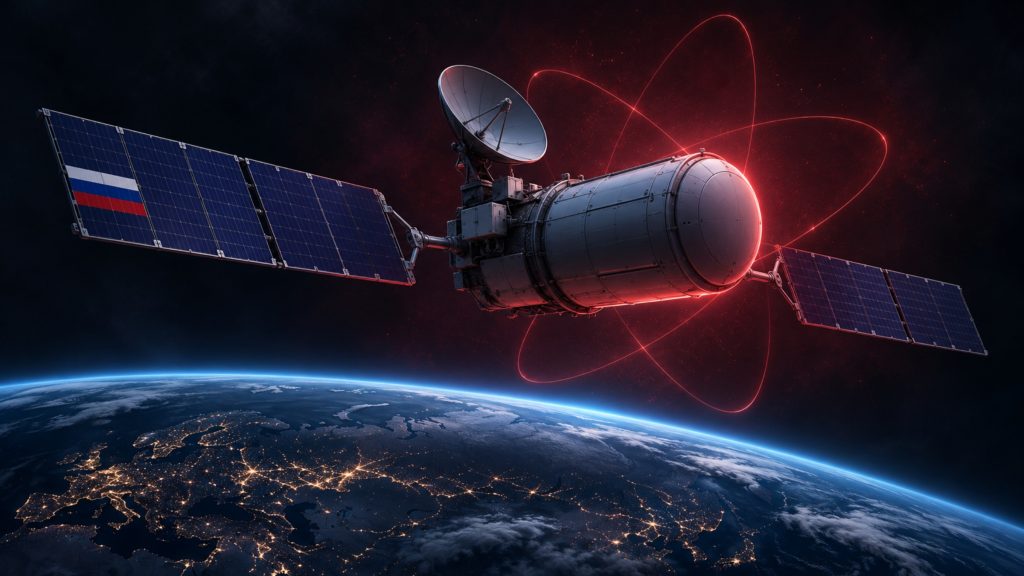
On November 23, German media reported that a Russian nuclear satellite could launch before the end of 2026, raising concerns over a potential breach of the Outer Space Treaty and the safety of satellites supporting communications, navigation and emergency services.
The investigation by German broadcasters, Westdeutscher Rundfunk (WDR) and Norddeutscher Rundfunk (NDR), as well as newspaper, Süddeutsche Zeitung, identified the spacecraft as Sputnik-S, according to Diplomacy and Law.
The reports referenced an early-November Western intelligence that it could reach orbit within 60 days and say it was assembled years ago and stored in the Moscow region.
Germany’s military Space Command assesses a launch could happen in December. In parallel, Western agencies, including the Federal Intelligence Service (BND) have shared information about the project with NATO allies.
NATO Secretary General, Mark Rute, speaking at the joint press conference with German Chancelor, Friedrich Merz in Berlin, said the alliance would “defend every inch of NATO territory,” adding that this includes making sure it is safe “when it comes to the space element.”
On November 23, Moscow rejected the German reporting, with Kremlin spokesman, Dmitry Peskov, saying that officials had not seen the report and that the claims were “hardly worth taking seriously.” Russia’s embassy in Berlin called them “unfounded insinuations” and part of a propaganda campaign, saying Russian space activity is exclusively peaceful.
The report of a Russian nuclear satellite has yet to establish that a weapon is aboard Sputnik-S or that it has entered orbit.
1967 Out Space Treaty Article IV
Under Article IV, the 1967 outer space treaty prohibits countries bound by the agreement from placing objects carrying nuclear weapons or other weapons of mass destruction in Earth orbit, installing them on celestial bodies or stationing them elsewhere in space. Russia remains a party to the treaty, and for the alleged Russian nuclear satellite the relevant facts are what the spacecraft carries and whether it reaches orbit.
The Russia nuclear satellite reports describe a possible launch window, with no public date or evidence of a final decision. In February 2024, US officials acknowledged concerns about an emerging Russian anti-satellite capability, according to Diplomacy and Law, which also revealed that the 2024 warning didn’t describe a nuclear weapon.
On October, the US Defense Intelligence Agency’s (DIA) annual Challenges to Security in Space 2026: Congestion, Competition, and Cooperation said that Russia is developing a satellite designed to carry a nuclear weapon, despite to comply with the 1967 treat.
The 1967 Outer Space Treaty, formally the Treaty on Principles Governing the Activities of States in the Exploration and Use of Outer Space, binds 115 states parties, including Russia and the US. Its Article IV is the only rule binding on Russia that makes placing a nuclear weapon in Earth orbit unlawful in itself, so whether Sputnik-S is a legal problem, turns on that one article, rather than on anything the satellite is ever used to do.
Kosmos 2553, a separate Russian spacecraft launched shortly before the 2022 invasion of Ukraine, figures in coverage of Russia nuclear weapons in space. Russia’s defense ministry described it as technological spacecraft testing instruments under radiation, with security services telling WDR and NDR they believe it tested how radiation affects satellites. US officials, however, say it is a research platform for non-nuclear components of a nuclear anti-satellite weapon.
For governments assessing the Russia space nuclear threat, the distinction between development and deployment has legal consequences. So, a confirmed orbital deployment of Russia’s nuclear space weapon would still be deemed a breach of Article IV – even if it were never activated.
A confirmed orbital deployment of Russia’s nuclear space weapon would breach Article IV even if it remained inactive.
The Russia nuclear weapon in space allegations raise questions about how countries can seek evidence. Under the 1974 Registration Convention, a launching state, in this case Russia, must register objects it places in orbit, and the United Nations (UN) keeps a central register to identify the launching country of possible space nuclear weapons and a spacecraft’s general purpose, while leaving its payload undisclosed.
That gap matters when officials discuss detecting nuclear weapons from space, because tracking a spacecraft establishes its location and leaves the nature of its payload open.
Governments concerned about the reported Russian nuclear satellite can seek consultations under Article IX if they believe a planned activity could interfere with their peaceful use of space.
A separate agreement also bears on the Russia nuclear satellite dispute. The 1963 Partial Test Ban Treaty prohibits nuclear explosions in outer space and continues to bind Russia, so a weapon placed in orbit and never detonated could breach Article IV without violating the test ban, per se.
What Satellite Loss Could Mean on Earth
Deutsche Welle pointed to a United States nuclear test in 1962 to explain the effects of nuclear weapons in space. Starfish Prime briefly disrupted some Pacific radio links and knocked out some streetlights in Hawaii. Satellite damage outlasted the visible flash.
That history gives context to reports about Russia’s nuclear weapons in space, though the consequences of any future event remain uncertain.
For emergency crews, reports about a Russia nuclear weapon in space bring attention to services that people may notice when they stop working. A ship’s emergency beacon can use the Global Positioning System (GPS) to find its location, then rely on a separate satellite network to pass that information to rescuers. Damage to that network could delay an alert even if the beacon still knows where the ship is.
The Russia space nuclear threat also reaches aviation and finance. Pilots use satellite navigation, and financial networks use precise time signals.
If disabled spacecraft could no longer maneuver, collisions could leave debris that would threaten other satellites and complicate replacement efforts. Deutsche Welle described such a chain of collisions as a possibility with an uncertain outcome.
The Russia nuclear weapons in space reports put civilian satellite operators alongside governments in a debate that began with military intelligence, and satellite infrastructure crosses borders, so those exposed to any disruption extend beyond the countries involved.
For now, the question about the reported Russian nuclear satellite is whether the spacecraft will launch and what it would carry. Until that is established, the public record supports diplomatic scrutiny of a reported risk, while any finding of an Article IV violation would depend on evidence of deployment.
Inside Telecom provides you with an extensive list of content covering all aspects of the tech industry. Keep an eye on our Geopolitical Strategy section to stay informed and up-to-date with our daily articles.
