Your customer can stay with you for ten years and still buy their travel data from someone else. That’s the problem travel eSIMs have created for mobile operators. The customer doesn’t leave. The line stays active. The bill gets paid. But a few days before a trip, they open another company’s app, buy a data bundle, and their operator never sees the sale.
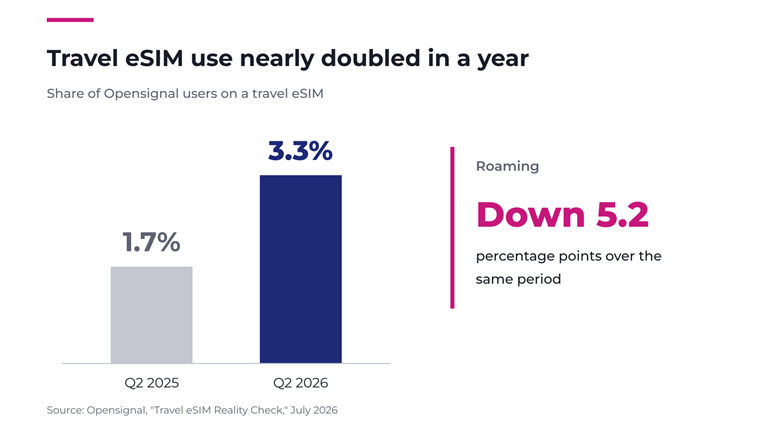
This is no longer a small shift. Opensignal found that the share of its users on a travel eSIM nearly doubled between mid-2025 and mid-2026, from 1.7% to 3.3%. Roaming dropped by 5.2 percentage points over the same period. Counterpoint Research expects operators’ roaming revenue to fall by a third by 2030.
Most operators see this as a threat. I see a sale they can still win. Operators have two things no travel app can copy. Their customers already trust them. And their customers already use the operator’s app to check a balance or pay a bill. The question is whether operators put those two things to work.
Start with Travelers Who Rarely Buy Roaming
A customer who buys a profitable roaming pass every summer may switch to a cheaper eSIM from the same operator. If the eSIM earns less after direct costs, the operator makes less money on that trip. That is the real risk to measure.
The best place to test the offer is among travelers who rarely buy a roaming pass.
Some switch off mobile data the moment they land and live on hotel Wi-Fi. The industry calls them silent roamers. Kaleido Intelligence says winning them over could be worth about $1.5 billion to operators by 2030. Others already buy travel data from another company. Some of that traffic may already earn the operator wholesale revenue. The test is how much margin the sale adds compared with what the operator would have earned on that trip.
The timing is right. GSMA Intelligence reported in October 2026 that travel eSIM use grew 50% in a year but is still a niche service. Its earlier figures show fewer travelers use eSIMs from outside brands than from their own operator, but the outside brands are growing about three times faster. Habits are still forming. Operators can still test, learn who buys, and shape the market before it settles.
Sell Travel Data in Your Own App
In most operator apps, roaming sits in the settings. It should sit on the shelf, like any other product.
Keep it simple. The customer picks where they’re going. They see how much data they get, what it costs and how long it lasts. They buy before they leave. Show your current roaming pass on the same screen, so the customer can pick what suits the trip. A business traveler who needs calls and their usual number may stick with roaming. A family on a two-week vacation may want the cheaper data bundle. Either way, you make the sale.
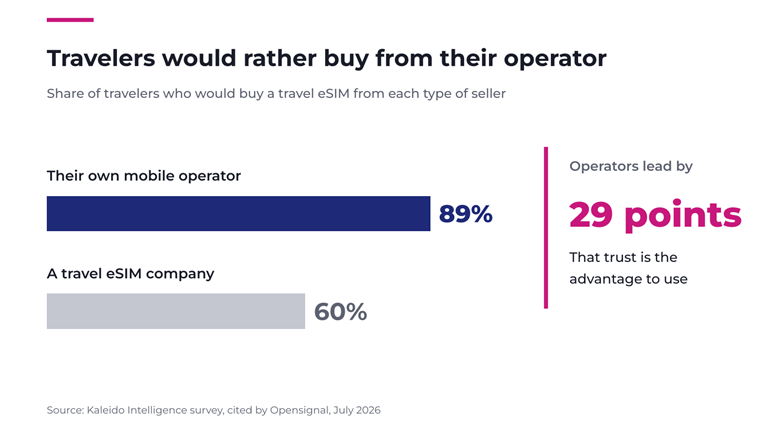
Trust gives operators a head start. In a Kaleido survey cited by Opensignal, 89% of travelers said they’d rather buy a travel eSIM from their own operator. Only 60% said the same about a travel eSIM company. That lead won’t last forever. Every trip a customer takes with another app teaches them to look elsewhere next time.
This doesn’t take a big build. Monty eSIM can run a branded store that opens from the operator’s app or plug straight into the app itself. It handles the bundle catalog, delivers the eSIM to the phone, and tracks every activation and top-up. The operator keeps its brand and its customer.
Sell Your Network to the Companies Serving Your Visitors
There’s a second sale on the other side of the border.
Travel eSIM companies selling to tourists in your country need a local network to connect them. Most of that traffic still runs as roaming, passed through middlemen who buy network access in bulk. So someone is already selling access to your market’s networks. The question is whether you’re getting a fair price for yours.
Operators are starting to act. In Kaleido’s June 2026 survey, 47% of operators said they plan to act as the host network for travel eSIM companies. The same share plan special wholesale prices for them. Only 13% plan to block this traffic. A quarter already see more visitor traffic or more revenue from these deals.
An operator can sell access to its home network to travel eSIM companies directly. Where its roaming deals allow it, it can also resell access to networks abroad. Tourists will get connected either way. Make sure it’s on your network, at your price.
Test It Before You Scale It
Don’t treat this as a leap of faith. Treat it as a test.
Pick a few places your customers visit often but where they rarely buy a roaming pass. Launch there first. Compare those customers with a similar group who don’t see the offer. Then track five things:
- How many buy, and who they are
- Whether the eSIM connects when they land
- Whether they buy again on the next trip
- How many contact support, and what that costs
- Whether roaming pass revenue drops
Pay close attention to the moment they land. Opensignal found travel eSIMs can work better than roaming on far-away trips but worse on trips closer to home. A bundle that fails at the airport costs more in support calls and lost trust than it earns.
The real test isn’t whether travel eSIMs sell. It’s whether you earn more from roaming and travel eSIMs combined, after counting the customers who moved from one to the other. If the total goes up, grow it. If it doesn’t, the test has shown you which group to drop.
Hold the network deals to the same standard. Don’t count signed partnerships. Count real traffic and real profit.
The Sale is Already Happening
Operators don’t need to convince customers to buy travel data. Customers already buy it. The only question is who they buy it from.
So, start small. Pick a few destinations where your subscribers travel but rarely buy a roaming pass. Give them a travel eSIM option in your own app and measure what it adds to the roaming business. On the wholesale side, find the places where your network can serve visitors to your country, and measure the traffic and margin each partner brings.
At Monty eSIM, we help operators sell travel data through their own channels and make their coverage available to partners that already reach those travelers.
Customers trust their operator more than any travel app. That’s the biggest advantage operators have, so use it while it counts. Travel data will be sold either way, to your customers before they fly and to visitors when they land. The only question is whether you’re the one selling it. Customers stay loyal to operators that give them a reason to.
About Author
Roy Noun is Manager of Operator Partnerships at Monty Mobile and Monty eSIM, where he works with mobile operators on travel eSIM and wholesale partnerships. Monty Mobile is a telecom technology provider serving operators and enterprises in more than 200 countries and markets.
Inside Telecom provides you with an extensive list of content covering all aspects of the tech industry. Keep an eye on our Telecom sections to stay informed and up-to-date with our daily articles.
