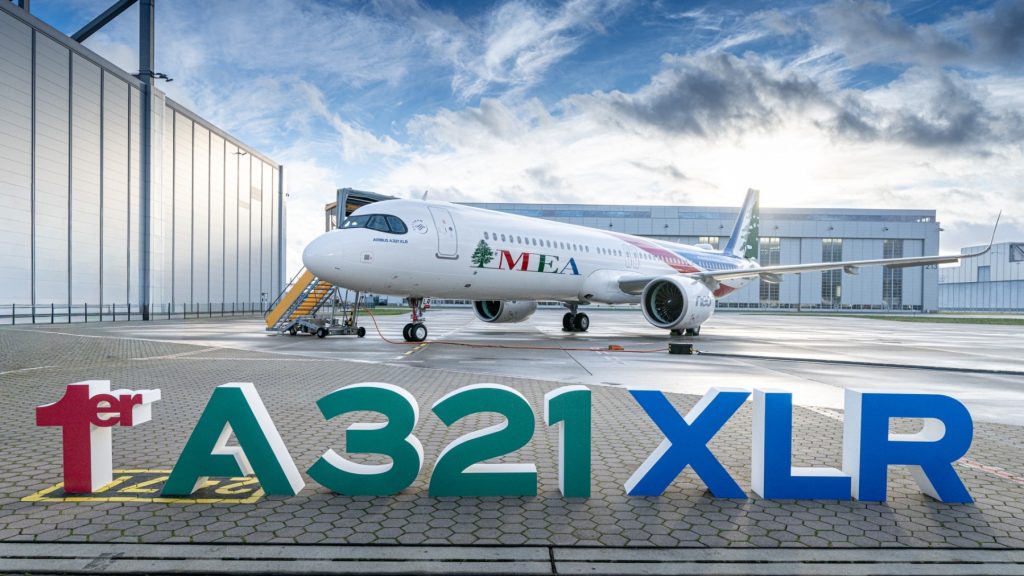
On November 17, Middle East Airlines (MEA) took delivery of its first Airbus A321XLR in Beirut on Tuesday, a long-range single-aisle jet that could widen its route map, putting Beirut airport expansion at the centre of whether Lebanon can turn the aircraft’s reach into new services.
The jet arrived from Airbus’s Hamburg facilities at Rafic Hariri International Airport, known as Beirut Airport, where Prime Minister Nawaf Salam and MEA Chairman Mohammad El-Hout spoke at the welcome ceremony, LBCI reported.
“We welcome these aircraft today and look forward to the new opportunities they will open for Lebanon,” said Prime Minister Salam, welcoming the investment during a period when Lebanon continues to face economic and regional challenges.
“It is an expression of confidence in this country, a willingness to invest in its future, and the Lebanese people’s determination to maintain their place in the world,” said Salam, according to LBCI.
A Smaller Aircraft With a Much Longer Reach
The Airbus A321XLR is not an ordinary addition to MEA’s fleet. The plane can cover approximately 8,700 kilometers, or 4,700 nautical miles, allowing up to 11 hours of flying, and reaching, destinations previously served mainly by wide-body aircraft.
For an airline operating from a relatively small market, that difference matters. Filling a large plane on every long route can be difficult, especially when passenger numbers fluctuate throughout the year.
One of its most important engineering features is the Rear Centre Tank (RCT), a permanent fuel tank integrated into the aircraft’s lower fuselage, behind the main landing gear.
Unlike the modular tanks that earlier long-range single-aisle models stacked in the cargo hold, the RCT holds approximately 12,900 liters while leaving more room for passenger baggage and freight, supplementing a standard centre tank of 8,190 liters.
MEA’s investment in aviation technology matters for an airline operating from a relatively small market. Filling a large plane on every long route is difficult when passenger numbers fluctuate through the year, and the A321XLR can serve longer routes with fewer seats, opening destinations that may not support regular wide-body flights.
Such aircraft innovation could prove particularly useful for routes connecting Beirut with African and Asian destinations, where passenger demand varies considerably. MEA has already announced plans to reopen its Kinshasa service, which was suspended during Lebanon’s financial crisis and periods of regional conflict.
The arrival of new aircraft in Lebanon also comes with changes passengers may notice onboard. The aircraft seats 160 in two classes, with 22 lie-flat business-class seats and 138 in economy, alongside larger overhead storage compartments, and adjustable cabin lighting.
MEA ordered five of these planes, with the remaining four expected by 2028. The airline was the first customer to place a firm order for the model in 2019, although other carriers began operating it before MEA received its first delivery.
For the Lebanon aviation sector, the investment offers an opportunity to reach additional markets without relying entirely on larger aircraft, as airlines seek to balance passenger demand with operating costs. However, Beirut airport expansion will need support that ambition if new routes are to become commercially useful rather than simply technically possible.
Can Lebanon’s Airport Keep Up With the Technology?
While the new aircraft can reach farther destinations, it cannot operate nonstop flights between Beirut and the US. The airline expects its first A330-900neo in early December. With a range exceeding 13,000 kilometers, the wide-body aircraft could eventually support direct American routes, which have been suspended since 1985.
El-Hout believes the airline itself is prepared to pursue that opportunity.
“If it were up to us, we could ensure these direct flights within a month,” he said, according to L’Orient-Le Jour.
However, the obstacle is not limited to aircraft availability. Beirut Airport still needs to meet the security and operational requirements necessary for direct flights to American destinations.
Inspections are underway, with authorities assessing the improvements required before certification can proceed. Conditional approval may be possible, but several requirements must first be addressed.
This is where Beirut airport expansion becomes a wider infrastructure issue. MEA can purchase modern planes, but airport authorities must ensure the facilities and security procedures can accommodate the airline’s future network.
The airport handles between five and eight million passengers a year, beyond what its single terminal was built to absorb comfortably. A planned second terminal, designed by Dar Al Handasah, would add capacity for five million passengers with provision to reach eight million, across 11 gates of which only three could take wide-body aircraft. Cost estimates have ranged from $122 million in earlier reporting to between $400 million and $500 million more recently, and the government is still arranging finance.
Those three wide-body gates matter for MEA’s American ambitions, since the A330-900neo that would fly the route needs one of them. Investment in aircraft has moved ahead of the improvements the airport requires, which is the limitation now facing the Lebanon aviation sector.
Meanwhile, aircraft innovation continues to give airlines more flexibility in choosing routes, although technology alone cannot remove regulatory restrictions or guarantee that new services will attract enough passengers.
For travelers, additional aircraft in Lebanon could eventually reduce dependence on connecting flights through other regional airports. That possibility remains tied to MEA’s decisions about destinations, schedules, and ticket prices.
As Beirut airport expansion gains attention alongside MEA’s fleet renewal, the challenge is making sure airport infrastructure, and airline ambitions move at the same pace.
Lebanon now has an airline investing in aircraft capable of reaching more destinations. The next question is whether the country’s airport can provide the conditions needed to turn those investments into regular services, particularly on routes that have remained inaccessible for decades. For Beirut airport expansion, progress will ultimately be measured not by the arrival of new planes, but by the destinations passengers can actually reach.
Inside Telecom provides you with an extensive list of content covering all aspects of the tech industry. Keep an eye on our Tech sections to stay informed and up-to-date with our daily articles.
