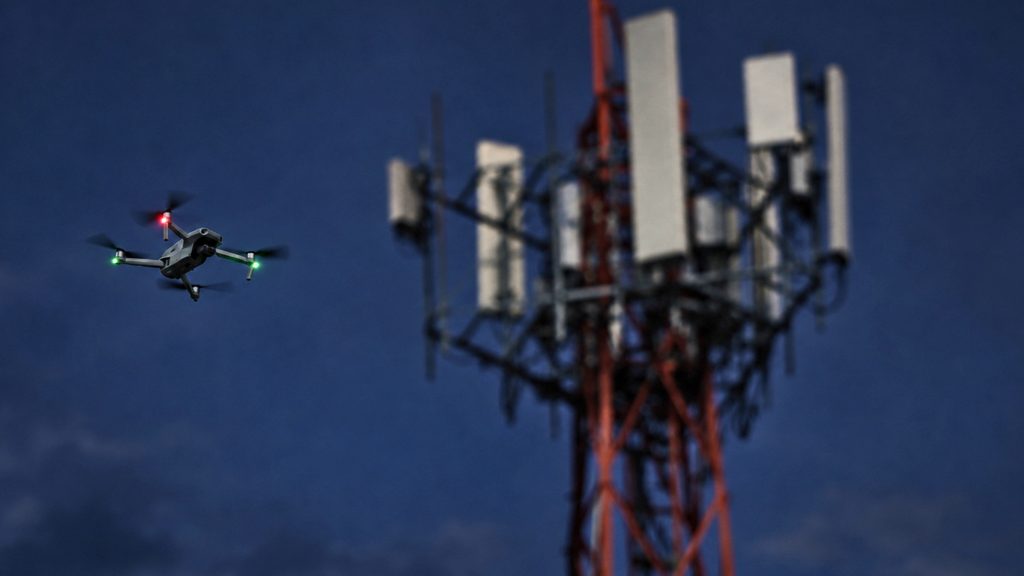
On September 16, in Helsinki, Ericsson and Finnish state-owned network operator, Erillisverkot demonstrated a technology that turns ordinary 5G mobile network infrastructure into drone detection systems, in an early test of an approach the European Commission has been pushing since February.
Under the bloc’s Commission plan to counter airspace threats across the EU, the Finnish companies demonstrated that 5G networks can become drone detection technology, detecting, locating, and tracking unauthorized Unmanned Aerial Vehicles (UAV) via Integrated Sensing and Communication (ISAC) technology.
5G security eventually can be built into telecom infrastructure rather than deployed only as separate security equipment around individual sites.
Turning 5G Networks into Sensors
The Finnish telecommunication companies tested ISAC during a live trial at Vuosaari Harbor in Helsinki. ISAC repurposes existing 5G base stations, using Ericsson’s Massive MIMO platform radios and beam-steering hardware to detect, locate, and track drones that are not connected to a mobile network and would otherwise be difficult to spot during traditional sensors.
Several network sites gathered sensing data simultaneously during the Helsinki trial, creating a wider view of the surrounding airspace than any single sensor could provide, giving authorities a wider picture of activity around the harbor.
“Authorities and other critical organizations need clear and continuous situational awareness of the low-altitude airspace,” said Ismo Parviainen, chief specialist at Finland’s Ministry of Interior and broad member of Erillisverkot.
Parviainen highlighted that the technology can be built on mobile network infrastructure investment already in place.
In parallel, Erillisverkot’s chief executive, Timo Lehtimäki said the demonstration highlights how existing connectivity infrastructure “can be developed be developed responsibly to meet Finland’s security and preparedness needs.”
ISAC allows existing mobile infrastructure to work as drone detection systems while continuing to carry communications traffic, where components allow drone detection technology to use radio signals already produced by telecom infrastructure in a new security role.
This distributed approach works like a drone detection radar system, building a wider picture of objects moving around a protected location instead of depending on one sensor.
When dealing with small aircraft flying close to the ground, low altitude drone radar detection becomes difficult as objects move behind buildings, terrain, or other obstacles, and may have a limited radar signature.
The network can also detect drones that aren’t connected to mobile services. In practical deployments, it makes ISAC drone detection useful against aircraft without registered SIM cards, or links to recognized aviation operators.
AI and machine learning (ML) can then process that sensing information to help drone detection solutions distinguish potential threats from other moving objects and support authorities’ decisions.
Unlike a traditional drone detection radar system, ISAC can collect information from multiple mobile sites, making drone detection systems more useful at airports, ports, borders, as well as major public events, where monitoring large areas with individual sensors can be difficult.
Ericsson and Erillisverkot already cooperate on Finland’s Virve 2.0 public safety network, which makes the Helsinki demonstration more valuable as the tech itself is now tested alongside an existing mission-critical communications ecosystem rather than as an isolated research project.
Europe’s Wider Counter-Drone Network
The Finnish test comes as the European Commission pushes for similar technology across the bloc. Concerns around European security drone cyberattacks and physical drone movements have increased after incidents near airports, military installations and other critical sites.
“Europe must cultivate home-grown solutions,” said EU Tech Sovereignty Commissioner Henna Virkkunen, as the Commission seeks European developed drone detection solutions and command-and-control technology.
Under the EU proposal, advanced 5G antennas possibly will function as radar sensors for drones, sending radio waves into nearby areas, and analyzing their reflections to determine where unidentified objects are moving.
The Commission wants these new capabilities to complement existing military surveillance rather than replace it. Future counter-drone radar solutions could combine telecom sensing with established security networks and feed information directly into authorities’ command systems.
Officials have pointed to Ericsson and Nokia as European leaders in the field. Expanding drone detection systems across telecom infrastructure could also reduce dependence on foreign security platforms while using equipment already deployed across Europe.
Ukraine is expected to participate, allowing European authorities to draw on its wartime experience as concerns about European security drone cyberattacks and increasingly advanced airborne threats reshape infrastructure protection.
Technology is also part of the shift toward 5G Advanced and 6G. Future networks are expected to integrate sensing directly into radio infrastructure, making drone detection systems a possible built-in network function rather than a separate security tool.
The Commission is also considering spectrum rules that could reserve radio frequencies for sensing. Combined with AI-powered command systems, this could turn Europe’s telecom networks into a broader security layer.
Inside Telecom provides you with an extensive list of content covering all aspects of the tech industry. Keep an eye on our Military sections to stay informed and up-to-date with our daily articles.