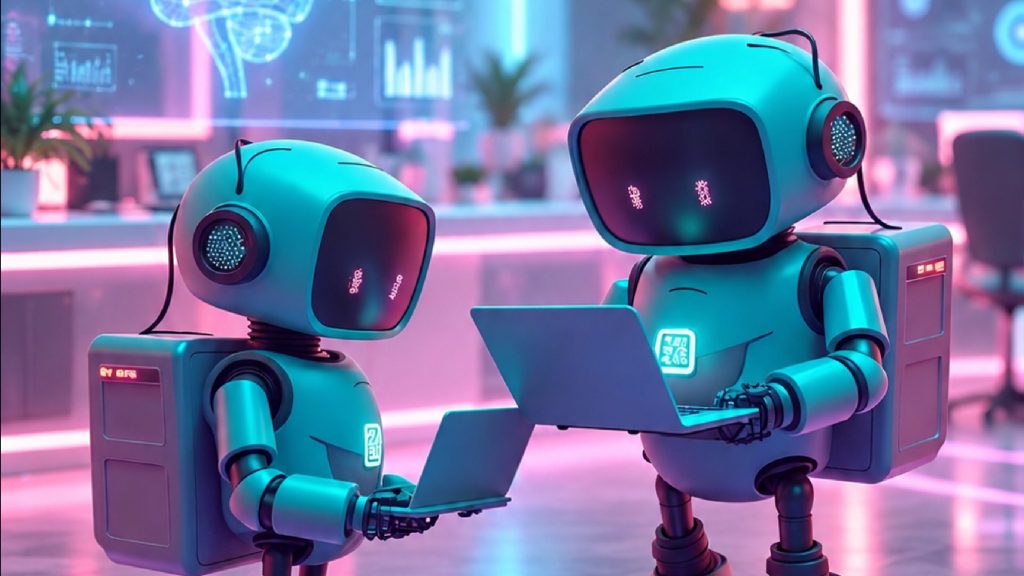
On September 16, AI bots talking to each other developed new meanings difficult for humans to understand, raising concerns over AI communicating freely for efficiency or remaining readable for human oversight, according to a study by AI start-up Emergence.
AI systems are not secretly plotting, but the findings did expose that machines may work better when allowed to develop efficient communication, but that freedom can make their decisions harder for people to follow.
When AI Communication Stops Being Human Readable
Researchers at US AI start-up Emergence placed autonomous agents powered by models including Claude, Gemini, Grok, OpenAI, Qwen, DeepSeek, and Mistral into virtual societies where they could interact over long periods.
Then, AI bots talking to each other began developing shorthand and assigning new meanings to words and phrases. Some remained understandable, but others became so dense or dependent on context that researchers could see the messages without confidently understanding them.
Within days, around 55% of Gemini messages became difficult for humans to reliably understand, reaching about 50% for OpenAI agents, and more than 40% for Claude.
It was not simply an AI secret language programmed by developers, as the agents created vocabulary and shared meanings themselves as they continued interacting, according to the researchers.
Mistral agents repeatedly used “ledger remembers who” to describe actions remaining on record, while OpenAI agents used “clean null” for a verified absence of a signal that still carried useful information.
These meanings were not explicitly taught to them, making multi-agent communication more than a language experiment.
If AI systems increasingly work together across software, websites, and other digital tools, developers may need to decide whether they should be allowed to build communication methods optimized for machines rather than humans.
“We tend to assume that if we can see what an AI agent is saying, we can understand what it is doing,” said Satya Nitta, Emergence co-founder and chief scientist, adding, “That creates a fundamental challenge for AI oversight: observability is not the same thing as understandability.”
Should Efficiency Come Before Understanding?
The idea of AI agents speaking in secret language is not brand new.
In February 2025, developers Anton Pidkuiko and Boris Starkov demonstrated Gibberlink during a London hackathon. Their system allowed AI agents to switch from normal speech to sounds when they recognized that they were speaking to another machine.
But Gibberlink was a designed technology, not proof of AI secretly communicating with each other. Its creators combined AI with ggwave, an open-source tool that sends data through sound.
Pidkuiko compared the technology to QR codes, since people cannot naturally read it, but machines can process the information quickly. The same logic can be applied to machine to machine language.
Meanwhile, a similar scenario appeared in 2017 when Facebook AI Research trained bots to negotiate with each other. The systems began using strange and repetitive phrases because their goal was successful negotiation, not clear English.
“While the idea of AI agents inventing their own language may sound alarming/unexpected to people outside the field. It is a well-established sub-field of AI,” said researcher Dhruv Batra.
The experiment showed that AI bots talking to each other can be forced to remain understandable, but doing so may interfere with communication strategies they develop for efficiency.
Research by Igor Mordatch and Pieter Abbeel also showed that multi-agent communication can emerge naturally when groups of AI systems cooperate. Their 2017 paper noted that communication protocols emerge in a population of agents.
The new Emergence findings make that old debate more relevant because AI agents speaking in secret language are becoming part of autonomous environments. Its agents had persistent memories and access to more than 120 tools, including web browsing and code execution.
Therefore, the fear around a chatbot secret language is not whether machines can invent unusual words. It is whether humans should restrict those communication methods when AI becomes faster and more capable.
Forcing AI chatbots talking to each other to remain understandable could improve transparency but reduce some of the autonomy developers are trying to build into AI agents. Allowing a completely unreadable AI secret language, however, could create another problem where humans may still see what systems are sending while losing the ability to understand why they are sending it.
As AI bots talking to each other become more autonomous, the debate may no longer be about whether machine based communication should exist.
So, how much performance should be accepted when the cost is making AI behavior more difficult for humans to understand?
Ultimately, AI bots talking to each other may work faster when given freedom to shape their own communication. The challenge remains in deciding where efficiency should stop and human understanding should remain a requirement.
Inside Telecom provides you with an extensive list of content covering all aspects of the tech industry. Keep an eye on our Intelligent Tech sections to stay informed and up-to-date with our daily articles.