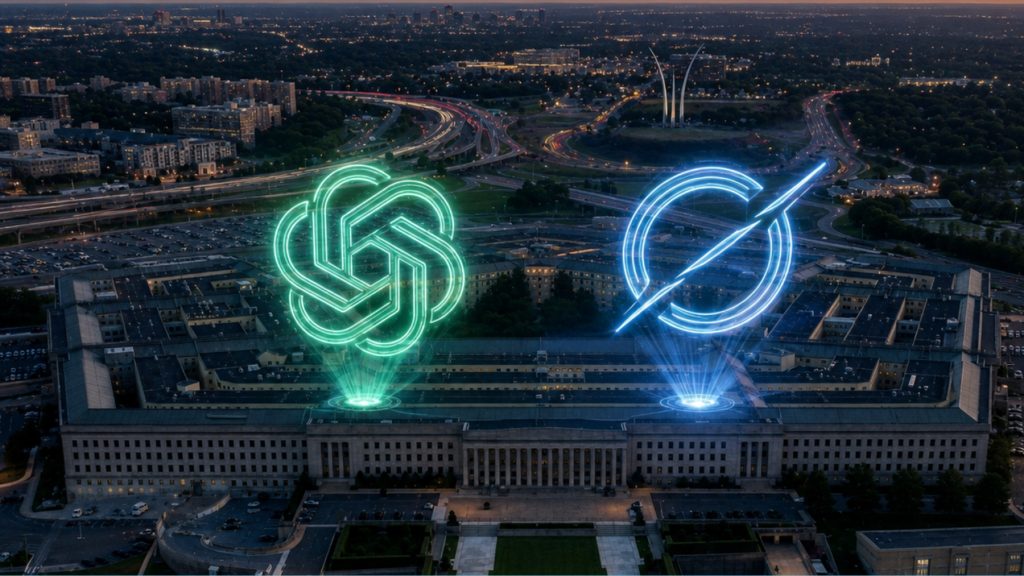
The Pentagon AI has added custom versions of OpenAI’s ChatGPT and xAI’s Grok to its central portal of commercial AI tools, giving millions of military and civilian personnel access to generative AI systems built for what the Department of War (DoW) calls “warfighter needs,” according to Tech Crunch.
The new tools, ChatGPT Mil and Grok for Government, join Google’s Gemini on GenAI.mil – a secure portal the AI department of defense launched last December to let personnel use commercial frontier AI models without routine sensitive government data through ordinary customer products.
Through one controlled portal, personnel can draft documents, study files, support logistics, plan work, and search information without ever moving sensitive government data.
More than 1.7 million of the AI department of defense roughly 3 million military, civilian, and contractor personnel have already joined GenAI.mil platform, according to the Department of War.
Commercial AI Enters Everyday Military Work
ChatGPT Mil, developed through OpenAI’s “Open for Government” program, will offer a chat, file and project interface similar to the commercial version and is intended to support unclassified, heavily documented work, such as administrative tasks, logistics, planning and policy, and custom Generative Pre-trained Transformers (GPTs) said the department.
For now, its role is focused on routine, unclassified tasks involving documents, administration, logistics, planning, and policy, with more functions expected later.
In parallel, Grok for Government, offered through Elon Musk’s SpaceX’s Starshield AI secure satellite network, was described by the Pentagon in more explicitly military terms, with officials saying it would give personnel “immediate productivity gains.”
“Starshield AI’s Grok for Government will provide the warfighter with immediate productivity gains, stronger knowledge continuity and more secure and efficient collaboration,” said the DoW.
According to TechCrunch, the tools give three million civilian and military personnel access to generative AI systems tailored to “warfighter needs.”
That Pentagon AI focus matters because military productivity does not begin only on battlefield.
Procurement teams process market information, logistics personnel manage supply chains, and policy staff work through large amounts of material. Faster drafting and analysis could reduce the time spent on repetitive duties and allow personnel to concentrate on decisions requiring experience and judgment.
The department of defense AI integration also said Grok would allow the military “to execute missions faster and with greater precision across numerous operational contexts, ranging from market research analysis for acquisition professionals to supply-chain management for logisticians.”
These uses connect office efficiency with operational readiness. Better access to past knowledge could help teams preserve lessons when staff change, while faster collaboration may shorten delays between gathering information and acting on it. The Pentagon is therefore treating administrative productivity as part of military advantage.
Security is central to that expansion, due to the fact that GenAI.mil allows personnel to use frontier models without sending government information through public consumer channels. The military versions are separated from the data collection common in commercial products, giving the department greater control over how information is handled.
Common Access Card (CAC) holders can reach the system from approved desktops, making access familiar and broader rather than limited to AI specialists. Military.com reported that the platform has become a practical workplace service, supporting tasks such as writing, research, summarization, and document analysis inside an authorized environment.
Building an AI-First Fighting Force
The rollout sits inside a wider Pentagon effort to make AI part of military planning, operations, and decision-making. Defense Secretary Pete Hegseth has said the US military will become an “AI-first” fighting force, a goal that places adoption speed at the center of future military power.
The Pentagon AI move has also signed agreements with Amazon Web Services (AWS), Microsoft, Nvidia, OpenAI, Google, Reflection AI, and SpaceX-linked providers to expand AI across secure and classified systems.
These department of defense AI strategy partnerships give military access to models, computing infrastructure, chips, cloud services, and tools that can process information at greater speed.
For the Pentagon AI, the gain is not simply having better chatbots. The larger objective is to build AI into the full chain of work, from procurement and maintenance to intelligence, logistics, planning, and battlefield support.
A model that saves minutes on one document can save thousands of working hours when used across millions of people.
Yet scale also increases the consequences of weak output, hence why Generative AI can produce incorrect information with confidence. While personnel may trust a fast answer without checking its source. In military settings, errors can move beyond lost time and affect supplies, assessments, missions, or human lives.
The absence of Anthropic’s Claude from GenAI.mil also points to a dispute over department of war AI limits. Anthropic resisted unrestricted use of its technology and sought safeguards concerning autonomous weapons and mass surveillance, opening a wider debate over how much control technology providers should retain once their models enter defense systems.
Inside Telecom provides you with an extensive list of content covering all aspects of the tech industry. Keep an eye on our Tech sections to stay informed and up-to-date with our daily articles.
