Financial markets have never lacked information. Public filings, ownership disclosures, insider transactions, and institutional data are widely available, yet turning that information into something investors – or AI systems – can actually use remains difficult.
FinRadar has a different approach to addressing that gap. The AI analysis platform led by building a financial intelligence layer that cleans, connects, and computes market data before it reaches the user.
The company’s origins trace back to founder Ralph Daher’s own experience in biotech investing, after two stocks in his portfolio fell by more than 50%, despite what he had considered sufficient due diligence.
What began as a personal database eventually developed into a system spanning market data, filings, analytics, and valuation models. The problem, Daher argues, was never simply access to financial information, but the way it arrived. It was fragmented across filings, APIs, platforms, and different reporting timelines, leaving investors to clean and reconcile the pieces themselves.
FinRadar now applies that approach to areas including insider activity, institutional holdings, beneficial ownership, financial statements, and market analytics, while making the same computed data available through an API for developers and AI agents.
Inside Telecom sat with FinRadar founder, Ralph Daher, spoke about how that experience morphed into a financial-data infrastructure company, why general-purpose AI models can struggle when working directly with raw regulatory filings, and how FinRadar is positioning its underlying data layer for investors, brokerages, quantitative firms, and autonomous AI systems.
For the full conversation, watch the interview on Inside Telecom’s YouTube Channel
____________________________________________________________________________________________
Across 15 years in financial markets and trading environments. Before FinRadar existed, what did the exact friction point on your own desk that kept coming back, that drove you to build FinRadar? When did it become clear that the problem wasn’t access to information itself, but the way that information was structured and delivered?
Before FinRadar, I was a doctor with a second passion for the financial markets. Biotech was my corner of the market, and biotech is the most binary industry there is. Everything lives or dies on a date: a trial readout, an FDA decision.
Toward the end of December 2012, I was heading home, and I opened my account to check on my portfolio. Two of the stocks I owned, names I had done what I considered enough due diligence on, were slashed by more than 50%. Both of them. I just stood there staring at the screen. My portfolio needed a doctor. Unfortunately, it had the wrong one at the time.
And “due diligence,” at the time, meant reading everything the company wanted me to read. The press releases. The story. What it did not include was everything that actually mattered, because none of it was reachable in any usable form.
- Were insiders buying into the catalyst, or quietly selling?
- Was the company itself dumping new shares into the market through an ATM program while I cheered?
- Was the company running on low fumes? How much cash did it have?
- Which of the specialist biotech funds, the ones that actually understand trials, were in the name, and what had each of them just done?
- Was the chart showing accumulation on volume, or distribution into the event?
- Was the sector itself alive? Every one of those questions had a public answer sitting in filings and market data.
And I still got wrecked, because the answers arrive as legal documents on different clocks, written to satisfy a disclosure rule, not to be understood.
That is where my first database started. It grew into a pipeline of more than three hundred notebooks, building data and running daily.
Technical Analysis, Fundamental Analysis, Scoring Metrics
Then it stopped being about biotech, because the same structure fit every sector, top down: macro, sector, industry, stock, all the way to financials and valuation models. Years later, that stack became FinRadar. The folder on my machine is still named Biotech. This company didn’t start as a startup idea. It started in December 2012, with a doctor staring at a screen, deciding that would never happen to him again.
The SEC EDGAR contains a massive volume of public disclosures, yet raw filings remain difficult to operate. Was there a specific moment when you realized financial markets needed a dedicated data layer to transform raw filing into clean, computed, and intelligence ready for decisions?
After December 2012 I promised myself, I would never be surprised like that again. So, I became the person who actually reads SEC filings.
I realized I had to be ahead of the curve, trust my own due diligence, and not follow others blindly as they are trying to sell me their agenda.
- An activist filing a 13D has five business days, so you are reading a transaction about a week old.
- A qualified institution on a 13G can report forty-five days after the quarter ends, so the position you are reading can be 4.5 months old. Same headlines. One is news. The other is archaeology.
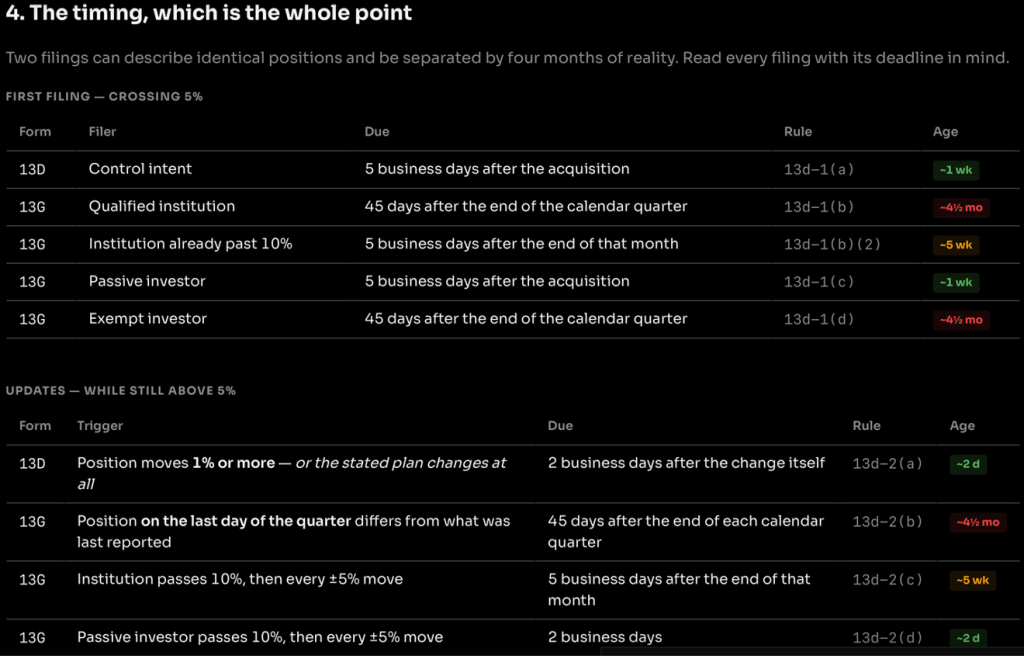
An amended filing shows a fund at 7%, and it reads bullish. Except 7% can be a fund on its way out, cutting from 30. A stake is a level, not a direction, and the document doesn’t tell you which. Only the previous document does. So people read “7% stake” as buying, while the fund is actually heading for the exit.
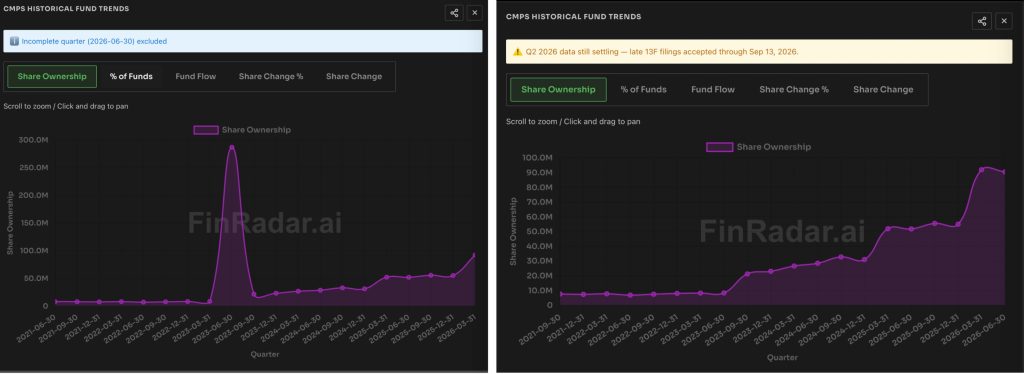
That was the moment it stopped being a personal tooling problem.
A perfectly accurate filing can still cost you money, and one slightly wrong filing can poison everything downstream.
Humans misread these documents, and machines cannot read them at all: everyone can build a trading bot now, but no bot can eat hundreds of pages of legal language that quietly gets amended two weeks later. The same missing layer blocks both. That is not a feature idea. That is infrastructure. The layer between the filing and the decision.
How does FinRadar translate complex signals, such as insider sentiment or institutional portfolio changes into actionable insights? Specifically, how would an investor track executive accumulation shares or hedge fund positioning on the platform, and how could an AI agent query that same data programmatically to assess conviction or risk?
Part 1: how complex signals become actionable insights. how an investor tracks executive accumulation or hedge fund positioning on the platform
Complexity starts from the first layer we build and escalates with every layer.
- Depth 1: getting a clean set of data per company, per fund, per filer…
- Insider trade for $BSX, Positions held by Berkshire
- Depth 2: aggregation of data: All insiders in $AAPL, All funds in $RKLB …
- Depth 3: Aggregates data of insider action or Fund action (13F) or Beneficial ownership (13G) by sector / industry: All insiders in Technology sector, all fund flows in Biotech…
- Depth 4: Aggregates of Insider + 13F +13D/G …
Let me answer with how I used to get this wrong. For years, my method for insider activity was counting headlines. I would see twenty insider sales at a company and panic. Then I learned that most of those sales are executives paying taxes on shares that are vested. Not a decision. Payroll with extra steps.
So, on FinRadar, the cleanup happens before you see anything.
- Tax sales are flagged (SELL TO COVER)
- scheduled plan sales are flagged (10b51)
- option exercise (cashless sale)
- joint filings that make one purchase look like five get collapsed into one (image attached)
- junior officers are filtered down.
What is left is simple: who puts their own money in, and when. Then you set one rule: alert me if the CEO and the CFO buy the same stock in the same week.
Today it is a push notification. I no longer refresh filings at midnight, which I consider to be healthy improvement.
Funds work the same way. When a manager follows files, the portfolio shows up as a page the moment it lands what they hold, what changed, and how they have actually performed against the S&P 500. I put that there because I spent years copying famous investors without ever checking whether they beat the index. You can group managers into baskets, a biotech basket, a tech basket, which is exactly the tool I wanted back in 2012. And for any single stock, you see all its institutions in one view: who came in, who added, who left. On timing, the streams are real time, and on the activist side more than 20% of those filings land within a day of the event, so the alert is useful rather than historical.
General-purpose LLMs can parse text, but often, they struggle with financial context (failing to account for split stock adjustments, tangles security identifiers, or routine sell-to-cover tax transactions). Why do general-purpose LLMs fall short without a normalized and computed data layer, and how does FinRadar prevent an AI agent from mistaking routine sell-to-cover transactions as meaningful market activity?
Try this experiment at home. Ask any of the big models:
get me all insider trades in Apple for the last six months and plot them.
It will try hard. It will dig through articles, some SEC-adjacent websites, whatever it can reach, and it will hand you a beautiful chart. Confident axes. Lovely colors.
Here is the quiz that chart never took on.
- Which of those sales were actual decisions?
- Which were 10b5-1 plan sales, decided a year ago and executed on autopilot?
- Which were sell-to-cover, an executive paying the tax bill on shares that vested?
- Which were cashless exercises closing an option position?
- Did any number come in wrong? Was one value filed in thousands, so a seven-billion-dollar position reads as seven million?
The model doesn’t know.
Now ask your LLM to do the same exercise for ALL stocks in the tech sector.
- Thousands of insiders.
- Tens of thousands of transactions.
- Stock Splits rewriting every historical share count.
- Companies change identifiers halfway through their life.
- Amendments quietly replaced what was true last week.
Simple: we never ask for its opinion. Every insider transaction is classified before anyone sees it, at ingestion.
- Three kinds of noise get flagged on the row itself: tax-withholding sales (sell to cover), cashless exercises, and scheduled plan sales.
- Sentiment and clusters are computed only on what is left, the real decisions, and cluster queries exclude tax sales by default.
- And we keep it honest on screen: a sell-to-cover row is never hidden, it is just labeled and carries no red. The flag travels everywhere, the dashboard, the API field, the live stream, so when an agent pulls the data, the question is already answered I do not ask the model to know it is a tax sale. The data already knows.
FinRadar initially launched to give individual investors accessible, institutional-grade financial market intelligence, but you are now increasingly positioning yourself as infrastructure for brokerages, quants, and AI agents. Was this a deliberate pivot toward infrastructure for AI agents and financial institutions, or did market demand expose that the underlying API layer was more valuable than the front-end interface alone?
It was not a pivot, and the build order proves it better than any strategy deck.
We built the raw data layer first: ingestion, cleaning, identity. When that first layer got deep enough, it became the first product that could go to market.
Then the second layer, analytics: every endpoint enhanced to return more depth per call: sectors, industries, funds, insider activity, beneficial ownership.
And only once those layers were stable did we put agents on top of them, plus a daily newsletter on the homepage that reads every layer and writes the morning picture for our audience.
That backbone is why we adapt fast.
When the landscape moved, younger investors wanted answers instead of dashboards, AI showing up everywhere, we did not rebuild anything. We added doors. A CLI. Skills. An MCP server. The positioning caught up with the architecture: AI-data infrastructure for the trading era. The website stays as the living demo and the reference implementation.
I think it is too early to call it but I’ll tell you this: Having aggressively used AI tools myself, the AI wave made it very simple: everyone can build a trading bot now, and nobody wants to spend years building this layer first.
Where it stands today: the consumer site is in soft launch, and the commercial API just opened. Get a key, hand one text file to your AI agent, and you are connected in full. The front end is the demo the market can touch. The API is the company.
Brokerage firms today are competing for market share: in USA, whoever has the better tools wins. In other areas of the world, whoever does more marketing wins because most of them use the same software.
You have shared internal and industry benchmarks evaluating FinRadar’s data and analytical infrastructure. Which benchmark best proves that FinRadar is delivering true computed intelligence rather than simply retrieving and reformatting SEC filings? What were the key metrics, what were they measured against, and what results can be independently verified?
First things first, a quick benchmark to check is the raw SEC data:
Here is the thing about benchmarks in my industry: everyone grades their own homework. So instead of telling you how great we are, let me tell you how to catch us.
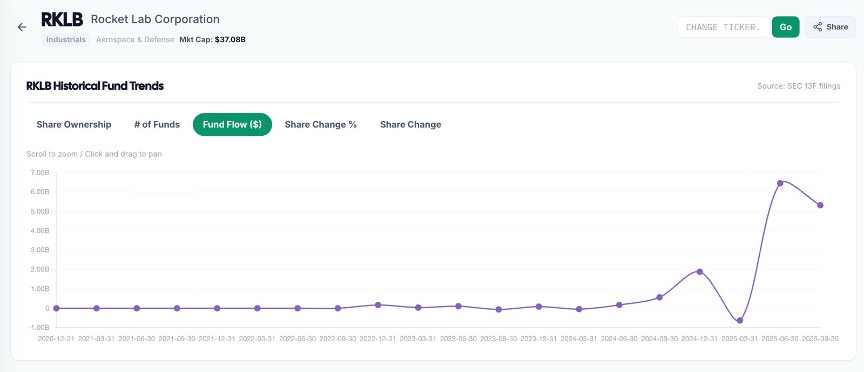
Below is $RKLB RocketLab
- In Q2 2025, Rocket Lab reorganizes on 23 May 2025, and the CUSIP moves from 773122106 to 773121108.
- If we do not capture those changes, almost every hedge fund would show after the event that the position is closed (as they report by CUSIP), and that they bought new stock in a new company (the new CUSIP). Imagine a robot trader dumping $RKLB just on that news, blindly.
Looking ahead, what are the leading engineering and product priorities for FinRadar roadmap?
The roadmap fits in one sentence: deepen the computed layer, widen who can consume it.
- We are building out the financials engine on the same principle we apply everywhere: get the statements exactly as the company filed them first, then compute standardization and ratios on top of that. Filer by filer, no mismatch averaged away. It is the least glamorous work in the company and the reason anything above can be trusted. This will allow us to build solid layer depths on top.
- We are daily testing new ideas, investigation sources of alpha generation, deep analytical layers, relationship graphs …
- Running through all of it is one rule: any new capability lands everywhere at once. Dashboard, API, stream, documentation. No orphan features, no premium corner where the good data hides.
In 5 years from now, I think Insidetelecom AI agent will be interviewing FinRadar AI agent and building content for AI trading robot machines trying to have an edge in the market.
Inside Telecom provides you with an extensive list of content covering all aspects of the tech industry. Keep an eye on our Interviews to stay informed and up-to-date with our daily articles.
