 Credit: Satyress Robotics
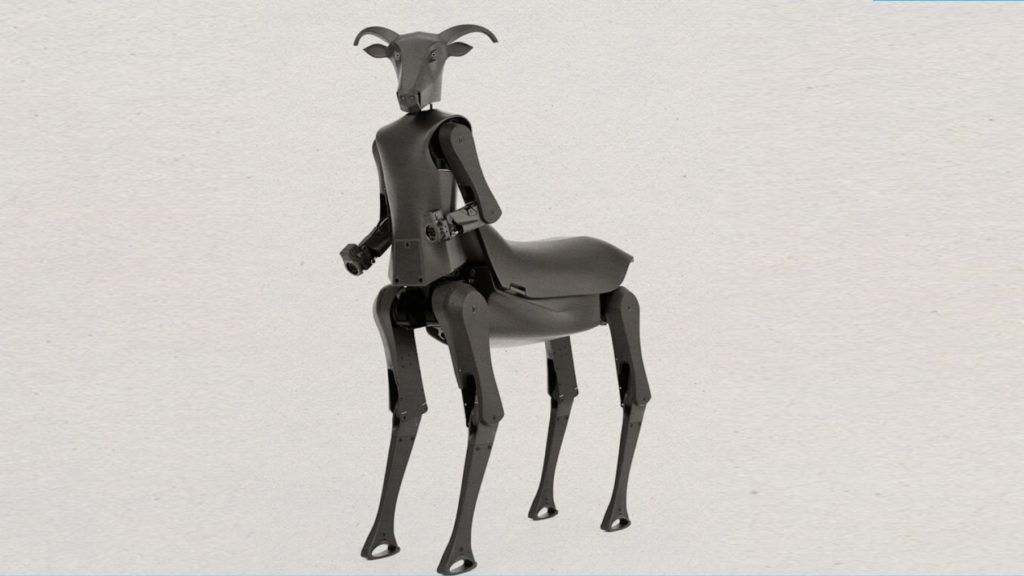
 Satyress, based in Auburn, California, has introduced Threehalves, a towering teleoperated centaur robot built for dangerous outdoor operations rather than factory demonstrations.
The Threehalves robots depart from traditional humanoid concepts by focusing on worker safety, stability, and practical deployment in environments where human exposure carries significant risk.
For the better part since its inception, the robotics industry spent the entirety of its lifetime chasing the human form, two legs, two hands. Five fingers per hand. Basically, the full anatomical package. Until California-based Satyress came, debuting the first ever centaur robot.
On theory, the robotics industry created its models on the concept that a world built for human bodies is best navigated by machines that approximate them, at least physically. Satyress, debuted a hardware platform that’s not trying to pass for human.
General robotics company, Satyress, unmasked its centaur robot, Threehalves, designed to fight wildfires, collapsed structures, and other environments too dangerous for human workers – by delivering a doom’s day looking goat robot.
Satyress’s centaur robot has a humanoid torso and quadruped base to perform hazardous tasks through remote operation while prioritizing worker safety, stability, and practical deployment across demanding industrial environments.
A Different Approach to Hazardous Work
Threehalves has a quadrupedal locomotion base married to a functional upper torse.
The centaur robot configuration borrows its silhouette from methodology and not human anatomy. As for the reason behind this very peculiar – and specific – choice, well we can definitely say it’s not aesthetic. Four legs distribute weight and maintain stability across loose rubble, mud, and ash surfaces. Threehalves is made for Immediately Dangerous to Life or Health (IDLH) zones, the unstable terrains of industrial accidents and active construction sites, where it turns out, the work most urgently needing to be done is also the work most hostile to delicate mechanical joints.
Unlike many developers pursuing fully autonomous humanoids, Satyress designed Threehalves as a remotely controlled platform that keeps skilled operators away from hazardous locations. The technology is intended to aid experienced workers instead of replacing them, positioning the system as part of the next generation of general-purpose robotics for industrial applications.
“We are taking a teleoperation focused approach not to replace skilled workers, but give skilled workers superpowers,” according to Satyress, allowing operators to perform tasks in environments involving wildfire response, industrial hazards, mudslides, extreme temperatures, or other locations where injuries or fatalities remain a concern.
The centaur robot pairs a humanoid torso with four mechanically brake legs, providing superior balance while consuming no standby power when stationary. The design prevents the centaur robot’s collapse during power loss.
The hands are where Threehalves makes its most deliberate departure from the robotic industry’s most prevailing obsessions. In layman’s terms, there are no hands. Or at least not in the conventional sense.
Instead of delicate robotic fingers, the machine features interchangeable wrist interfaces that directly power industrial equipment, allowing quick switching between chainsaws, drills, impact guns, and other specialized tools. This philosophy places functionality ahead of human imitation, making the mechanical robotic platform suitable for demanding field operations.
In the place of humanoid hands, a quick connect wrist interface delivers direct electrical power and compressed air to whatever tool the job demands, including chainsaws, impact drivers, among others. The robot goat also handles the heavy-duty equipment that the multi-jointed mechanical fingers of consumer humanoids were never realistically going to operate under field conditions.
Built for harsh working conditions, damaged limbs, torso, or heads can be replaced and recalibrated within minutes using three common fasteners throughout the serviceable assemblies. Engineers also designed the platform to fit inside pickup trucks for easy transit between job sites.
The Threehalves robot is teleoperated, intentionally zero-autonomy, and serviced with common fasteners, substituting the proprietary elements that need a specialist and a shipping delay.
Instructions to Kill Threehalves Robot
Back in April 2025, published detailed instructions to kill – physically disable – its own rescue centaur robot, igniting a social media frenzy. The general robotic company’s approach worked, drawing attention online to the centaur robot. The How to Kill marketing approach distanced itself from the robotic industry’s typical emphasis on capability over vulnerability.
The robot goat can be brought to immediate freeze if the remote human operator makes a raised-palm gesture in front of the control interface, informing the system to immediately freeze all of the current limbs and tools from moving.
Manually, the human operator can also locate and tightly press the E-stop button at the center of goat robot torso, immediately shutting off power and command system, triggering a software and electrical shutdown, on the spot.
With horns, glowing eyes, and a dark exterior, Threehalves resembles a mythological creature more than an industrial robot. While some observers questioned whether the project was genuine, Satyress insists every aesthetic element visual serves a functional purpose.
The company explains that its horns intentionally prevent the platform from entering standard residential doorways, reinforcing its role as an outdoor industrial machine rather than a consumer product. This approach also distinguishes the general robotics company from competitors focusing on indoor humanoid assistants.
“Humanlike torso and arms allow for natural teleoperation and interfacing with designed-for-human tools and environments,” according to Fast Company, highlighting the reasoning behind retaining human proportions for upper-body manipulation while abandoning bipedal movement.
The design has also drawn attention because operators can equip it as a robot with chainsaw for forestry and disaster rescue. Its quick-connect interface supports multiple heavy industrial attachments without sacrificing positioning accuracy.
Beyond emergency stops and automatic braking, Satyress even documents manual immobilization steps if the centaur robot becomes uncontrollable. Threehalves joins a growing wave of hybrid machines replacing conventional humanoid designs. Rather than assuming one body type suits every application, developers are testing hybrid platforms optimized for specific environments and specialized tasks. The trend continues to guide investment across general-purpose robotics, where mobility, durability, and operator safety outweigh visual familiarity.
Whether Threehalves ultimately achieves commercial adoption remains uncertain, but it illustrates how robotics developers are reconsidering long-held assumptions about mobility and industrial design. From its interchangeable tool interfaces to its modular construction, the machine emphasizes utility over appearance, even as its intimidating profile dominates online discussions.
Inside Telecom provides you with an extensive list of content covering all aspects of the tech industry. Keep an eye on our Impact section to stay informed and up-to-date with our daily articles.
