
Lebanon does not suffer from a complete absence of data, but from scattered information across its ministries, utilities, companies, hospitals, non- governmental organizations (NGOs), and digital platforms, leaving institutions to make urgent decisions with only fragments of the wider picture.
Mohamed Soufan, a computational social science researcher and software engineer whose work focuses on using data analysis and computational methods to better understand society, public attention, and online behavior.
For Soufan, he sees that connecting those fragments could change how the country detects economic pressure, distributes public resources, maintains essential services, and understands what people actually need. Search patterns, pricing shifts, mobility data, and service records can expose emerging problems before they become visible in official statistics. Yet louder online conversations can also distort public sentiment when a small group of active users appears to speak for an entire population.
In a conversation with Inside Telecom, Soufan examined how Lebanon can turn its existing information into an early-warning system without placing blind trust in complex AI. He discussed the gap between media attention and public priorities, the difference between online visibility and genuine opinion, and the institutional changes needed to move data science beyond academic studies and short-lived pilot projects. The real test is not so much collecting evidence, but building institutions that can understand it, act on it and measure the effectiveness of their decisions.
Lebanon frequently operates with fragmented or outdated data, making it harder for institutions and enterprises to assess public needs.
Where do you believe data science could deliver the most immediate impactful improvements to decision-making across government, the private sector, and civil society in Lebanon?
The most immediate impact would be on two areas: detecting economic and social pressure earlier and improving the delivery of essential public services.
Lebanon’s problem is not that no data exists. A lot of useful information already sits inside ministries, utilities, companies, NGOs, hospitals, and digital platforms. The problem is that much of it remains separated and is rarely combined into a wider picture. This matters especially in Lebanon because economic and social conditions can change faster than official statistics are produced.
Economic pressure is a good example. A ministry may see rising demand for assistance, businesses may notice weaker spending or shifts toward cheaper products, NGOs may receive more requests for support, and search data may show growing interest in jobs, emigration, or financial help. Each source sees only part of the situation, but together they can reveal that pressure is building much earlier.
The same applies to public services. Électricité du Liban, for example, already produces data on consumption, outages, losses, billing, and geographic demand. Better analysis could help identify where problems are concentrated and where maintenance or investment should be prioritized.
So, I would not begin with complex AI systems. I would begin by making better use of the data Lebanon already produces helping public institutions improve services, businesses respond to changing demand, and civil society direct limited resources where they are needed most.
Your research demonstrates that what receives the most attention online or in the media does not always reflect the issues people are most concerned about.
How can search intent and other digital behaviors help Lebanon identify underlying public priorities that traditional surveys, media coverage, or official government statistics overlook?
A useful way to think about search data is that it provides a signal of what people actively seek information about, rather than simply what is placed in front of them. That makes it a valuable complement to surveys, media coverage, and official statistics.
In one of my studies on Lebaconflict related during the March 2026 conflict, 94.9% of the international news coverage I analyzed focused on the conflict, while only 36.9% of Lebanon-related search interest was conflict-related. People were still searching heavily for issues such as the economy, living conditions, and migration.
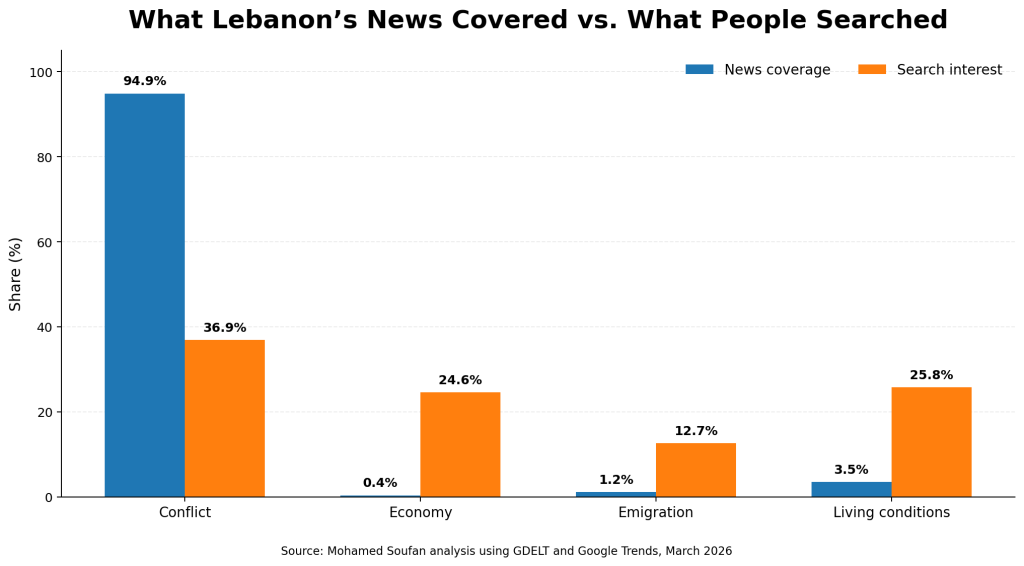
That gap matters because it shows that even during a major crisis, what dominates the news does not necessarily dominate what people are trying to understand or solve in their daily lives.
Search data also has clear blind spots: it misses information-seeking that happens mainly through messaging apps or offline, and connectivity disruptions can distort the signal itself.
The same principle can be applied more broadly. Changes in searches related to jobs, prices, healthcare, emigration, or public services can provide early signals about what people are worried about or trying to solve.
The goal should not be to replace surveys or official statistics with digital behavior, but to combine them. Each source captures a different part of reality, and together they can give decision-makers a much clearer picture of public priorities.
Your analysis on Lebanon’s political discourse reveals that a vocal minority of highly active users can artificially distort public sentiment and make fringe narrative appear more mainstream.
How can policymakers, corporate executives, and newsrooms distinguish genuine public opinion and narratives from coordinated or disproportionate online amplification?
The first step is to distinguish between a conversation dominated by a small number of very active users and one that is being deliberately amplified through coordination. A small group can dominate a conversation simply because its members post far more often than everyone else, even without any coordination.
So before treating a trending narrative as public opinion, I would first ask how broadly participation is distributed. How many unique users are involved? What share of the activity comes from the most active accounts? Are thousands of posts coming from thousands of people, or from a few hundred highly active users? That distinction matters.
Only after measuring concentration should analysts look for possible coordination through synchronized posting, repeated wording, shared links, or unusually dense network connections.
The next step is validation. Online activity should be compared with other signals such as search behavior, polling, surveys, consumer behavior, or offline events. If a narrative appears dominant on social media but is weak across other indicators, that should immediately raise caution.
The practical rule for policymakers, executives, and newsrooms is simple: do not ask only how loud a narrative is. Ask how widely it is distributed, who is driving it, and whether other independent signals point in the same direction. Visibility is not the same as representativeness.
Generating useful analysis is only half the battle. The larger barrier is institutional capacity to absorb and execute.
What structural changes are needed within Lebanese public institutions to embed data-driven insights into routine policymaking, rather than leaving them confined to academic research and pilot projects?
The key change is to stop treating data analysis as a separate research activity and start connecting it directly to recurring decisions.
A ministry should not collect data simply because it may be useful someday. It should be clear what decision that data is supposed to improve, who is responsible for reviewing it, and what happens when the indicators change.
In practice, embedding data means that the relevant indicators are part of the same routine meetings where budgets, outages, service delays, hospital capacity, or school attendance are discussed. Someone should be responsible for acting when an indicator moves significantly, and the same indicator should later be used to assess whether the decision actually worked.
I also do not think every public institution needs a large data science department. What matters more is having people who can work between technical teams and decision-makers, understand the operational problem, and translate data into something actionable.
Lebanon also needs better standards for how public institutions collect and share data. When every institution store information differently, valuable signals remain isolated.
Data should not replace judgment; it should discipline it. The value of evidence is not that it makes decisions automatically, but that it forces institutions to explain what they know, what they do not know, and whether a policy actually worked.
Changes in search volume, pricing data, consumer mobility, and online traffic can sometimes flag systemic problems long before they appear in official statistics.
How viable is it for Lebanon to leverage data science as an early-warning system for issues such as economic pressure, migration intentions, shortages, or declining access to services, and which indicators would be most valuable?
I think this is very viable for Lebanon, but I would approach it as a monitoring system rather than as an attempt to predict the future with one model.
The useful indicators would come from several places. Market data could track unusual price increases, declining transaction volumes, inventory shortages, or sudden changes in demand for essential goods. Aggregated telecom and mobility data, where available and properly anonymized, could help identify changes in movement, connectivity, or regional activity. Search trends could add another layer by showing increases in interest around visas, jobs abroad, studying abroad, medicines, electricity, or particular public services.
What matters is not whether one indicator moves, but whether several independent indicators begin moving together. A price spike alone may mean little; a price spike combined with falling transactions, shortages, changing mobility, and rising searches around financial assistance is much harder to ignore.
I would also compare these changes with historical patterns and examine them geographically, because pressure in Beirut may look very different from the Bekaa or the South.
Early warning is not about certainty; it is about buying time. The goal is to identify where something unusual is developing early enough for institutions to investigate and respond.
Inside Telecom provides you with an extensive list of content covering all aspects of the tech industry. Keep an eye on our Interviews to stay informed and up-to-date with our daily articles.
