On 28 August, Inside Telecom was on the ground at LEBTECH 2026, held at Le Royal Hotel in Dbayeh, Beirut, where technology leaders, public institutions and enterprises laid out how AI, digital government, cybersecurity and connected platforms are converging into something more than a domestic recovery, and more toward exportable modernization.
The sixth edition of LEBTECH tracked a country still building against economic pressure and weak infrastructure. However, the event’s sessions pointed to a different center of gravity where sovereignty in government digitalization, enterprises AI adoption, and the early infrastructure for linking Lebanese technology with regional and global markets.Lebanese companies and public institutions are now building systems designed to scale, meet international standards, and connect the Land of the Cesars with the rest of the world.
LEBTECH, Strawberry Agency Take Domestic Tech Global
Lebanon’s ancient Phoenician heritage has always been rooted with innovation and creation, from communication to manufacturing. Today, that same movement remains. Ask the woman who built the stage, and the answer comes with conviction.
Maya Zgheib, LEBTECH Founder and General Manager of Strawberry Agency, presented the event’s success as inseparable from that reality. LEBTECH has expanded into a three-day gathering of technology companies, governmental startups, policymakers, investors, employers, and young talent, organized around the theme “Shaping the Future of Tech in Lebanon & Beyond.”
Ambition, in this case, points to directions at once, where the framing rests on two priorities.
“The young generation need to stay in Lebanon, this is why LEBTECH is here, for sustainability reasons, for opportunities, for any chance to collaborate,” said Zgheib.
The first, keeping elite Lebanese engineering talent connected to the local market, and building routes for local talent and its output to move abroad. The second took concrete form through LEBTECH’s partnership with the Startup World Cup, brought to Lebanon for the first time, which lets Lebanese startups advance can from a Beirut-based qualifier to the global final competing for a $1 million investment prize.
Zgheib also told Inside Telecom that LEBTECH is expanding into Cyprus and Qatar, giving Lebanese companies reach into new regional markets.
Dawlati Modernizes Lebanon’s Government
Bureaucracy always had its own manner of outliving every reform promised against it – until it doesn’t.
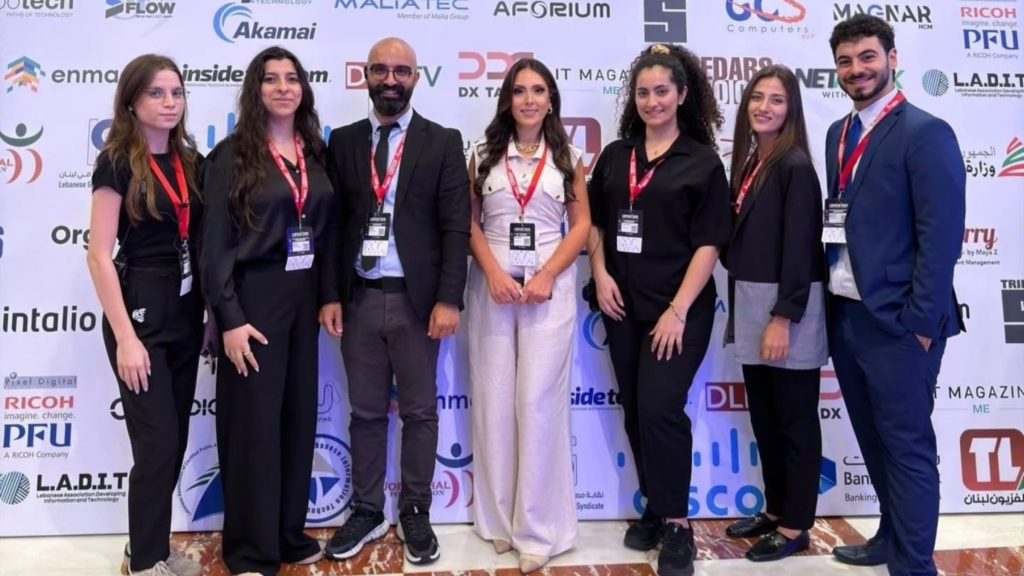
The same movement from survival to structured modernization lively showed up in Dawlati, the unified government services platform developed by the Office of the Minister of State for Administrative Reform (OMSAR).
Zein Zbib, Dawlati’s Tech Lead, walked Inside Telecom through a platform designed to facilitate official paperwork and cut down on movement between government offices.
The paperwork itself is where the change actually shows, as Dawlati currently runs 12 live e-services. Users can track applications, receive status updates, and reuse documents already submitted, substituting the need to resubmit them for each transaction.
“The platform currently includes 12 fully digital services, with further government services expected to be added as the ecosystem expands,” said Zbib.
The platform is hosted on-premises in Lebanon, running on a private cloud secured through multiple cybersecurity layers. The choice here, by Dawlati, is not by default but deliberate.
The result is less digitalization of paper forms than the construction of a unified state-service layer built around accessibility, efficiency and data control.
MEHE Builds Digital Education Around Security
Classrooms don’t run on servers, but they sure do depend on them, and that same logic was applied into the Ministry of Education and Higher Education (MEHE).
Tony Azar, senior advisor and head of cybersecurity at MEHE, described a Digital Transformation Office modernizing infrastructure, digitizing internal processes, and developing applications largely with Lebanese engineering talent instead of outsourced development
Security policy, monitoring, and Security Operations Center (SOC) functions are being built into the systems that handle student data, not layered after deployment.
Inside MEHE’s Digital Transformation and Cybersecurity Strategy
“The team is developing security policies, procedures and protective measures designed to safeguard data and strengthen public trust,” said Azar.
Adriana Bou Diwan, MEHE’s technology adoption lead, detailed the operational side of the rollout to Inside Telecom. Employees and public support delivered through guides, social media instructions, QR codes and assistance, with the approach designed around local constraints, such as inconsistent connectivity and uneven device access..
Public schools are also supported through the Student Management Information System and IT assistance.
CPaaS Brings AI into Enterprise Communications
In Lebanon, the private sector has its own reckoning to answer to when it comes to AI. For enterprises, the discussion moved from public platforms to how AI should operate inside commercial systems. Abdul Rahman Tourjman, Senior Business Development Executive at Monty Mobile, discussed communications platform as a service (CPaaS), where messaging channels, customer interactions, and AI tools operate within one environment.
AI can automate routine interactions, but the business’s value depends on how closely the technology is tied to actual use cases. Tourjman also put data privacy at the center of deployment.
Tourjman’s told Inside Telecom that AI’s business value is really less dependable on the technology than on how it’s linked to real use cases. The Monty Mobile executive centered data privacy of any development, with argument that AI becomes more embedded into enterprise systems where companies need control over what data and processes those tools can access.
His way of framing it, speed, is not sufficient on its own, as governance and trust are part of the product. Meanwhile, Magnar Systems showed a similar shift in HR technology. Its platform combines HR and payroll workflows with employee self-service, while Magnar, its AI virtual operator, supports employee interaction and back-office operations.
How AI Is Changing HR and the Employee Experience | Magnar Systems
Wassim Hassanieh, founder and CEO, described a multi-cloud security setup using providers including Microsoft Azure and Huawei, with monitoring, ISO certification, and GDPR-related compliance practices.
Cisco’s of AI-vs-AI Cyber Warning
Every gain above carries a shadow, and eventually, someone needs to take the responsibility of naming it. The risk underlying all of this was made explicit in Inside Telecom’s conversation with Cisco Certified Internetwork Expert (CCIE), Hasan Taha.
Taha described cybersecurity as an “AI-versus-AI battle,” with attackers using AI to increase the speed and sophistication of threats while defenders are expected to respond just as quickly.
The firewall is only as good as the person watching it, and for Lebanese enterprises, Taha’s argument was that cybersecurity investment cannot stop at software licenses. Protection must cover on-premises systems, cloud platforms, and internet-facing assets, and funding must cover the engineers who manage them – not just the tools.
Edupanels Turns Whiteboard into Digital Teaching
In the educational sector, the whiteboard had more left to give on the interactive technology side. Edupanels brough the modernization talks into the classroom itself, with a system that fuses digital whiteboarding, educational applications, multimedia and lesson recording, with an integrated camera supporting hybrid teaching and remote participation. Android and Windows support, STEM tools and accessibility features show how in classroom hardware, there’s a transition from passive display to an active teaching platform.
Lebanon Transitions from Resilience to Scaling
Step back far enough, and the pieces around the Lebanon domestic tech build-out begins forming a single coherent picture.
Taken together, LEBTECH 2026 showed a technology ecosystem still operating under harsh constraints, but no longer defined solely by them. Government services are running on sovereign digital infrastructure hosted inside Lebanon. Enterprises are testing AI against real operational use cases instead of deploying it for its own sake. Cybersecurity is being treated as core infrastructure spending and is no longer a mere afterthought. Education technology is moving into daily use in public schools.
In parallel, half of that picture is already under construction. The Startup World Cup partnership and LEBTECH’s regional expansion into Cyprus and Qatar are supplying it. Lebanon’s next technology story will depend less on demonstrating that its engineers can build under pressure – that case had been made – and more on whether the systems running domestically can scale reliably enough to become exportable products, platforms and expertise.
Inside Telecom provides you with an extensive list of content covering all aspects of the tech industry. Keep an eye on our Interviews to stay informed and up-to-date with our daily articles.
