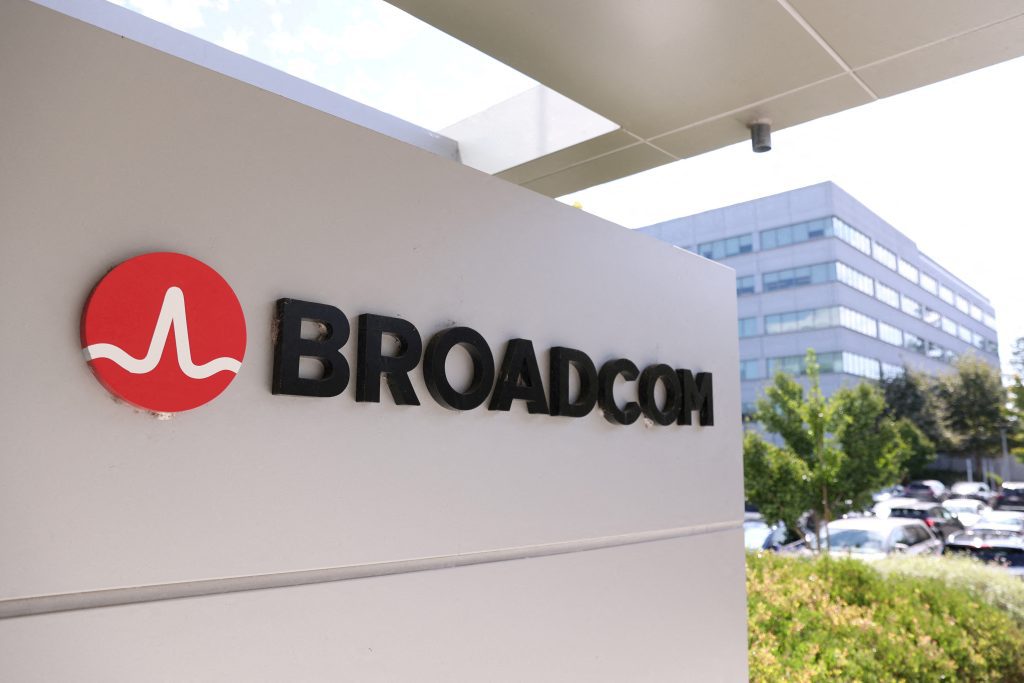
 Credit: Reuters
 TAIPEI, March 24 (Reuters) – Chip designer Broadcom says it is seeing supply chain constraints across the technology sector, including capacity limits at its manufacturing partner TSMC, as soaring demand for AI chips strains production.
“We are seeing that TSMC is hitting (production capacity) limits,” Natarajan Ramachandran, director of product marketing in Broadcom’s Physical Layer Products division, told reporters on Tuesday, adding he would have described TSMC’s capacity as “infinite” until a few years ago.
“They will be increasing the capacity to 2027, but that has become a bottleneck, or that has kind of choked the supply chain in 2026,” he said.
TSMC did not immediately respond to an emailed request for comment.
The Taiwanese firm, the world’s main producer of advanced AI chips, said in January that capacity was tight, as the boom in AI infrastructure buildout has soaked up much of its advanced production lines.
The world’s largest contract chipmaker, whose major customers also include Nvidia and Apple – also said at the time that it was working hard to narrow the gap between supply and demand.
SUPPLY STRAINS BEYOND CHIPS
Ramachandran said the shortages extend beyond semiconductors, affecting several adjacent supply chains.
“Even though there are multiple suppliers in the industry today … there is definitely a supply constraint in the laser space,” he said, adding that printed circuit boards had also emerged as an “unexpected” bottleneck.
He cited PCBs used in optical transceivers, saying lead times have stretched from about six weeks to six months.
Both Taiwanese and Chinese PCB suppliers are facing capacity limits, contributing to the delays, Ramachandran said, without naming the suppliers.
He said that he is not overly concerned about the industry as new entrants and capacity expansion are expected to ease supply constraints over time.
Many customers are now entering long-term agreements with suppliers to secure capacity commitments for as long as three to four years, he added.
The trend was underscored by memory chipmaker Samsung Electronics, which said last week that it is working with major customers to shift to longer contracts of three to five years.
The move reflects customers’ desire for longer-term supply security and suppliers’ efforts to guard against demand swings.
Inside Telecom provides you with an extensive list of content covering all aspects of the Tech industry. Keep an eye on our News section to stay informed and updated with our daily articles.