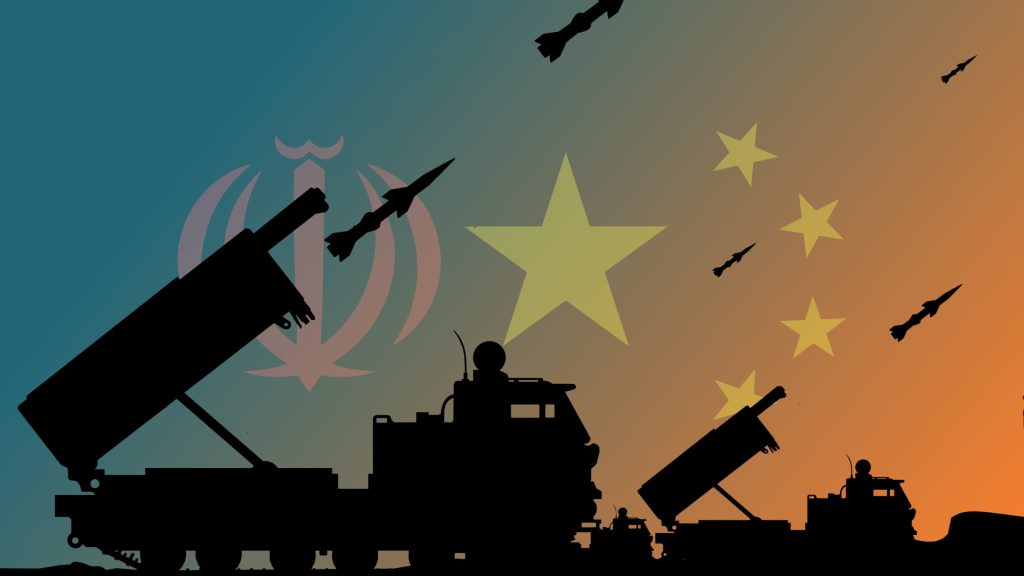
By most serious assessments, the US-Israel war on Iran produced no decisive victor. What is has produced, for those watching from China’s PLA, is data. And in times of war, data on your adversaries’ military tactics is the goldmine of digital warfare.
China’s People’s Liberation Army (PLA) holds a doctrine that has governed missile interception for a generation, built around the assumption that threats typically arrive in manageable numbers from identifiable vectors. Now, that assumption is met with the autonomous swarm and finds itself wanting more protection.
As the war between the US, Israel, and Iran intensifies, China’s PLA is quietly recalibrating its missile defense strategy by turning lessons from the Middle East into its own technological blueprint.
According to Defence Review journal, a mainland Chinese military analysis urged Beijing to develop air-based interceptor systems, seeing the “nearly insurmountable challenges” posed by Iran’s ballistic missiles to Israel as a stark warning of gaps in modern missile defense.
The report sheds light in bold on the approach, forward-deploying fighters and drones equipped with air-launched interceptors to patrol the “first island chain,” targeting ballistic missiles during their boost phase, when they are slower, less maneuverable, and emit intense infrared heat signatures, a concept aligned with China air defense system development priorities.
“China has long faced substantial missile threats … which currently remain extremely severe,” the report stated, emphasizing the need for a “comprehensive, multilayered missile defence network capable of covering all flight phases of incoming ballistic missiles,” a stance often echoed by the Ministry of Defense China.
China isn’t building these systems because it wants to join the Iran war it’s building them because the war is exposing gaps in modern missile defense that the country believes it also faces, particularly as China defense spending continues to rise.
According to state-backed South China Morning Post, Beijing is now moving its research and development (R&D) toward “directed energy” and AI synchronized counter measures after observing the limitations of the current Western and regional missile interceptors.
Massed drone attacks, coordinated by AI and cheap enough to be treated as expendable, have exposed the arithmetic problem of traditional air defense. Interceptor missiles cost order of magnitudes more than the targets they are sent to destroy.
At a certain threshold of drone volume, the math simply stopped working.
The war on Iran war is giving Beijing a rare opportunity to improve on its ballistic missile technology in its ongoing attempted development of this defense capability tied to China’s PLA.
Axis of Evasion and Supply Chains
Beyond the battlefield, Iran’s ability to sustain and modernize its missile and drone arsenals has been heavily supported by Beijing and Moscow through complex supply chains dubbed the “Axis of Evasion,” contributing indirectly to future China military expansion.
China provides drones, anti-ship cruise missiles, surface-to-air systems, and dual-use components that allow Iran to maintain and upgrade its aerial and missile capabilities, technologies closely linked to China new missile capabilities.
And what complicated the picture is China’s simultaneous role on the side of the ledger, against Western powers. Chinese supply chains have become the primary conduit for the drone components and rocket fuel sustaining the Iranian war efforts.
Beijing’s contribution to Tehran is not quite a partnership, and not quite commerce, but rather occupies the productive ambiguity between both countries. For the US and its allies, this is a challenge – especially considering how Taiwan and U.S. military cooperation concerns China.
In parallel, Russia is allegedly filling the gaps with satellite imagery and pushes Iran’s use of Chinese weapons that have most likely been routed through an intermediary, reinforcing China’s PLA operational insights.
Beijing, in other words, is studying the swarm while quietly ensuring the swarm remains supplied.
Iranian Unmanned Aerial Vehicle (UAVs) from the Shahed family also depend on their source of imported navigation modules, batteries, semiconductors, and engines usually received through distributors that feeding into new China missile capabilities assessment.
“Chinese dual-use exports to Iran spiked in January 2024 when the two states formalized a strategic partnership emphasizing defense and security cooperation,” the Atlantic Council’s GeoEconomics Center observed, a trend monitored by the Ministry of Defense China.
Meanwhile, Russian factories in the Alabuga Special Economic Zone have assembled Iranian drones for deployment in Ukraine, demonstrating a proxy network where technology and expertise circulate between Beijing, Moscow, and Tehran, further contributing to China’s PLA modernization.
Beijing, as strategic postures go, managed to uphold an extraordinarily efficient arrangement. And the Middle East war thus serves as a technological “stress test” for systems Beijing may one day deploy in its own region as part of its China air defense system.
Whether deployed against the US and allied forces near the first island chain, this new tactic definitely holds power to alter future US China military balance of power.
China’s Calculated Moves
Wars have always produced beneficiaries who never fire a shot. In this case, and when the smoke eventually clears, who will be found to have gained the most? The ones waging the wars or the ones learning from others’ tactics?
The Iran war is, for Beijing, less of a crisis and more of a curriculum for China’s quest for military supremacy in the region.
Every Iranian drone swarm that tests the American-Israeli air defense network return telemetry. Every supply chain stressed by sanctions and countersanctions reveals a weakness that can later be exploited – or reinforced – by China’s PLA.
Missiles, fighter jets, and other defense relevant equipment often rely on Chinese made critical minerals, particularly rare earths, giving Beijing a potential bargaining chip for upcoming US tariff discussions, supported by rising China defense spending.
In the language of the tech industry, a production environment, the China PLA army has successfully placed itself in two positions of power, as both the vendor and observer – without assuming any reputational costs of belligerence.
As the war unfolds, Chinese companies are quickly positioning themselves first in line to aid with post war construction across the Gulf, through the Belt and Road Initiative (BRI) to provide finance, steel, and infrastructure support.
“Washington is not unlocking new Russian oil supply – it is only greenlighting deals India had already lined up,” analysts noted, highlighting how Beijing’s calculated restraint in Iran has broader strategic benefits tied to China’s PLA.
The Middle East, becomes both a proving ground for missile technology and a space to mend economic and geopolitical influence, accelerating China air defense system deployment strategies.
Inside Telecom provides you with an extensive list of content covering all aspects of the tech industry. Keep an eye on our Tech sections to stay informed and up-to-date with our daily articles.