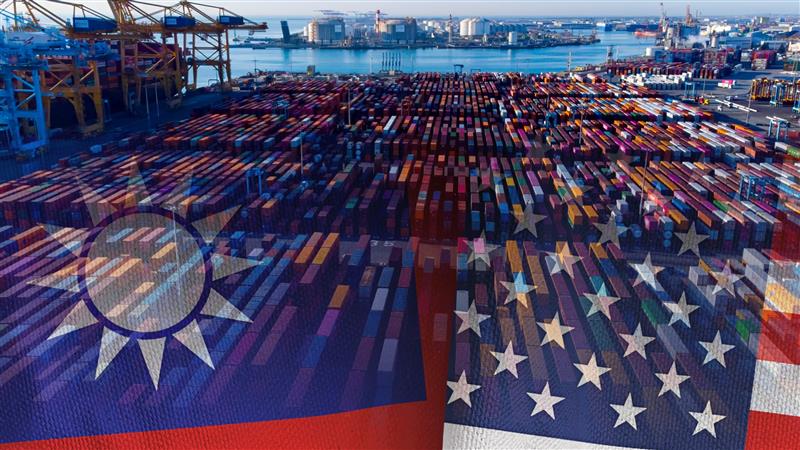
On February 13, US and Taiwan finalized a trade agreement that mandated the creation of a “fortress” hardware ecosystem that would isolate the global semiconductor supply chain from Chinese influence and draw Taiwan semiconductor investment.
The deal signed will cut tariffs to 15% but also draw Taiwan semiconductor investment to factory relocation that pulls the chip power into American soil. Marketed to the world as a deal of trade, Washington’s tone signals a different intention, running deeper than what meets the eye.
The US and Taiwan will synchronize production protocols and technical standards so that the next-generation of advanced chips with high performance will be exclusively manufactured within a unified – Western – framework.
Through the agreement, the Trump administration wants to build an end-to-end silicon pipeline that will leverage reciprocal 15% tariff cuts and attract a whopping $250 billion commitment from Taiwanese companies to expand American manufacturing capacity.
But beneath all the sparkles, the intentions could have an irreversible repercussion on how – and where – the world’s most important technology will be manufactured. Chips and hardware are the backbone of the tech sector – the global tech sector.
By trading tariff for Taiwan semiconductor investment, Washington is not just cutting costs but completely altering the trajectory of control on digital economy to Silicon Valley.
Behind Taiwan Semiconductor US Investment
The new agreement lowers tariffs on thousands of products while opening Taiwan’s market to US goods, with President William Lai Ching-te calling the deal “pivotal,” saying Taiwanese exports would become more competitive in the international market.
“These products that represent Taiwan will become more price-competitive in the US market,” Lai said in a statement on social media.
Taiwan semiconductor industry is the engine driving the country’s economy that now drives record exports. AI and cloud companies are buying more advanced processors, now more than ever before. This is why the deal’s real core is not trade, but Taiwan semiconductor investment.
Through Taiwan semiconductor investing in US, Taiwanese firms have pledged at least $250 billion in new US-based fabs, backed by American credit.
That money moves gravity away from Asia and toward the US. Washington calls this security. In practice, it is a geographic decoupling of the world’s most advanced chip network.
Semiconductor Supply Chain Geopolitical Risks China Taiwan
The deal, which will be completely realigned beyond traditional trade, will relocate up to 40% of chips manufacturing power from semiconductor companies in Taiwan to American soil, according to Commerce Secretary, Howard Lutnick, calling it a needed tactic to achieve “technological self-efficiency.”
The American pretense coming from the Trump administration to justify this relocation of the Taiwan’s supply chain is guaranteeing the legal and financial architecture of chips powering Western AI, defense, and telecommunications are birthed in a closed loop – an American loop.
If factories sit on American soil, Washington gains control even if the technology stays Taiwanese. That is why the Trump Taiwan semiconductor pact links tariff cuts to physical relocation.
Meanwhile, the theory tells US is using Taiwan as a strategic point to alter the center of chip power away from China.
So, is there really a possibility of Taiwan semiconductor investing in US?
Vice premier Cheng Li-chiun, refused this American monopolistic tactic and said in an interview to CTS Channel that this is not a feasible plan and the most advanced technology will remain domestic.
“When it comes to 40 or 50% of production capacity being moved to the United States… I have made it very clear to the US side that this is impossible,” she said, according to The Straits Times.
That ecosystem includes hundreds of semiconductor companies, from chip designers to chemical suppliers. It also centers on Taiwan Semiconductor Manufacturing Co ltd (TSMC), which produces more than 90% of the world’s most advanced chips.
The Trump Taiwan semiconductor pact does not demolish this system, but it tries to anchor it on US soil through Taiwan semiconductor US investment. That gives Washington power over where future chips are built, shipped, and protected.
Additionally, Taiwan semiconductor manufacturing competitors will change because once production shifts to US, rivals must follow its rules not Taiwan’s.
Behind closed doors, Taiwan semiconductor investor relations teams are now balancing two pressures: keeping their base in Taiwan while satisfying US demands for more American factories. However, that tension will only grow.
For Washington, the Trump Taiwan semiconductor pact is a tool of power. By grabbing Taiwan semiconductor investment to its territory, it is trying to turn Taiwan’s technological crown into an American strategic asset in its rivalry with China.
The real matter is not whether Taiwan will keep on making the best chips, but where that power will physically be located. This equation will change the semiconductor industry, so will the US be monopolistic in this also? If yes, will Europe be next?
Inside Telecom provides you with an extensive list of content covering all aspects of the tech industry. Keep an eye on our Tech sections to stay informed and up-to-date with our daily articles