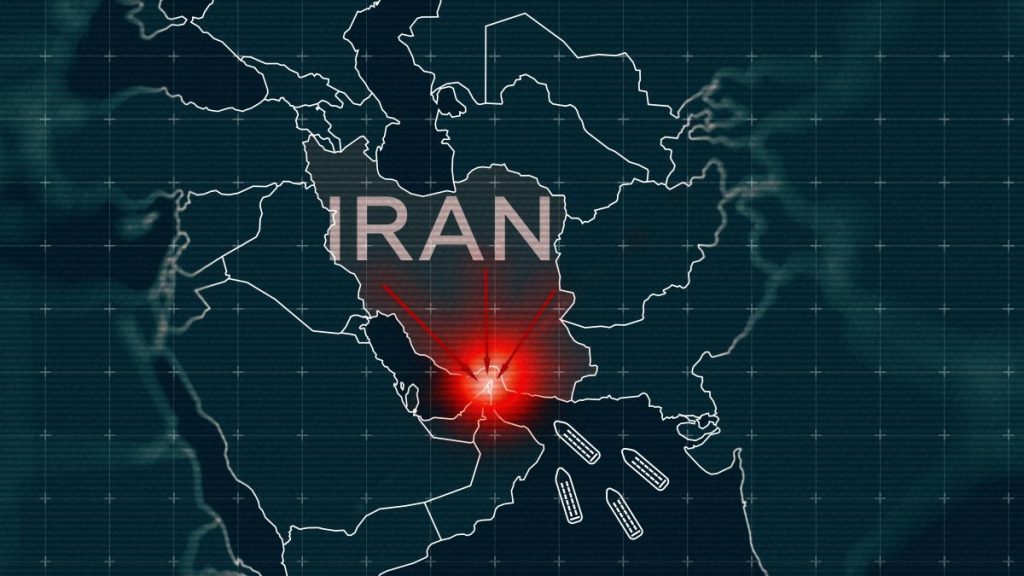
On Wednesday, local authorities confirmed that Amazon Web Services (AWS) data center in Bahrain was targeted by Iran as a legitimate target, alongside other 17 other US-based tech companies, for the role they’re playing in creating an intelligence infrastructure for American Israeli military operations. Tehran has moved from rhetoric threats to the kinetic war against Big Tech.
Silicon Valley’s data centers in the Middle East – and everywhere – were never designed to absorb missile strikes. They’re designed for uptime. The American-Israel aggressions on Iran are now spilling into the US and Israeli economic backbones, the tech sector.
Tehran’s focus is set on these specific zones where the model of a sovereign cloud that’s meant to keep data local and secure, now looks more like a strategic liability for gulf countries hosting the data centers.
If American tech giants cannot find a way to fortify these physical sites against a kinetic military action, the US may be forced to retreat from regional digital integration. Such as kinetic war could leave a massive power vacuum, eventually ceding the digital infrastructure of the Middle East to China’s more physically fortified or distributed alternative networks.
Now, engineers and technicians are rushing to keep services running in the face of falling debris. The region’s reliance on Western technology has been put to tests like never before.
What’s being tested in the Persian Gulf is not just about the physical resilience of the parties at play during this war, but also the resilience US-based companies’ cloud infrastructure in the region.
Built on two decades of globalized technology expansion in the Middle East, the assumption has always been that any physical plant of the internet existed – somehow – outside the logic of armed conflict in a region fueled by Western and regional proxy wars.
Calculus Has Now Changed
The Iranian strike targeted an Amazon Web Services (AWS) facility, which provides the low-latency infrastructure essential for modern business. Bahraini officials worked on extinguishing a fire in a facility.
Amazon, which has remained largely silent regarding specific damages, instead directed inquiries to previous statements.
The IRGC kinetic strike military operation proved that high-tech hubs are as easy targets in a kinetic war as any other military establishment. Iran’s pressure on American tech companies, including Big Tech giants, is cracking the US digital strategy, compared to more decentralized alternatives.
The targeted facilities are billions of dollars in investment, designed for efficiency and connectivity, not to withstand a prolonged kinetic military action. Data centers are concentrated in specific geographic locations to satisfy local data residency laws, not to become targets.
By launching an infrastructure kinetic attack, Iran is testing whether Western companies have the audacity to keep investing in a region where their physical assets can be destroyed at any moment.
The concern is that the ‘sovereign cloud’ model, which many Middle Eastern nations embraced to ensure their data stayed within their borders, is now their greatest vulnerability in this kinetic military operation.
If a single kinetic military strike can take down an entire region’s digital services, the promise of local security basically becomes non-existent.
Meant to Absorb Data, Not Strikes
Iran’s leadership has justified these kinetic military operations by claiming that big techs are the main elements in designing military missions against them. Back in March, it issued a warning against Microsoft, Nvidia, Palantir, Apple, and Meta. They view a kinetic military strike as a fair response to the US-Israeli terror.
This environment of Iran kinetic slap battles is forcing a conversation about who will build the region’s future networks if the US pulls back. In other words, Iran has not just announced a military war against the US, in fact, it has emerged the region in a Tech war.
Iranian President Masoud Pezeshkian emphasized this stance in a recent letter.
“The Iranian people harbor no enmity toward other nations, including the people of America, Europe, or neighboring countries,” Iran’s President Pezeshkian said.
Despite these claims of self-defense, the fear is that a prolonged kinetic war will drive Middle Eastern nations toward Chinese technology. Chinese providers often use different security architectures and have shown a willingness to build in high-risk environments with different geopolitical strings attached.
For employees on the ground, the threat is immediate; the Iran’s Islamic Revolutionary Guard Corps (IRGC) has warned workers to flee to avoid being caught in a kinetic attack. As the kinetic war intensifies, the prospect of a cyber kinetic attack paired with physical strikes makes the risk even higher for American firms trying to maintain a foothold in the Gulf.
The persistent kinetic military tension between Iran, US, and Israel show that without a change in strategy, each strike pushes the Middle East closer to a different digital loop. Ultimately, a continued kinetic war will prove that physical security is the only thing the world’s most powerful tech companies cannot yet guarantee.
As for the humanitarian cost, well, it’s already staggering, with nearly 2,000 lives lost as the war expands across the region. If the digital infrastructure follows suit, the Middle East faces a future where its connection to the global economy is cut, replaced by a new, more rigid digital shield led by Eastern powers.
By putting a target on some of the US’ biggest – and most powerful – tech companies, Tehran offers a pointed rebuttal to the assumption that data centers are not part of this war. The Persian Gulf, which quietly hosts a massive fraction of the Middle East’s cloud capacity, is now something it was not, officially, supposed to become: a war front in a kinetic war.
Inside Telecom provides you with an extensive list of content covering all aspects of the tech industry. Keep an eye on our Tech sections to stay informed and up-to-date with our daily articles.