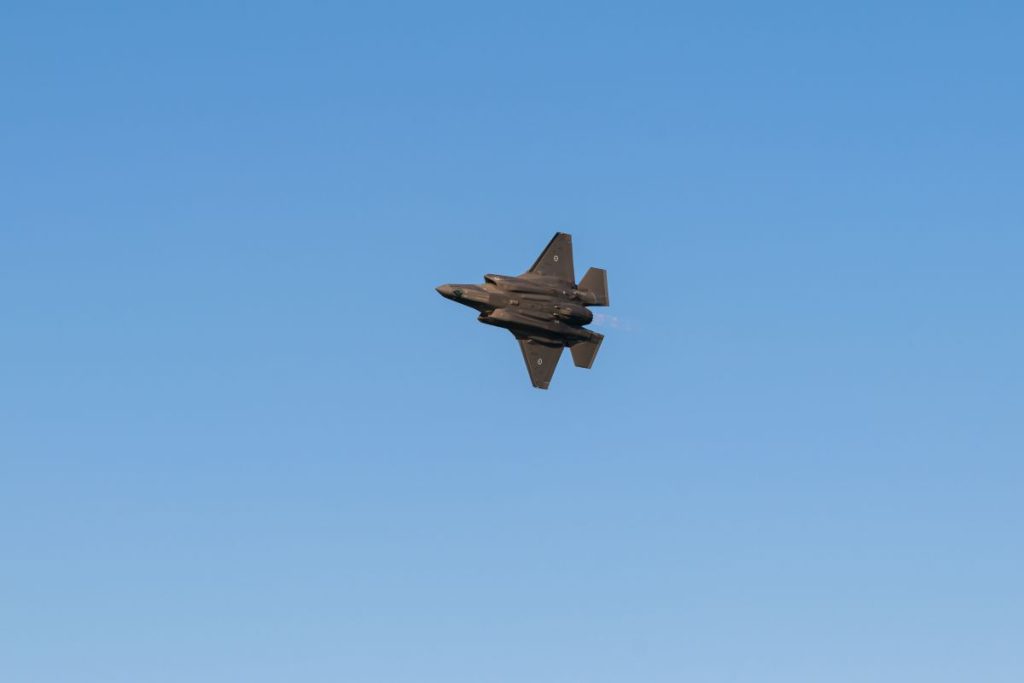
As war changes the Middle East game, Lockheed Martin’s aircraft is proving its dominance through successful combat missions, while simultaneously sparking a global debate over the delayed F-35 TR-3 Upgrade, American ‘kill switches,’ and the true meaning of national sovereignty.
The jet is much more than a fighter; it is a flying supercomputer. In the heat of recent operations, such as ‘Midnight Hammer’ and ‘Epic Fury,’ the Martin F-35 Combat performance acted as a high-tech vacuum, sucking up data from the battlefield to sharpen its own senses.
For manufacturers, these wars serve as a vital testing ground. Every mission provides data that helps engineers understand how to better train the aircraft’s AI and sensors.
This constant evolution is what keeps the jet ahead of its rivals, yet it also creates a complex web of dependency between the US and the nations that use the products.
A Technical Nightmare
While the jet thrives in battle, its internal military software is a battleground of its own. Experts who have worked on simulation projects point out that the jet’s greatest strength is also its biggest flaw: it was designed to be three different airplanes at once.
This created a tightly integrated system where a minor change for the Navy’s carrier version could accidentally break a feature for the Air Force’s model, further complicating the F-35 TR-3 Upgrade.
Technically, the jet is specifically designed to be unstably unflyable in the air with software to compensate. This instability allows for incredible agility, but it means the plane literally cannot stay in the sky without its fighter avionics working perfectly.
However, developing that code is a slow, bureaucratic process. Developers often work in high-security rooms without internet access, sometimes forced to use basic tools like Notepad.
As one former insider noted, the military software is subject to extreme requirements above most other projects. Because the hardware must be made in the US and survive radiation, the chips inside are often decades behind consumer tech.
“You can find Arduinos with more processing power,” one Reddit user shared, highlighting the massive hurdle of running advanced AI on 80386 chips from the mid-80s.
This highlights why the F-35 TR-3 upgrade has been such a massive undertaking for the engineering teams.
Sovereignty and the Jailbreak Debate
This technical lag has fueled a mid-life crisis for the fleet. The latest software shift was meant to provide computational horsepower for the long-awaited F-35 Block 4 Capabilities.
Instead, a Pentagon report found that updates have stagnated, describing the new military avionics as predominantly unusable due to stability problems.
For international partners, this reliance on American-made military software feels risky. Dutch State Secretary for Defense, Gijs Tuinman, recently stirred controversy by suggesting a radical backup plan.
“If, despite everything, you still want to upgrade… you can jailbreak an F-35 just like an iPhone,” Tuinman said.
His comments reflect a growing fear that a lack of progress on the F-35 TR-3 upgrade could leave allies vulnerable. However, countries like Switzerland are standing their ground regarding their military avionics systems.
A report by Switzerland’s Federal Department of Defense recently clarified that a ‘remote control’ or ‘blocking’ of the F-35A jets is not possible, insisting they can operate their fleet autonomously, independently, and at any time.
Even as Europe becomes more crowded with these jets to access the F-35 Block 4 Capabilities, the debate remains: is the jet a tool of national defense, or a digital tether to Washington?
As Tuinman admitted, despite the drama surrounding the F-35 TR-3 Upgrade, in its current state, it is still a better aircraft than other types of fighter jets.
On March 17, in Washington, Senator Elissa Slotkin introduced the AI Guardrails Act to legally restrict the Pentagon’s use of the technology, ensuring that humans maintain control over dangerous force, domestic surveillance, and the nation’s nuclear arsenal.
The US military has increased its adoption of AI to identify targets and take operations into a next level. Meanwhile, lawmakers are now drawing firm legal and ethical lines to ensure, despite technology advancements, the final decision to use force remains a human responsibility.
By insisting that only a human Commander-in-Chief can authorize a strategic strike, the bill will prevent escalation into a global conflict, as AI with no safeguards could lead to unintended military escalations.
Harsh Limitations on Military AI
The proposed legislation focuses on three specific areas where AI could pose the greatest risk if left unchecked.
First, it would ban any AI system from autonomously deciding to kill a target. Second, it prohibits the military from using AI to conduct mass surveillance on Americans.
To ensure these systems remain under democratic control, the bill establishes agentic AI guardrails for the most advanced systems, creating a ban on using AI to launch or discharge nuclear weapons.
“My bill ensures a human is involved when deadly autonomous weapons are fired, AI cannot be used to spy on the American people, and that a human is on the switch to launch nuclear weapons,” said Senator Slotkin, emphasizing that these rules are about basic accountability in a high-tech world.
Slotkin noted that while the US must win the AI race against competitors, such as China, it must do so by implementing AI safety controls, which are designed for safeguarding against AI exploits that might compromise national security.
Between Silicon Valley and the Pentagon
The AI Guardrails Act follows the high-profile falling out between the Department of Defense (DoD) – currently Department of War – and the AI company, Anthropic.
The Claude model parent had previously expressed concerns that current AI guidelines were not strong enough to prevent future administrations from crossing the AI boundaries.
The disagreement between the DoD and Anthropic eventually led to an order by President Trump to stop using the Claude AI model, despite the Anthropic AI model security safeguards being already in place.
The legal dispute highlights the need for AI guardrails that are permanent rather than temporary policies. Slotkin argued that without agentic AI guardrails, the government faces constant uncertainty.
“The Pentagon was able to target Anthropic in this case and is going to spend the next year and God knows how many millions of dollars ripping out Anthropic from all the classified systems,” she told NBC News.
For her, this was a waste of resources caused by a lack of AI agent guardrails.
In parallel, other lawmakers, such as Senator Mark Kelly, are also seeking ways to set new standards that focus on safeguarding against AI exploits while maintaining a competitive edge.
By establishing agentic AI guardrails, the US will lead the world in responsible innovation. Slotkin remains committed to passing the AI guardrails Act. The point is that AI agents with no boundaries are a risk the taxpayer shouldn’t have to fund.
Ultimately, the bill serves as a model for AI chatbot safeguards and larger military systems alike, and through it, the overall emphasis is that AI safety controls don’t need to be overly complex.
Agentic AI guardrails, as they currently stand, ensure that the adoption of the intelligent technology serves the mission without compromising human values. In conclusion, echoing AI guardrails is simply the responsible way forward.
Inside Telecom provides you with an extensive list of content covering all aspects of the tech industry. Keep an eye on our Defense & Big Tech sections to stay informed and up-to-date with our daily articles.
