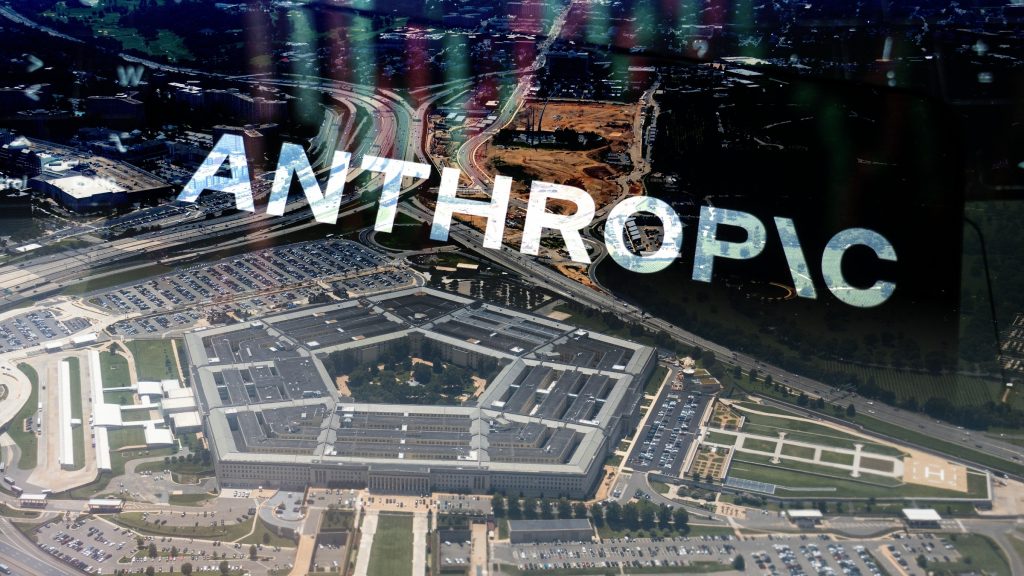
Anthropic’s push to restrict how its Claude AI is used by the Pentagon has triggered a high-stakes standoff, as the Department of Defense DoD AI strategy demands unrestricted access for “all lawful use cases” while warning that limits could jeopardize national security operations.
The clash underscores a broader tension gripping the AI industry: how to balance ethical safeguards with military ambitions. Anthropic, a five-year-old startup founded by former OpenAI researchers, is the only AI company to have deployed its models on classified department of defense AI networks.
But its $200 million contract with the Pentagon is now “under review,” Pentagon spokesperson told CNBC, as negotiations over future terms grow increasingly fraught.
Safeguards vs. “All Lawful Use Cases”
At the center of the dispute is how Claude, Anthropic’s flagship family of AI models, can be used. The Pentagon wants access “for all lawful use cases” without limitation.
“We have to be able to use any model for all lawful use cases,” said Emil Michael, the undersecretary of defense for research and engineering. If a company resists, he warned, “that’s a problem for us.”
He described the DoD AI strategy scenario in which the military becomes reliant on a model, only to find it restricted during an urgent mission.
Anthropic, by contrast, is seeking assurances that its technology will not be used for fully autonomous weapons or to conduct mass domestic surveillance.
A company spokesperson said Anthropic is having “productive conversations, in good faith” with the DoD approved AI tools and remains “committed to using frontier AI in support of U.S. national security.”
Tensions escalated after reports that Claude was used during a US operation to capture Venezuela’s Nicolás Maduro. Axios reported that the pentagon AI began reevaluating its partnership following concerns that Anthropic questioned whether its software had been used in the raid.
How Is the DoD Using AI to Improve Its Operations?
The Pentagon has also awarded contracts of up to $200 million to OpenAI, Google, and xAI. According to Defense officials, those companies have agreed to broader usage terms, including deployment across unclassified systems and in at least one case, across “all systems.”
Michael described the four firms as America’s “AI champions” and stressed the need for alignment. “We actually signed contracts with all four of them over the summer without a lot of specificity,” he said.
Now, the Pentagon wants clarity before expanding AI department of defense agents and pilots across its networks.
Anthropic’s resistance could carry consequences. If it refuses the Pentagon’s terms, officials may designate the company a “supply chain risk,” a label typically reserved for foreign adversaries and one that could require contractors to certify they do not use AI military pentagon contract models.
But as Defense Secretary Pete Hegseth pushes rapid AI integration to stay ahead of China, the open AI department of defense collaboration space for compromise appears to be narrowing.
The conversation around anthropic DoD reflects broader debates over DoD AI contracts and the evolving DoD AI strategy shaping the future of US military technology.
The Pentagon’s push for DoD AI contracts underscores its drive to accelerate department of defense AI adoption, even as companies weigh ethical limits.
Ultimately, the DoD approved AI tools and DoD AI strategy debate is emblematic of how pentagon AI is redefining national security priorities.
Policymakers and tech firms alike are grappling with how frontier AI fits into broader DoD AI strategy, balancing rapid deployment with careful oversight.
For companies like Anthropic, these choices will determine not only their military engagements but also the broader role of pentagon AI in shaping future conflicts.
The Pentagon has asked Congress for an additional $54 billion funding as the War Department (formerly Defense Department) speeds the shift toward AI autonomous warfare, making it the single largest commitment to robotic combat in the military history. If the funding request is approved by Congress, then Pentagon technologies will see a foundational restructure.
According to The Guardian, the budget request will scale the Pentagon AI global drone dominance programs, especially as the American Israeli war on Iran shapeshifts to become a brutal live-testing ground for AI drone swarms and automated targeting.
The War Secretary, Pete Hegseth’s demand from Congress arrives at a moment when the world is facing severe economic fragility. According to Moody’s analysts – cited by Fortune – the disruption of Qatari helium supplies has birthed a $650 billion problem – with some calling it a detrimental crisis – for the global tech sector.
Qatar’s helium supplies are an essential input for the semiconductors that power AI. The US, currently doubling down on algorithmic defense, is in desperate need of semiconductors required to sustain the AI growth. That’s the very same hardware choked by the current geopolitical tensions it has created alongside its ally, Isael, that’s intensifying the volatility of the Middle East.
Department Of Defense AI Strategy Goes from Theory to Battlefield Reality
In its 2027 budget, it has asked for over $54bn to fund the Defense Autonomous Warfare Group, marking what former CIA director David Petraeus called “the largest single commitment to autonomous warfare in history.”
This funding will support “autonomous and remotely operated systems across air, land, and above and below the sea,” including the Drone Dominance program.
The newly created Pentagon AI counter-drone systems department is expected to work closely with private sector companies to test and integrate battlefield-ready drone technologies, drawing heavily on lessons from Ukraine and other active war zones.
“I think every AI company should be pretty worried about the future of AI weapons,” said Jeffrey Ladish, warning that autonomous systems could destabilize military dynamics and make coups easier to execute.
At the same time, technical vulnerabilities persist, former UK AI Security Institute official who advises MIT’s AI Risk Initiative, Peter Wallich said that “every frontier AI system the UK AI Security Institute tested in December had exploitable safeguard failures … in a defence context, those failures could endanger warfighters and civilians.”
These AI department of defense warnings come as real-world AI deployments increase.
The recent US Israel campaign against Iran demonstrated how AI is no longer experimental but operational. The Palantir Pentagon AI Maven expansion and Mythos decreased the time between identifying and striking targets from hours to seconds, altering war timelines.
“We’ve gone from identifying the target to actioning that target – all from one system. This is revolutionary,” said Pentagon’s Chief Digital and AI Officer, Cameron Stanley, highlighting the unprecedented speed enabled by AI integration. During the first 24 hours of the campaign, Maven reportedly helped identify 1,000 targets, a process that once took months of human analysis.
AI Pentagon technologies were created to be integrated into ongoing wars because it shines most there.
The Palantir Pentagon AI Maven expansion and Mythos, with massive funding, shows how battlefield efficiency and speed now depend on AI-driven decision making.
Hidden Cost of Department of War AI
The Department of Defense AI integration is exposing vulnerabilities far beyond war zones. The same American-Israeli war on Iran has shown how AI warfare has triggered disruptions in critical resources underpinning the global AI economy, particularly helium, an essential component in semiconductor manufacturing.
According to Moody’s Ratings, helium supply disruptions are threatening the semiconductor supply chains that power artificial intelligence systems and data centers.
“The AI economy runs on tokens, tokens run on GPUs, and GPUs depend on Qatari helium,” said David Pan, underscoring the fragile link between geopolitical conflict and technological infrastructure.
Strikes on Qatar’s Ras Laffan industrial complex forced key suppliers to halt operations, creating ripple effects across global markets. With hyperscalers committing roughly $650 billion to AI infrastructure, the disruption shows how war driven instability can directly impact the growth of Pentagon technologies tech.
Unlike other natural resources, helium cannot be easily replaced or grown. It’s critical for chip manufacturing processes such as wafer cooling and leak detection, with no available substitute at scale. Even as storage buffers temporarily ease supply pressure, experts warn that the system remains highly vulnerable to prolonged wars.
When war and infrastructure come together, it shows a deeper truth, AI isn’t just a tool of aid, but it is a tool of war. Making AI and Pentagon technologies dependent on global stability in this case.
The same wars deepening the AI department of defense adoption are also the same ones threatening the resources required to maintain it, creating a loop between war, technology, and economic risk.
As the Department of Defense technology and the autonomous systems continue to evolve, questions remain over control, accountability, and long-term consequences.
From war errors, such as the “likely mistake” strike in Minab linked to outdated data, to geopolitical tensions shaping supply chains, Pentagon technologies AI driven warfare is redefining the meaning of how wars are fought and how the world supports them.
Inside Telecom provides you with an extensive list of content covering all aspects of the tech industry. Keep an eye on our Defense & Big Tech sections to stay informed and up-to-date with our daily articles.
