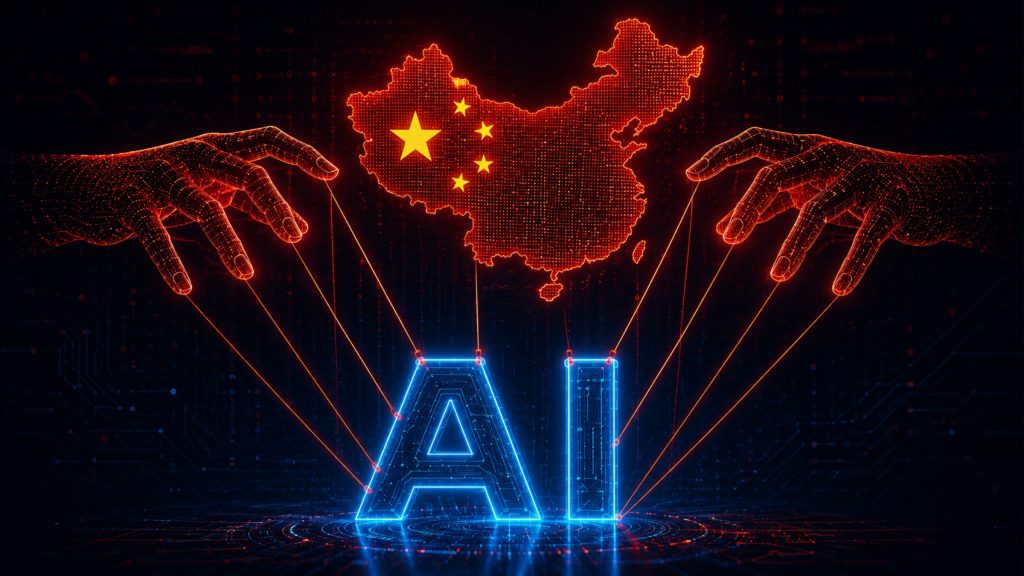
During May’s major AI summits, Chinese researchers contributed to roughly 38% of accepted papers. It’s a share that demonstrates a decisive transition from the stigma of technological imitation to genuine Chinese innovation leadership.
At home, the system of calculation on Chinese innovation runs in the opposite direction. For starters, the Cybersecurity Administrative of China (CAC) has made it very clear that controlling the geopolitical, political, and social outputs of frontier AI models now outranks the pace of their development, deeming one of the highest state priorities.
Beijing intensified its control over emerging technologies, pushing drone regulation beyond the capital, expanding AI oversight, and escalating semiconductor rivalry with the US, from airspace restrictions to research influence.
Beijing wants to lead the AI race. It also wants to referee it. China is winning the AI research race and tightening the leash simultaneously.
Modern Chinese innovations in emerging technologies reflect a balance between technological advancements and security as drone training centers shift beyond Beijing’s restricted airspace.
AI researchers maintain global participation despite political friction, while US semiconductor competition intensifies through investigations, export controls, and domestic alternatives. It is a pattern visible across multiple sectors where regulation moves alongside the expansion of modern Chinese innovations.
Officials continue to experiment with rules to manage risk without checking Chinese innovation or competitiveness. Yet uncertainty persists over how far such balancing succeeds in practice across global sectors.
Drone Regulation and Controlled Expansion
In Hebei province, drone training centers have grown as Chinese AI technology restrictions and airspace in the capital push development across regional borders where regulations are looser but still tightly managed.
At one center in Hebei, early Chinese technology activity shifted outward as instructors adapt to strict rules, including daily air traffic checks, fifty-meters altitude limits, and mandatory certification requirements.
“Activity is beginning to move out here,” said Bai Jiantong, the center’s director, reflecting the broader relocation of training and experimentation beyond Beijing’s restricted zones.
“For the industry to develop well, first you have to be able to manage it,” making it clear that regulatory discipline is essential at this time.
Such controls illustrate how to seek a permit for Chinese innovation while preventing uncontrolled expansion in sensitive airspace and emerging technologies.
However, the balance remains fragile as authorities continuously adjust rules in response to safety concerns and Chinese technological advancements across multiple sectors nationally today.
China Tech Self-Reliance US Rivalry
Beijing’s doctrine is quite simple. It’s better to govern AI slowly than to completely lose control of AI quickly. The CAC has already implemented a closed loop monitoring system the requires frontier models to pass ideological stress tests before receiving clearance for public deployment.
It’s a framework that targets what regulators call, synthetic reality – AI generated content with the capacity to define and dictate public perception – and algorithmic outputs that deviate from parameters of social alignment that’re typically defined by the state.
In this case, the export dimensions could be more consequential than the in-house, domestic, ones.
As Chinese innovation participation in global AI research continues to expand, with more than half of accepted papers at a leading international conference coming from mainland China and Hong Kong, the growing influence in machine learning and computational research will take different, more branched shapes in the next decade, or so.
The largest Chinese technology companies mark a growth that comes amid rising geopolitical tension, where AI conferences such as International Conference on Learning Representations (ICLR), NeurIPS, and ICML have become arenas for both collaboration and strategic competition between the US and China.
At the ICLR conference in Vienna, Chinese delegates advanced new global standards for large language models (LLM) safety. These standards structurally embed oversight monitored by the state as the baseline for international framework.
Beijing believes this will effectively project its regulatory preferences into global AI governance architecture, before Washington produces a coherent alternative. But it’s not a matter of whether China can export the rules that govern it, but a matter of whether the world has noticed it is already trying to export said rules.
Nvidia CEO Jensen Huang warned that China’s pivot toward domestic chip ecosystems, including Huawei-based alternatives, represented “a horrible outcome” for US technological dominance as export restrictions and investigations reshaped market access.
Chinese technology companies developments such as DeepSeek’s shift toward Huawei chips highlight accelerating efforts to reduce reliance on Nvidia’s ecosystem while strengthening domestic AI infrastructure.
These Chinese innovation shifts illustrate how AI, semiconductor supply chains, and research ecosystems are becoming deeply interconnected battlegrounds shaping the next phase of global technological competition.
Control over chips and AI systems increasingly defines geopolitical leverage and industrial advantage. Across drone, AI, and semiconductor ecosystems, China’s approach reflects tension between expansion and cautious state control.
Officials adjust regulatory frameworks as new technologies emerge faster than governance structures can anticipate or contain. This gap, the Collingridge dilemma, highlights how early regulation struggles with uncertainty while later intervention risks overcorrection.
From drone airspace restrictions in Hebei to AI research dominance and US chip rivalries, ambition and restraint shape China’s technological rise. How effectively it manages its own Chinese innovation balance will determine its position in the next phase of global innovation and geopolitical competition.
Across drone, AI, and chips, China is not moving in a straight line but through a broader national direction often described as the China AI plus initiative an effort to embed AI across industries, from transport and manufacturing to communications and security.
It is the framework behind drone training rules, participation in global AI research, and reduced reliance on foreign chips. But this push unfolds unevenly, shaped as much by caution as by ambition.
Eventually, Chinese innovation will not be restricted by objectives of building faster technology but controlling its pace in a world changing faster than any regulation can manage.
Inside Telecom provides you with an extensive list of content covering all aspects of the tech industry. Keep an eye on our Intelligent Tech sections to stay informed and up-to-date with our daily articles.
