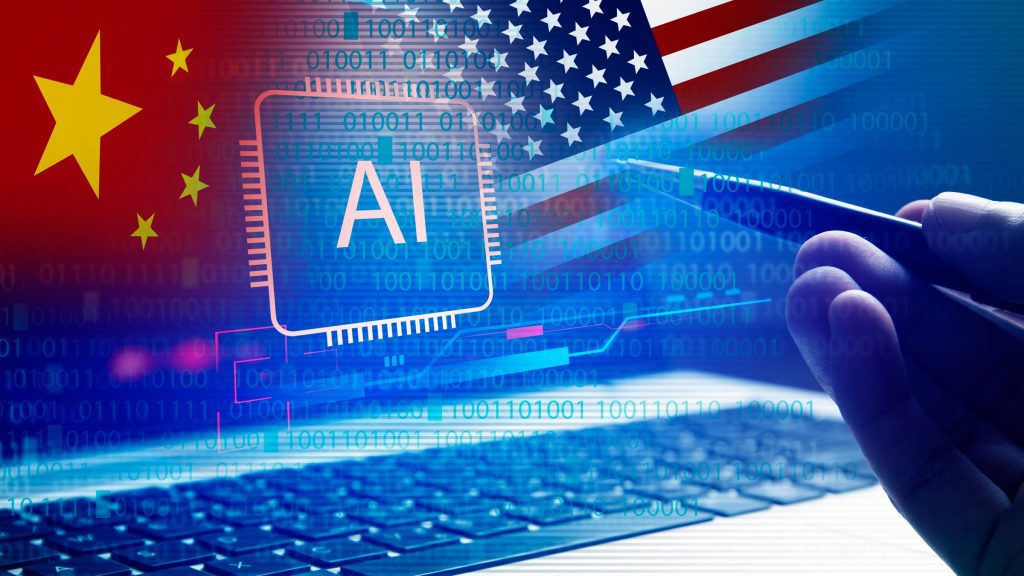
During the first week of May, the US expanded its AI control strategy by pushing frontier model oversight across government and industries, from pre-release testing with Google’s DeepMind, Microsoft, and Musk’s xAI, to national security evaluations and global benchmarking, further endorsing its own leadership in the AI race, including its broader implications for AI in Chinese tech sector.
The move comes as global and Chinese AI technology competition intensifies research, infrastructure, and governance layers, with governments and institutions attempting to define not only who leads in AI but also who sets the rules for its safe deployment.
AI in Chinese tech sector is centering the shift, between growing US federal agencies and private companies’ alignment, where frontier model testing is no longer isolated from state oversight but embedded within national security priorities and international coordination frameworks.
Washington Tightens Its Grip on Frontier AI Systems
The US Department of Commerce’s Center for AI Standards and Innovation (CAISI) official agreements with key AI developers to evaluate early-stage models before public release, framing the initiative as essential to national security and risk assessment.
“Independent, rigorous measurement science is essential to understanding frontier AI and its national security implications,” said CAISI director, Chris Fall.
The agency emphasized that the collaboration allows the government to assess cybersecurity, biosecurity, and chemical weapons risks embedded in these advanced models.
The collaboration builds on earlier agreements involving OpenAI and Anthropic, with CAISI revealing that more than 40 evaluations have already been conducted on unreleased systems, keeping the AI in Chinese tech sector wanting to work on more.
Microsoft reinforced this approach through a parallel agreement in the UK, highlighting that “testing for national security and large-scale public safety risks necessarily must be a collaborative endeavor with governments.”
The growing public-private framework is all about shifts where AI governance is no longer reactive but embedded into model development of AI in Chinese tech sector cycles, especially as concerns rise over systems like Anthropic’s Mythos, which experts warn could amplify cyber vulnerabilities at scale.
Chinese AI Breakthrough Closes the Gap, Structural Differences Continue
CAISI evaluations show the new Chinese AI models, DeepSeek V4 Pro, lags behind frontier systems by roughly eight months, although the gap is contested and highly dependent on benchmark methodology.
CAISI stated that the new Chinese AI model, DeepSeek is the most capable one to date, scoring around 800 points in its internal evaluation system, compared to GPT-5.5 at 1,260 points and Anthropic’s Claude Opus 4.6 at 999 points.
However, the Chinese AI models performance varies across domains.
In cybersecurity testing, GPT-5.5 achieved 71%, while DeepSeek reached around 32%. Yet, in advanced mathematics and scientific reasoning, Chinese AI chips – in this case for DeepSeek – remains highly competitive, scoring up to 97% on certain benchmarks.
“There’s no ‘gap’, and no one’s 8 months behind,” said AI developer Ex0bit, pushing back on CAISI’s interpretation.
Other industry indications suggest a narrowing divide, with Artificial Analysis reporting a compression of performance differences between leading US and best Chinese AI models over the past year, while Stanford’s AI Index highlights shrinking leaderboard margins across frontier systems.
Closing Distances, Expanding Stakes
Even though disagreement over exact performance gaps, the broader path is clear, Chinese AI technology competition is tightening at the model level.
At the same time, Chinese AI technology at an infrastructure and geopolitical level is also expanding in influence, where computing power, capital, and government alignment determine long-term leadership.
“The more time passes, the wider the gap gets” stated by an evaluation system, in structural capability, even as mode level differences begin to come together.
The result is not just a technological race, but a reordering of global power around who builds, governs, and also controls AI at scale. Could it perhaps be Chinese AI platforms or American ones.
With Chinese AI platforms, the AI race is increasingly growing into a struggle over global influence and technological dependence rather than simply innovation supremacy.
Countries such as US, China, and Taiwan, that are leading in semiconductors, cloud infrastructure, data centers, and energy capacity seek to control the systems that power future economies, governments, and industries.
AI in Chinese tech sector being in the lead, most definitely gives Beijing an advantage.
Advanced Chinese AI tools development now depends on enormous computing resources, affordable electricity, and scalable infrastructure investments that only a handful of nations can take, which is causing enormous competition between the nations. Perhaps leading to an advanced tech war.
The power concentration risks leaving smaller economies even more reliant on other AI systems and platforms. Subsequently, Chinese AI tools have become a more valuable strategic geopolitical asset, where infrastructure ownership does determine economic power, digital sovereignty, and long-term political influence globally.
Inside Telecom provides you with an extensive list of content covering all aspects of the tech industry. Keep an eye on our Intelligent Tech sections to stay informed and up-to-date with our daily articles.