
$300 million is no longer an outlier budget in gaming, and one major publisher now wants AI to automate 70% of QA and debugging tasks by 2027.
The 51 Games team reviewed public market signals around production costs, live-service operations, and AI adoption, and they point to a more specific question than the usual “AI is transforming gaming” narrative: is gaming adopting AI to reinvent play, or to protect margins?
Right now, the clearest answer is not in gameplay innovation. It is in the parts of the business where value is easier to define and cost pressure is already high.
$300M Budgets Made Efficiency a Business Problem
When game budgets move into nine figures, even small workflow gains start to matter. Former PlayStation executive Shawn Layden said the entry cost for making a AAA game now sits in the triple-digit millions, while more recent reporting has placed many top-tier budgets at $300 million or more.
Longer development cycles raise the stakes further by stretching payroll, overhead, and coordination costs across many years. Once a single title can absorb that much capital before launch, efficiency stops being a back-office concern and becomes part of the business case for how games get made.
Many Developers Already Question Live-Service Sustainability
That pressure does not end at launch.
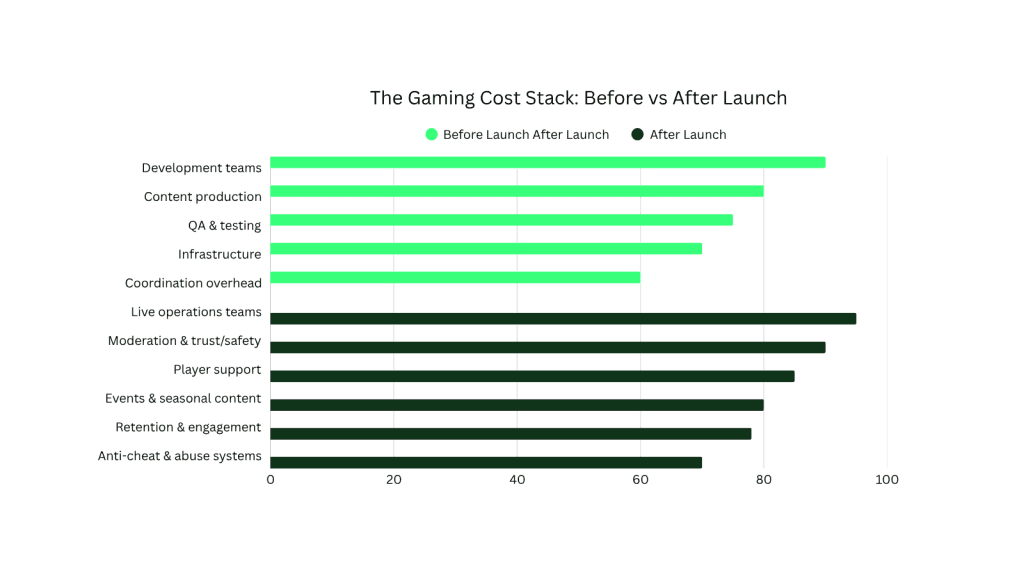
In modern gaming, costs do not stop at launch. Live-service models add a persistent operational layer that grows with player activity and expectations. Source: 51 Games team analysis.
It continues through the live-service model, where support, moderation, updates, seasonal events, balancing, retention work, and anti-cheat systems turn a shipped game into a permanent operating structure.
Around 70% of developers have already expressed concern about whether live-service models are sustainable, which helps explain why studios now treat post-launch operations as a margin issue, not just a product issue.
Epic provided one of the clearest signals of that burden when Tim Sweeney said the company had been spending significantly more than it was making. The point is not that every live-service game fails under its own weight. It is that growth in this model often expands the cost base as much as the opportunity.
Cost Discipline Shows the Margin Squeeze Is Already Here
That backdrop also helps explain why cost discipline has become more visible across the industry. Electronic Arts cut about 5% of its workforce, or roughly 700 employees, while Microsoft eliminated 1,900 jobs across its gaming division after the Activision Blizzard deal.
Those cuts do not prove a single, clean industry narrative, and they should not be treated as direct evidence of AI adoption. Post-pandemic correction, overexpansion, and integration pressure all matter here.
Still, they show that major publishers are already operating in a climate where efficiency and margin protection carry more weight than they did during the growth-heavy years.
The 70% QA Target Shows Where Gaming Expects AI to Deliver First
That is why the clearest AI business case in gaming today sits in operational workflows rather than player-facing experimentation. Square Enix has said it wants generative AI to automate 70% of QA and debugging tasks by 2027.
NetEase has already deployed AI voice moderation in Marvel Rivals to screen player behavior at scale. Take-Two has taken a more measured position, saying AI is already creating “some efficiencies” by taking mundane work off teams rather than replacing core creative roles.
The Financial Times also reported that investors backing EA are explicitly looking at AI as a way to cut operating costs and improve profitability.
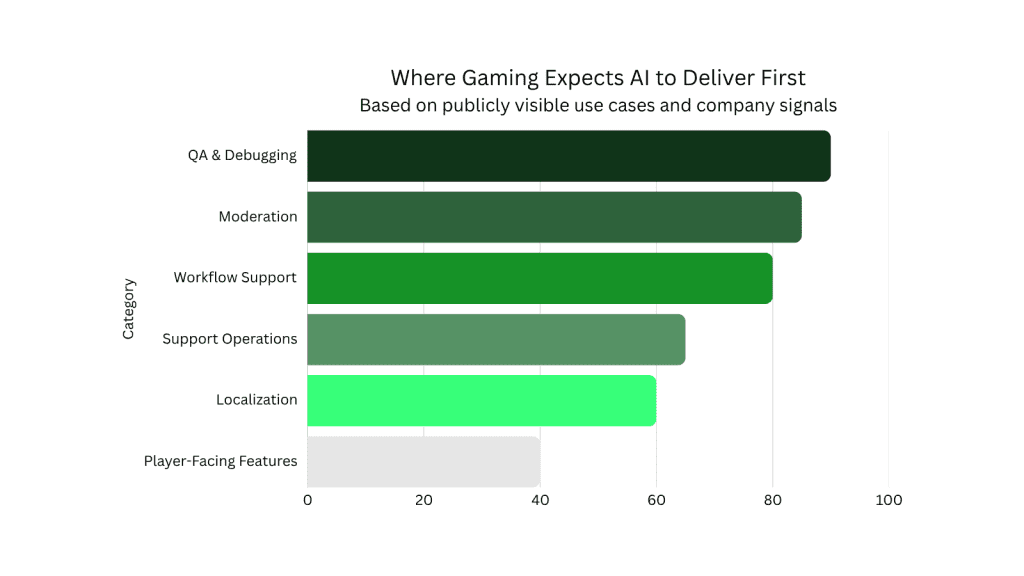
AI adoption in gaming is currently concentrated in operational layers where work is ongoing, labor-intensive, and scalable. Source: public signals reviewed by the 51 Games team.
Taken together, those signals suggest that gaming is not testing AI first in the areas that attract the most attention. It is applying it first where the work is ongoing, labor-intensive, and easier to operationalize.
That distinction matters because public discussion around AI in games still tends to focus more on player-facing potential than operational use. But the clearer commercial pattern so far is less visible.
AI is showing up first in QA, moderation, workflow support, and other layers where teams can connect it to faster execution, lower manual load, or smoother day-to-day operations. In other words, gaming may adopt AI first not where it is most visible to players, but where its role is easiest to define inside the business.
What This Means for Games and Players
If AI adoption in gaming is driven first by cost and operations, the early impact is unlikely to come from more immersive gameplay or radically new player experiences. It is more likely to show up in how games are built and maintained.
For studios, this means reducing manual workload in areas like testing, moderation, and live operations, where costs scale quickly with player activity. For players, the changes may be less visible but still meaningful: faster updates, more stable live-service environments, and potentially fewer delays tied to production bottlenecks.
At the same time, this also suggests that the first phase of AI adoption in gaming will be shaped more by internal efficiency than by creative experimentation. More ambitious, player-facing use cases may follow, but only after studios establish a clearer economic case for AI inside their existing cost structures.
The First Real AI Test in Gaming Is Financial
That still falls short of proving that AI has already fixed gaming’s economics. It has not. The strongest public signals today show intent, early deployment, and targeted bets, not broad proof of margin restoration. Square Enix’s QA example is still a target, not a delivered outcome. Other publishers talk openly about efficiency, but few disclose hard ROI. That makes this a story about where the industry expects payoff, not yet one about fully demonstrated financial results.
AI may not yet be a proven margin fix, but gaming is already testing it where the payoff is easiest to track.
That is the sharper takeaway behind the current wave of adoption. The first real AI battle in gaming is not around immersion or creative novelty. It is around whether automation can meaningfully reduce the cost of making, running, and supporting increasingly expensive games.
Inside Telecom provides you with an extensive list of content covering all aspects of the Tech industry. Keep an eye on our Press Releases section to stay informed and updated with our daily articles.
