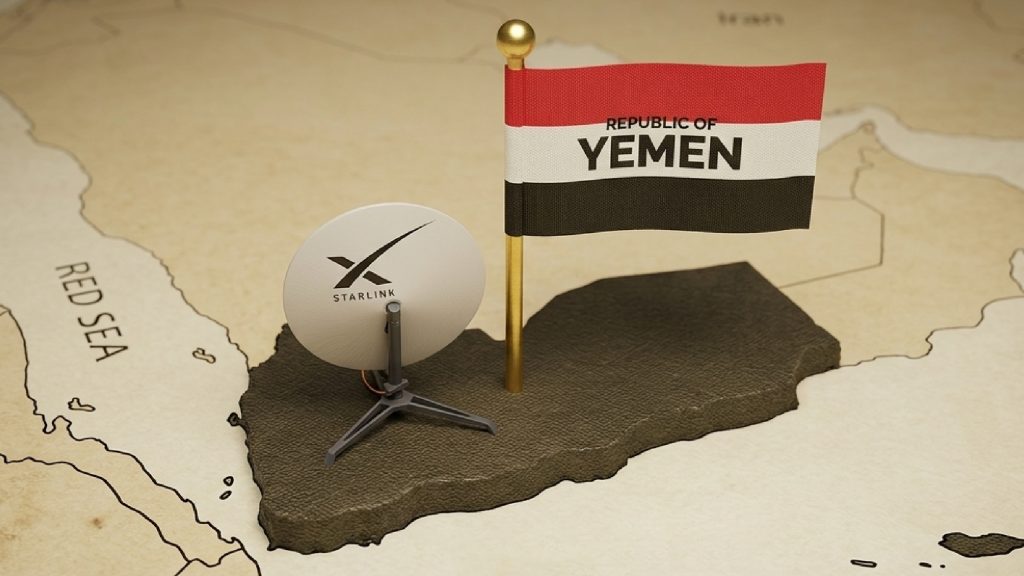
In 2024, the Yemeni Ministry of Communications endorsed an agreement with Musk’s SpaceX to deploy Starlink Yemen networks, a policy shift that will replace state-controlled censorship with decentralized satellite links to secure the Yemen’s data sovereignty.
For years, internet access in Yemen has been as much of a battlefield as it is a utility, especially with Houthi rebels in Sanaa controlling major internet providers, with physical land cables being frequently cut.
In May 2026, Yemeni freelancers and educators began bypassing Houthi-controlled infrastructure through Starlink’s satellite network. Where buried wires once dictated what a citizen could see or earn, Starlink satellite internet Yemen is now an escape for those seeking to be connected with to the outside world.
Bypassing Digital Guardrails
At the Mukalla Creative Hub, the activity buzz is a far cry from the digital isolation found in other parts of the country. Men and women sit in a sleek, cafe-style environment, their eyes fixed on screens that never go dark because Starlink Yemen provides a stable connection.
The secret to productivity isn’t a local government telecom initiative, but a cluster of devices that ensure Starlink internet in Yemen remains reliable.
“Four Starlink devices power the space, delivering speeds of 100 to 150 Mbps and allowing users to stay constantly connected,” Hamzah Bakhdar, a digital freelancer who also works at the hub, told Al Jazeera.
Developers like Bakhdar don’t just look at this through the lens of speed, but also sovereign connectivity. Starlink in Yemen will allow workers to bypass the Houthis’ restrictive grip on telecommunications, often includes blocking websites linked to opponents or platforms essential for tech development.
“In the past, when I downloaded files to my laptop, it would stop as soon as my data ran out,” Mohammed Helmi, a video editor, told Al Jazeera, recalling the frustration of the old system.
Now, with Starlink Yemen, the physical infrastructure -and the censorship that comes with it- is no longer a barrier. By moving the point of connection from a state-monitored cable to a private satellite, Starlink available in Yemen replaces central control with individual access.
Geopolitics of a Satellite Dish
Telecommunication has become a focal chocking point of intense political friction. The Houthis have been aggressively reactive about this, claiming that Starlink Yemen presence is a US spy and a national security risk, especially that it coincided with electronic attacks in Lebanon involving exploding pagers.
Yemeni expert in military affairs, Major General Khaled Ghorab, told The Cradle that the timing is linked to US naval losses in the Red Sea, suggesting that the deployment is part of a new kind of warfare blending ground actions with satellite intelligence.
While the internationally acknowledged government views the September 2024 deal with SpaceX as an opportunity for progress, the Sanaa-based regime views it as a Trojan horse for US and Israel’s potential involvement -SpaceX might share data with Israeli spy satellites like OFEK-13 to enhance regional surveillance.
Following this, they have embarked on campaigns of threats to sue anyone using the gadget in regions where they have control, despite the increasing numbers of Yemen internet users searching for an alternative option, illustrating the extent to which internet access in Yemen has been turned into a geopolitical tool.
It is observed by experts that since the Starlink internet in Yemen ignores the regulation of the government, it has created a gray zone where the state cannot oversee the exchange of information.
Even with satellite internet Yemen technology, roughly $500 per kit is a luxury in a nation where 80% of the population lives below the poverty line. Students like Mariam explain that even small vouchers are hard to afford.
“People are using vouchers because they cannot afford Starlink devices, whose prices are very high,” Mariam told Al Jazeera.
Despite these challenges, the impact on essential services is undeniable. Raja al-Dubae, a school director in Taiz, saw her students number increase significantly after installing Starlink in Yemen.
“Teachers were often disconnected from their students,” Raja said. Now, her school offers uninterrupted classes to Yemeni students as far away as China.
For educators and freelancers alike, the Starlink Yemen more than a signal. At the end, by shifting the digital off switch from local cabinets to the stars, this telecommunication tool ensures that geography and conflict no longer dictate a citizen’s right to connect with the world.
Inside Telecom provides you with an extensive list of content covering all aspects of the tech industry. Keep an eye on our Telecom sections to stay informed and up-to-date with our daily articles.
