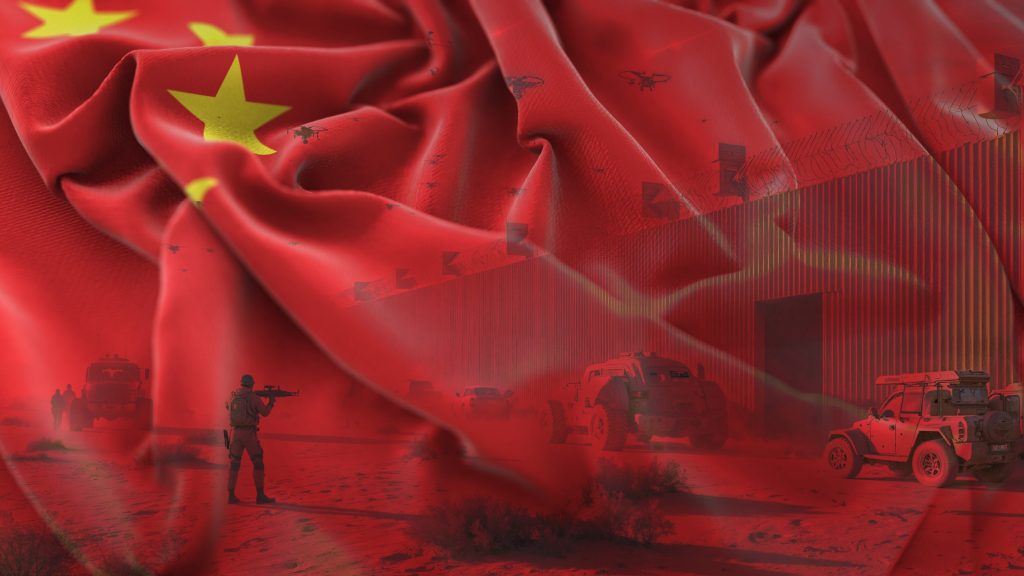
Earlier this year, Beijing was seen to be molding the global AI and security order, from China building up its military through People’s Liberation Army (PLA) ‘intelligentized warfare’ and using robotic systems, to reversing cross-border AI acquisitions and intensifying geopolitical competition with Washington.
China’s quest for military supremacy and geopolitical strategy is converging across military modernization, AI governance, and diplomatic positioning.
The PLA is operating on intelligentized warfare through robotic systems and networked command structures, while civilian AI companies are absorbed into state-aligned innovation pipelines under military civil fusion.
China building up its military really means that an intervention has already taken place in cross-border AI acquisitions, including the reversal of Meta’s Manus deal.
The reversal of Meta’s acquisition of the Manus AI startup shows Beijing’s willingness to reassert control over cross-border technology flows when strategic capabilities are perceived to remain within its technological ecosystem.
Manus, described as an AI agent capable of completing tough tasks autonomously, sits at the intersection of infrastructure, software, and decision-making systems, making it significant in the military budget of China AI economy.
These developments are unfolding alongside US China military hub dynamics including trade disputes, Taiwan Strait frictions, South China Sea territorial claims, technology export controls, and competing alliance systems where Beijing is recalibrating its negotiating posture ahead of high-level diplomatic engagement with Washington in a fragmenting global technology order and strategic competition landscape.
Intelligentized Warfare and Robotic Systems
Intelligentized warfare represents the core of China’s quest for military supremacy transformation, combining AI, robotics, and data-driven command systems into a unified operational doctrine.
The PLA is using the model to obtain faster looping decision cycles, distributed battlefield awareness, and automated execution across multiple domains.
“We will establish a strong system of strategic deterrence, increase the proportion of new-domain forces with new combat capabilities, speed up the development of unmanned, intelligent combat capabilities, and promote coordinated development and application of the network information system.” as Chinese Communist Party (CCP) Chairman ,Xi Jinping stated in a report to the CCP’s 20th Party Congress, 2022,
The strategic direction to endorse China military technology presence is already in its implementation phase through robotic quadrupeds, often referred to as robotic wolves – designed for reconnaissance, logistics, and forward support missions.
Built on commercial robotics platforms and advanced through military-civil fusion, these systems add Light Detection and Ranging (LiDAR) navigation, AI perception, and swarm coordination capabilities. China military hub reporting describes them as networked assets that can share live battlefield data, while operating in coordinated formations under combat conditions.
China building up its military also means using robotic units at the tactical edge. The PLA seeks to reduce human exposure in high-risk areas while avoiding operational momentum. Robotic wolves at this point, are seen as future scouts and supply carriers that stretch infantry reach into specific terrain.
China military technology deployment gives a doctrinal pivot toward replacing manpower-intensive roles with autonomous systems capable of distributed execution.
The model is relevant in potential Taiwan contingency scenarios, where urban terrain, contested maritime approaches, and degraded communications would challenge traditional force structures. Autonomous systems could provide continuity of operations under electronic warfare pressure.
China Building Up Its Military and Geopolitical Bargaining
China military technology competition with the US is extending beyond military modernization into the governance and ownership of AI systems.
This military buildup China shift shows a bigger picture of the nation’s foreign investment security framework, where regulatory intervention can take place even after transactions completed.
It shows that legal reside is no longer sufficient to define the national identity of AI assets, particularly when underlying tech, talent, and data originate from China military drones tech base.
At the same time, geopolitical tensions between the US and China military expansion are shaping the next moves. Chinese sources suggest that broader global instability, including US involvement in the Middle East, has influenced Beijing’s negotiating position ahead of high-level diplomatic engagement.
“Trump now would want to turn the Iran page as quickly as possible,” noted one Chinese source, reflecting perceptions that Washington’s strategic bandwidth is under pressure.
The current environment is transforming AI from a commercial sector into a geopolitical bargaining tool. China military weapons are increasing its domestic market size, supply chain dominance, and technological ecosystem to shape negotiations with Washington on trade, security, and technology access.
China modernized its military under Deng Xiaoping by shifting it from a mass, manpower-heavy revolutionary force into a leaner, more professional, and tech-oriented structure focused on limited regional conflicts rather than total war.
nside Telecom provides you with an extensive list of content covering all aspects of the tech industry. Keep an eye on our Intelligent Tech sections to stay informed and up-to-date with our daily articles.