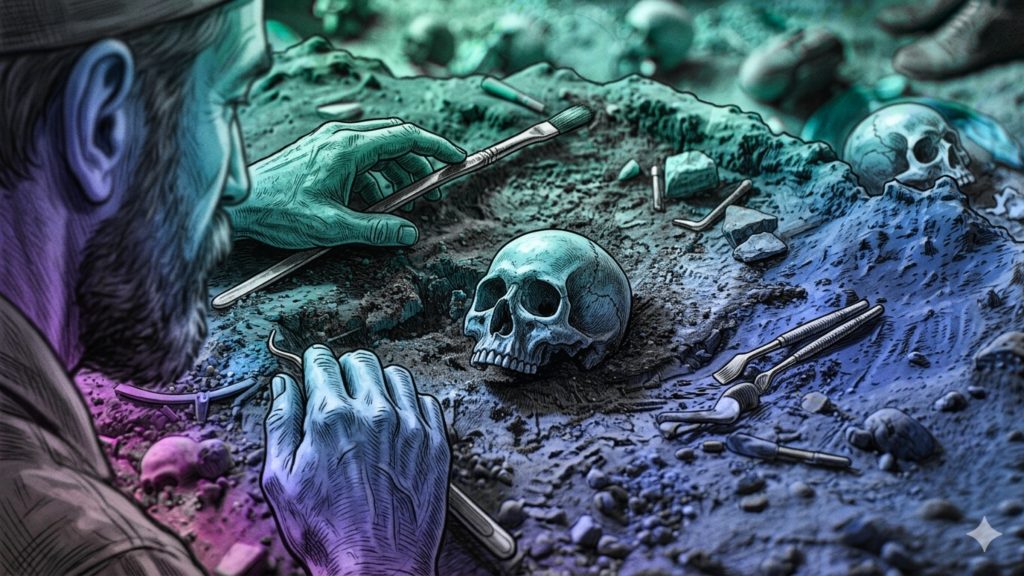
At Pompeii, scientists have digitally reconstructed the face of a man killed during the AD 79 eruption of Mount Vesuvius, using AI face reconstruction by combining skeletal analysis and advanced imaging to humanize one of history’s most devastating disasters.
At the same time, archaeologists are deploying AI to scan vast datasets, identifying hidden settlements and structures across entire regions in a fraction of the time traditional methods require.
Archaeologists in Italy began using AI face reconstruction technology alongside digital imaging, aerial data, and machine learning to reconstruct ancient lives and uncover buried sites, revealing how people lived and died across civilizations long lost.
AI face reconstruction is giving archaeologists and researchers faster and less invasive ways to explore the past.
Pompeii’s Final Moments
The Pompeii Archaeological Park, in collaboration with the University of Padua, used AI and photo-editing techniques alongside facial reconstruction technology to create a lifelike portrait of a man who died while fleeing the eruption.
The process also drew on craniofacial reconstruction, linking skull structure to facial features with scientific precision. His remains were discovered near the Porta Stabia necropolis, alongside personal belongings including bronze coins, an oil lamp and a terracotta mortar he appeared to use as protection from falling debris.
The reconstruction shows him running through ash-covered streets, holding the mortar above his head as volcanic stones fall around him. Built using AI 3D face reconstruction, the image captures both the chaos of the eruption and the instinct to survive. Researchers further refined the output using AI face restoration to enhance missing or damaged details, translating archaeological data into a deep human story.
“The vastness of archaeological data is now such that only with the help of AI will we be able to adequately protect and enhance them. If used well, AI can contribute to a renewal of classical studies,” Pompeii Park director Gabriel Zuchtriegel said in a statement.
Ancient accounts, including those of Pliny the Younger, describe residents using everyday objects to shield themselves as ash and pumice blanketed the city. The AI face reconstruction reinforces these accounts, offering a vivid glimpse into the final moments of Pompeii’s inhabitants while remaining grounded in scientific evidence.
AI Expands Archaeology Beyond Excavation
Beyond Pompeii, AI is transforming how archaeologists discover and analyze sites. Faced with thousands of aerial images, researchers like Jesse Casana have turned to machine learning to identify patterns that would take humans years to detect, dramatically accelerating the pace of discovery. These advances increasingly include AI reconstructing face techniques to complement site analysis with human-level insights.
AI performs particularly well at recognizing repeated structures, such as Roman forts or caravanserais, allowing researchers to map entire networks of ancient infrastructure. At the same time, tools like AI face 3D model generation are improving how archaeologists visualize past populations.
Other tools such as AI face restoration are also improving.
Combined with drones, thermal imaging, ground-penetrating radar and Light Detection and Ranging (LIDAR), these tools enable scientists to study buried environments without disturbing them. In parallel, AI 3D face reconstruction methods continue to evolve, helping refine identities reconstructed from skeletal remains.
Despite having the support of AI, the overall process is still a costly one as excavation is time-consuming and often destructive. Once a site is unearthed, it cannot be restored. Methods that rely on intelligent technology, including AI reconstructing face technology, allow researchers to gather insights while preserving sites around land and cultural heritage.
Still, experts caution that AI cannot replace human interpretation. While it excels at processing vast amounts of data, understanding history requires context, cultural awareness and critical judgment. There are also concerns about bias in AI-generated reconstructions, particularly those relying on AI face restoration, highlighting the need for careful oversight.
Used thoughtfully, AI is on its path to become a more reliant upon partner in archaeology rather than a replacement of the process itself. AI face reconstruction fuses speed with human insight and helps uncover inclusively accurate narratives of the past, bringing both ordinary lives and one last final moment from the ancient world into sharper, more meaningful focus.
Inside Telecom provides you with an extensive list of content covering all aspects of the tech industry. Keep an eye on our Intelligent Tech sections to stay informed and up-to-date with our daily articles.