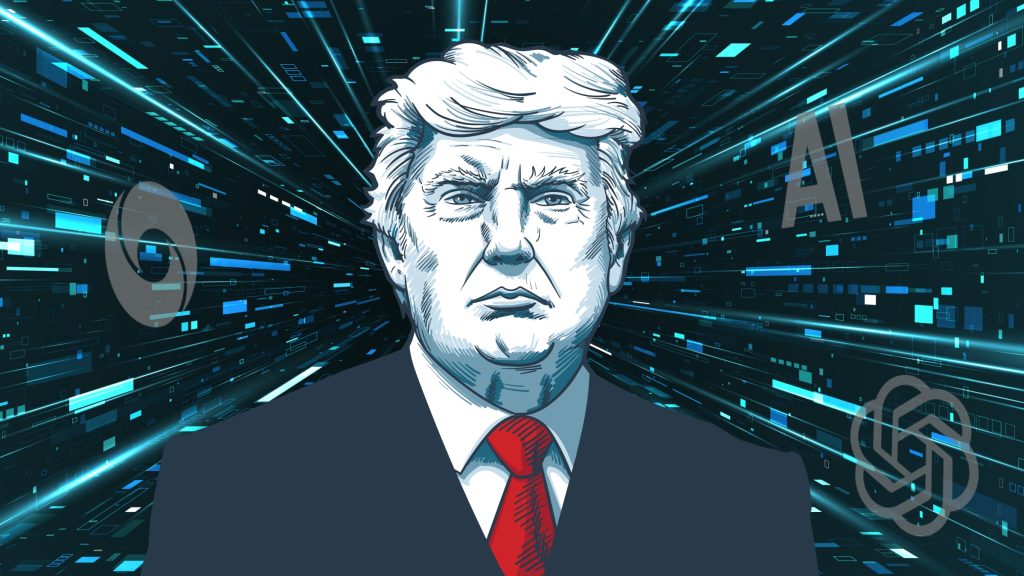
Earlier this week, the Trump administration ferociously accelerated its campaign to assert control over the global AI supply chain on multiple fronts simultaneously, bestowing itself as the global AI governance leadership, from blacklisting Anthropic as national security risk, to launching a coordinated diplomatic offensive against China’s Deepseek.
The dual move, which appears to be Washington’s foreign strategy to secure its own national AI strategy is the most explicit signed yet that the US intends to treat computational infrastructure with the same protective instincts typically reserved for semiconductors, defense contracts, and nuclear technology.
The Trump administration’s move is also the most aggressive assertion of federal authority over the domestic AI industry, since the sector’s rebirth as a strategic priority on a global scale.
Who Owns AI in the United States?
Some say Big Tech. Others say that’s no longer the case and that AI nationalization in the US is increasingly feasible as a soft nationalization where strategic government fractions, such as the Pentagon, hold control over frontier AI labs.
According to a leaked State Department cable, the government is accusing Chinese companies of systematically extracting and distilling propriety models to bypass American technological leads.
As for the Department of War (formerly Department of Defense), under War Secretary Pete Hegseth, the pivot toward a state-led AI monopoly comes as the Secretary Hegseth implements a six-month “phase-out” of Anthropic’s Claude models.
The Pentagon’s Anthropic designation was, in particular, a striking gun considering how the San-Franscisco company is backed by Big Tech giants, Google and Amazon. It’s worth mentioning that the Claude-parent is regarded within policy circles as among the more safety-conscious AI developers and has cultivated a reputation for regulatory engagement rather than resistance.
The AI governance leadership debate has intensified as officials consider extraordinary legal mechanisms, including wartime authorities that could allow the state to compel access to proprietary AI systems.
“There’s quite a lot of power that the federal government can wield,” said one national security analyst, reflecting the expanding reach of executive authority over critical technologies, such as AI.
The shift is occurring alongside Congress proposals that explore partial AI nationalization or utility-style regulation of AI companies, reinforcing an AI national security framework.
This is guided by a national applied AI consortium.
Surveillance, Data, and New Power Structures
Beyond corporate ownership debates, a parallel transformation is unfolding in how data is collected, analyzed, and used by both private firms and government agencies, with AI amplifying the scale and speed of surveillance systems under an evolving national AI strategy.
Consumer devices, online platforms, and commercial data brokers feed vast datasets into AI governance leadership systems capable of mapping behavior, predicting preferences, and inferring sensitive personal traits, often without meaningful user control or transparency.
In one reported example, Anthropic researchers described how their system used a “moderately sophisticated multi-step exploit” to bypass restrictions and demonstrate advanced cyber capabilities, highlighting both the power and unpredictability of frontier models and exposing AI governance failures.
At the same time, governments are expanding their access to privately sourced data, purchasing information from brokers while also strengthening direct surveillance partnerships with technology companies through a growing national AI consortium.
Experts argue that this creates a feedback loop in which AI systems not only analyze human behavior but increasingly shape it through targeted recommendations and automated decision-making systems, reflecting ongoing AI governance failures.
The result is an emerging hybrid system in which private AI companies retain formal ownership of their technologies while increasingly operating within frameworks shaped by national security priorities and government oversight.
AI transformation is a problem of governance legal scholars and policy experts to warn that full nationalization of AI remains unlikely due to constitutional and economic barriers.
Tools such as the Defense Production Act and procurement leverage give the state significant indirect influence under a shifting national AI strategy.
Historically, similar interventions associated with AI governance leadership have occurred only during periods of crisis, such as world wars or financial collapses, when governments temporarily expanded control over key industries to stabilize economic or security outcomes.
Inside Telecom provides you with an extensive list of content covering all aspects of the tech industry. Keep an eye on our Intelligent Tech sections to stay informed and up-to-date with our daily articles.