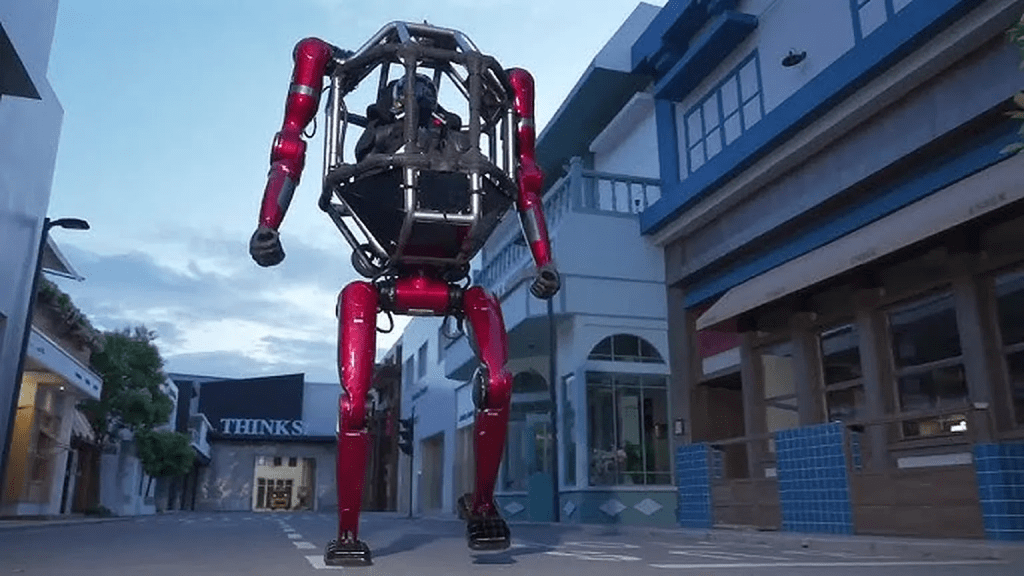
 Credit: Unitree
 On May 12, the CEO of one of China robotics companies, Unitree Robotics, climbed into the chest cockpit of the GD01 in Hangzhou, maneuvered the 500-kilos machine forward, and put a concrete brick wall through with one mechanical punch.
The demonstration lasted seconds. The footage went everywhere. The wall didn’t stand a chance – no pun intended.
The Chinese rideable robot, the GD01 stands at 2.7 meters tall, carries a $650,000 price tag and is the world’s first human-piloted transformable mecha robot.
The mecha machine comes with a deliberately cinematic framing, fusing Pacific Rim and Transformers into one colossal creation. Despite being inspired by fictional creations, its engineering is far from fictional, to the extent that Elon Musk was impressed by it.
The billionaire Tesla CEO called China’s rideable robot “cool” on X. In the current attention economy, that’s basically a product endorsement and market signal – especially coming from someone like Musk.
China Robotics and Challenges
The GD01 is a 500 kilograms mechanical marvel that transforms from a two-legged upright stance into a four-legged configuration for rough terrain. The Chinese rideable robot is what engineers call embodied AI, moving intelligence out of computer screens and into heavy machinery.
Experts note that China robotics has crossed a vital threshold, turning experimental laboratory concepts into commercial products with actual price tags, to the degree that even tech billionaire Musk took notice.
But bringing giant China robots to reality is hard. Specialists emphasize design problems, including limited battery life, poor pilot comfort, high maintenance, and an absence of safety rules for big machinery.
Moreover, its price of $572,700 (3.9 million yuan) makes it unaffordable for ordinary consumers, but either way, we highly doubt this rideable mech is made for ordinary consumption. Unitree specifies this starting price will be revised as Chinese robot companies improve their products.
Although designed for film production, amusement parks, rescue operations, and dangerous industrial zones, wider adoption will take some time.
“The application scenarios for Unitree’s products are mainly aimed at changing the way we work. For example, our robots can be used in high-risk and harsh environments,” Huang told the Global Times.
Expansionism of Chinese Robot Companies
The excitement about China’s rideable robot comes from a government-backed manufacturing revolution. China has emerged as the biggest consumer of industrial automation, allowing advanced Chinese robotics to flourish.
In early 2026, government regulations and dedicated robotics industry parks in Beijing, Shanghai, and Shenzhen helped create around 1,000 enterprises producing humanoid robots.
Such an extensive suppliers’ network gives Chinese robotics companies an edge over their rivals, enabling them to source high-grade motors, batteries, and carbon fiber parts locally at significantly lower prices than international competitors.
In fact, China robotics makers were able to control nearly 90% of the global humanoid market in 2025, while Unitree alone exporting more than 5,500 robots, surpassing any other competitor.
“The West is building incredible humanoid robots. China is building them faster, cheaper and at a scale nobody else is close to matching,” European robotics analyst, Lukas Ziegler, observed on social media.
While the West focuses on precision prototypes, the Chinese robotics landscape benefits from experimentation, from entering autonomous machines into half-marathons to building giant, wall-smashing mechas.
Ultimately, the development of these new China robots proves that a new generation of engineers is successfully turning old book dreams into tangible, modern technology, solidifying the global dominance of China robotics for years to come.
Inside Telecom provides you with an extensive list of content covering all aspects of the tech industry. Keep an eye on our Intelligent Tech sections to stay informed and up-to-date with our daily articles.
