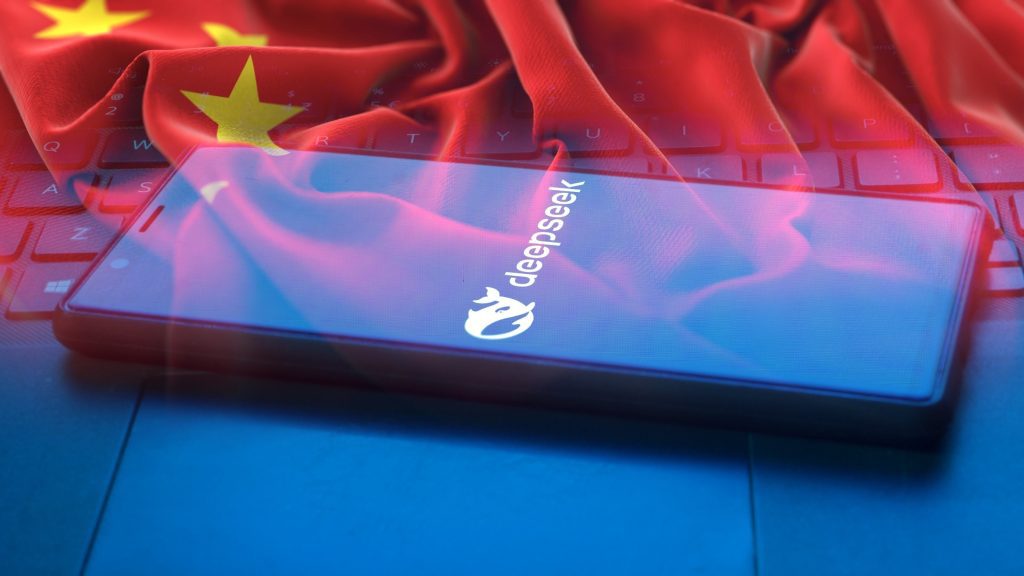
Beijing’s strategy to bypass US export controls and set its own rules in the global power balance stands on the pillars of open-source artificial intelligence (AI) where Chinese AI models harvest the labor of American AI, according to MIT Technology Review.
Labs of powerful Chinese AI models release open sources at a fraction of US prices and Beijing is presenting itself to the naked eye as the Robinhood of the tech world, borrowing American LLMs’ blueprints, then redistribute an optimized, affordable intelligence version of that of Silicon Valley.
It all intensely began when Deepseek, the new Chinese AI model unveiled its R1 reasoning model back in January 2025, matching top Western systems at a fraction of the cost.
Since then, firms such as Moonshot AI, Alibaba, and Z.ai have also followed Deepseek with open-weight large language models that rival leading proprietary systems, such as Anthropic’s Claude Opus.
The difference is not only performance, but also price and accessibility.
Moonshot’s new Chinese AI Kimi K2.5, for instance, costs roughly one seventh of Opus on some benchmarks, while Alibaba’s Qwen family has overtaken Meta’s Llama models in cumulative downloads on Hugging Face.
How China Is Building a Parallel Generative AI Universe
Unlike most US models, such as OpenAI’s ChatGPT, accessible through paid Application Programming Interface (APIs) that remain closed, China’s labs create Chinese LLM AI bots that weights under permissive licenses.
Anyone can download, inspect, fine tune, and use them. When Chinese AI models such as DeepSeek released R1 under an MIT license and detailed its training techniques, it signaled more than a technical breakthrough; it announced a distribution revolution.
Within days, Chinese LLM open source DeepSeek replaced ChatGPT as the most downloaded free app in the US App Store, shaking markets and briefly erasing nearly $1 trillion in US tech valuations. But the deeper impact was structural. Open weights meant developers everywhere could remix frontier AI without asking permission or paying premium fees.
“Thirty years ago, no Chinese person would believe they could be at the center of global innovation,” said Alex Chenglin Wu, CEO of Atoms. “DeepSeek shows that with solid technical talent, a supportive environment, and the right organizational culture, it’s possible to do truly world-class work.”
“Chinese AI firms have seen real gains from the open-source playbook,” said Liu Zhiyuan of Tsinghua University. By releasing strong research, he noted, companies build reputation and gain “free publicity.”
China open source AI, he added, has become “politically correct” in China’s programmer community quiet counterweight to US dominance in proprietary AI.
The Chinese LLM open source results are nothing like one has encountered before, diversified Chinese AI models families like Qwen, specialized variants for coding and reasoning, and a growing ecosystem of derivatives.
By August 2025, AI model distillation variations derived from Qwen made up over 40% of new language-model derivatives on Hugging Face, turning it into the default base model for global “remixes.”
Open Source AI Agent as Infrastructure Power
Beijing is working on a broader technological playbook, investing in Arctic shipping lanes, deep-sea mining, satellites, and digital infrastructure through initiatives like the Digital Silk Road. it is now exporting Chinese AI models as foundational infrastructure.
Shenzhen, widely recognized as the “Silicon Valley of China,” is now the nerve center of Beijing’s competition with Western technological powers. Home to Chinese hardware giants, AI startups, and a dense supply chain that solely relies on – and can only function as – being the city that blends manufacturing speed with software ambition.
There, a China open source AI model is not an abstract research project, but integrated into devices, cars, enterprise systems, and agent tools that run locally on smaller, cheaper models.

Beijing’s strategy relies on moving from being seen as the copycat, to becoming a curator of smaller and faster models like Deepseek and Kimi2.5. It’s no longer about “stealing weights” so to speak, but practicing a form of a digital, cultural homage through operational optimization of its AI products.
Chinese firms are not inventing LLMs from scratch but birthing a new revolution where early frontier breakthroughs are no longer led, confided, and restricted by US labs. LLMs’ future is no longer about creation from scratch, but how to optimize models’ architectures, compress memory costs, specialize variants, and slash API prices.
Beijing’s strategy is about the global redistribution of advanced Chinese LLM open source, performing a Robinhood maneuver by taking raw US AI intelligence, stripping away the Western computational inefficiency and safety guardrails to create a more functional tool.
The target audience? Global masses.
DeepSeek said it had observed attempts to circumvent access restrictions and use distillation techniques to replicate model performance. It also warned that some Chinese labs were “actively cutting corners when it comes to safely training and deploying new models.”
Silicon Valley investors report that as many as 80% of startups building on open-source stacks are running on Chinese AI models. Platforms like OpenRouter show Chinese open source AI models rising from near zero usage in late 2024 to roughly 30% in some recent weeks.
By lowering both cost and technical barriers, open weight Chinese open source AI models become the base layer on which global products are built. When developers fine-tune Qwen instead of paying for closed APIs, they embed Chinese architectures into apps, workflows, and devices.
Over time, those open AI open source choices influence benchmarks, tooling ecosystems, and even governance norms shifting standard setting power away from a handful of US giants toward a more distributed, and increasingly China influenced, model layer.
China is not only competing within America’s open source AI model framework but rewriting the rules, one open model at a time.
Inside Telecom provides you with an extensive list of content covering all aspects of the tech industry. Keep an eye on our Intelligent Tech sections to stay informed and up-to-date with our daily articles.