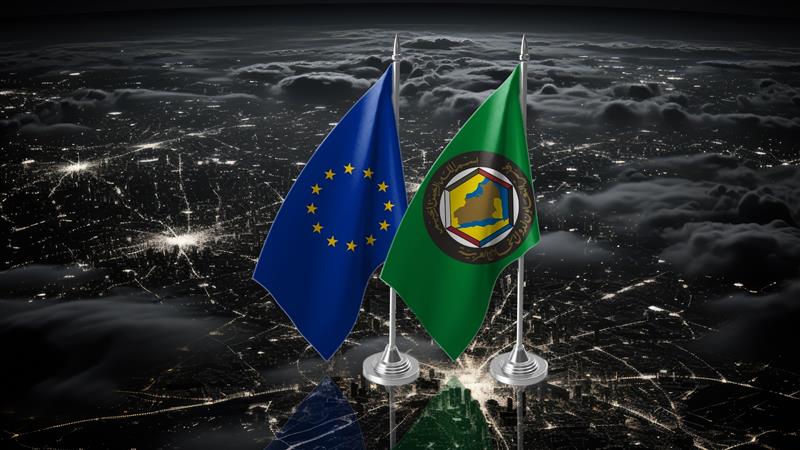
Italy and the United Arab Emirates (UAE) are establishing a cross-continental AI hub, as the European Union (EU) changes its AI in Europe strategy with pressure from Washington and Beijing takes more intense aspect.
The deal between European and Middle Eastern countries, led by the UAE and Italy, comes after negotiations between Rome and Abu Dhabi to set the needed groundwork for a key European economy to bypass its dependence on American and Chinese silicon for an independent, sovereign “intelligent corridor.”
The corridor will link European regulatory frameworks with the Gulf’s massive capital and energy resources.
Gulf states are investing US chips in colossal AI hubs and coming partnerships. Europe, however, is challenged with the embedment of its rules and values into advanced AI systems. Any Europe AI investment will no longer just be about funding, but sovereignty and long-term influence.
According to the European Council on Foreign Relations, the “AI Thaw” is a defensive realignment that will protect sovereignty of AI in Europe as the US trade policy takes a more of an offensive approach under a second Trump administration.
UAE’s superior AI infrastructure is built on years of aggressive investment in data centers and compute power. For Italy, this integration means the merger of the Emirates’ advanced AI foundations with the Rome’s industrial expertise and scrutinizing data privacy regulations.
But a European and Middle Eastern partnership such as this means the birth of a third geopolitical pole in the AI race that will force Brussels to confront a newly risen, difficult, conundrum.
The Gulf offering an escape room for the Washington-Beijing duopoly will require Brussels to reconcile its harsh ethical AI standards and regulations with a more centralized and hardware-heavy ambitions of Middle Easter monarchies.
Chips May Be American. Infrastructure Will Be European.
Starting from the core, the Pax Sicilia – US coalition that now includes Qatar, the UAE, Japan, Israel, Singapore and the UK – highlights a new era where geopolitics influence highly technology access.
Pax Sicilia’s sole goal is to reduce coercive dependencies on China in semiconductor chips, energy, and data infrastructure.
In practice, this means the US controls who gets advanced AI chips, shaping global networks before Europe or China can intervene. Because of that, the possibility of European cloud sovereignty is almost impossible.
Meanwhile, Gulf states have taken advantage. Saudi Arabia and the UAE now import hundreds of thousands of Nvidia Blackwell chips, fueling ambitious projects like Saudi HUMAIN and Abu Dhabi’s “Stargate UAE,” capable of delivering multiple gigawatts of AI compute.
Cheap energy and state funding make the Gulf ideal for large-scale infrastructure, but the rules governing those systems -who own the data, how AI is trained, which laws apply- will shape AI globally for years.
The Gulf is balancing between all powers, playing a smart game by partnering with the US for support in chips, and China and Europe for partnerships and funds.
However, AI in Europe opportunity lies in infrastructure. Italy’s $1 billion “Colosseum” supercomputer project, a partnership between UAE-based G42 and Italian AI startup iGenius, is set to become Europe’s largest AI supercomputer.
According to Italy’s Industry Minister, Adolfo Urso, this project will fortify Italy’s positions as a European hub for AI while ensuring control of data and infrastructure.
The facility, expected to be completed over five years, will host European data centers under Italian and EU law while using Gulf capital and US technology. Similarly, the UAE committed $40 billion in early-2026 Europe AI investment to Italy, supporting not only the Colosseum but broader AI initiatives.
Gulf funding allows Europe to scale fast, but they must remain in charge of the rules. These investments demonstrate how AI in Europe can leverage foreign capital without losing oversight, preserving cloud sovereignty.
How Does France’s AI Strategy Compare to Other European Countries?
In terms of EU countries riding the digitalization wave, France is a country that differentiated itself from other European states, seeking to make itself leader through strategic partnerships to advance AI in Europe.
France AI strategy links regulation, industrial capacity, and foreign investment. Paris is also forging partnerships with Middle Eastern monarchies.
The agreement with the UAE to build a 1.4-gigawatt AI campus near Paris means that Gulf funds build the infrastructure, while France ensures EU-aligned governance. Other countries, like Germany and Italy, are investing in AI but often lack coordination between other aspects.
Also, Paris has ordered 2.5 million civil servants to abandon Zoom, Microsoft Teams and Webex by 2027, replacing them with a French-built platform, Visio.
“We cannot risk having our scientific exchanges, our sensitive data, and our strategic innovations exposed to non-European actors,” warned civil service minister David Amiel.
France is becoming an EU AI Act deployer by taking European standards into global AI hubs. Through enforcing rules into Gulf projects, France is forming a European AI model controlled by EU rules and frameworks.
The EU AI strategy is uneven across the region. Each country leads its own way, making it more divided and easier to be influenced by foreign and western power that take advantage of the situation.
France leads in creating high-capacity European data centers with regulatory oversight, while Italy is making progresses via the Colosseum project. Coordinated European efforts will allow AI in Europe to compete with US and Chinese platforms without surrendering control and fearing restrictions.
EU AI Funding May Not Be Enough
By linking EU AI funding programs with controlled data sharing, Europe can train AI models in Gulf facilities without surrendering governance. AI regulation Europe allows the Union to exert influence over AI outputs, even when chips and servers are built abroad.
Inside Telecom provides you with an extensive list of content covering all aspects of the tech industry. Keep an eye on our Tech sections to stay informed and up-to-date with our daily articles.