
Revenue from travel eSIM packages grew 85% in 2025, from $989 million to $1.8 billion, according to Juniper Research. That’s the kind of number that ends up on the cover slide of every roaming strategy deck this quarter. But spend a few hours in a travel eSIM provider’s support queue or talk to whoever runs paid acquisition for one of these apps, and a different picture emerges: customer acquisition costs climbing month over month, repeat purchase rates that barely move, and a product shelf that looks identical across a dozen competitors.
Both things are true at once. The category is expanding fast, and the unit economics for most companies selling travel eSIMs directly to consumers are getting worse, not better. That’s not a contradiction. It’s what happens when a market moves from “novel” to “commodity” in about three years, which is roughly how long it’s taken since accessible eSIM apps brought the concept into the mainstream.
Bought Once, Deleted After Landing
Juniper’s own Competitor Leaderboard for travel eSIM enablers covers 16 vendors, and almost all of them compete on the same three axes: country coverage, price per gigabyte, and how fast the activation QR code shows up after purchase. When the entire pitch boils down to “cheaper data, faster setup,” differentiation collapses into price and app store ranking. A traveler buying a week of data for a trip to Portugal doesn’t have brand loyalty here. They search “eSIM Portugal cheap,” open whichever app ranks highest, has the most alluring marketing, or whichever comparison blog points them somewhere and move on with their lives.
That’s the part the growth headlines tend to skip. GSMA data shows that 51% of people using eSIM use it for travel, which is a remarkable usage number. But a product that gets bought once per trip, used for a week, and then deleted is structurally a discovery business, not a subscription business. The winners in a discovery business are the ones with the deepest marketing budgets or the best placement deals, and increasingly that’s not the same list as the operators with the best underlying networks.
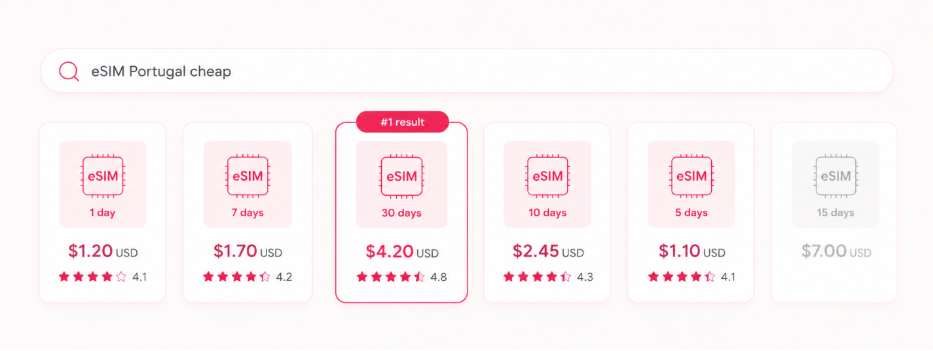
This is also why I’d push back a bit on the framing that travel eSIM is “disrupting roaming.” It is, for the silent roamers who previously did nothing. But for the providers fighting over those customers in the app store, it’s starting to look a lot like the early days of price comparison sites in insurance or flights: a race that mostly benefits whoever owns the comparison layer, not the underlying suppliers.
Built into the Booking. Not the App Store.
The more interesting question for 2026 isn’t which app wins that search result. It’s where the eSIM gets attached before the traveler ever thinks to open an app store at all.
Airlines bundling data allowance into premium cabins or top loyalty tiers. Card issuers including travel connectivity as a perk on a travel credit card, the same way they bundle airport lounge access or rental car insurance. Hotel groups offering it through their loyalty programs for international guests. Device manufacturers pre-provisioning a regional data profile at the point of sale for travelers buying a phone abroad. In every one of these scenarios, the traveler never searches for “eSIM.” The connectivity is simply part of something else they already bought, and whoever supplies it sits behind a brand the traveler already trusts.
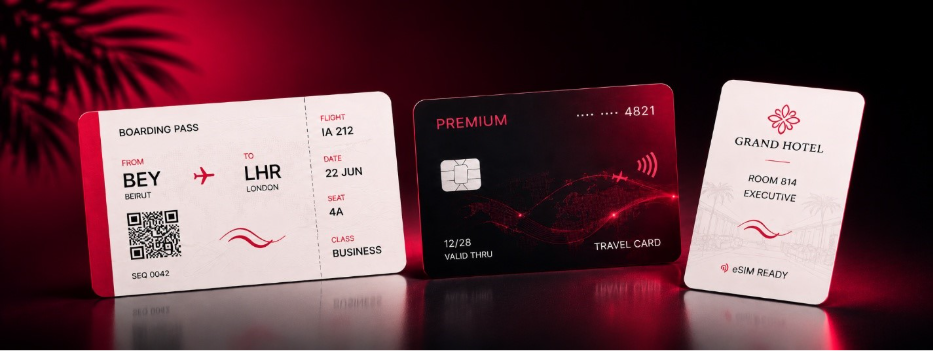
This is the embedded distribution layer, and it’s where the actual margin is going to live. But here’s the part that often gets missed: none of those partnerships get signed, scaled, or managed without a platform sitting underneath them that can onboard operators, handle reseller relationships across dozens of markets, and provision profiles at speed without the partner needing to build any of that infrastructure themselves. The airlines and banks aren’t buying connectivity; they’re buying a capability. And the companies that can deliver that capability through a single integration point, rather than asking every partner to stitch together their own stack, are the ones that will own this layer.
The companies that get there first lock in long-term agreements that are far stickier and far less price-sensitive than a one-off app store purchase. Everyone else ends up as an interchangeable wholesale supplier behind someone else’s brand.
There’s a structural shift happening alongside this too. Juniper’s 2026 connectivity trends report points to a convergence between MVNO-in-a-box platforms and travel eSIM enablement. Operators are increasingly looking for a single platform that manages both domestic plans and travel eSIMs — one that supports the full chain from operator to MVNO to reseller to end customer. That convergence matters because it changes who travel eSIM technology providers are actually selling to. Increasingly it’s other operators, MVNOs, and resellers assembling converged offers, not consumers browsing an app store directly.
Hassan Mansour, Monty Mobile CEO, puts it plainly:
“The B2B2C layer is getting thicker, and the platforms that can serve every tier of that chain through one hub become structurally hard to replace.”
Who Wins, Who Consolidates, Who Disappears
A few things I’d expect to play out over the next two years, based on where the money and the partnerships are already moving:
Smaller travel eSIM brands consolidate or go white-label. There isn’t room for 16 competitor-leaderboard entrants to all run independent consumer brands at sustainable customer acquisition cost (CAC). Several of today’s visible app store names will quietly become the backend connectivity provider behind an airline’s or bank’s branded offering, with the original consumer-facing app fading or disappearing.
Embedded partnerships move from pilot to default. Right now, an airline offering a free eSIM with a premium fare is a press release moment. By 2027, it’s closer to expected, the same way free checked bags or lounge access became table stakes on certain fare classes. The operators and enablers that have partnership agreements signed by mid-2026 will have a real head start on the ones still negotiating.
The hub model becomes the competitive moat. As the market matures, the real differentiator won’t be which provider has the cheapest gigabyte in 47 countries. It will be who has the most operators, resellers, and distribution partners already plugged into the same platform, buying and reselling data through a shared infrastructure. Network effects, not marketing budgets, become the defensible position. A platform with 200 resellers onboarded is not just bigger than one with 20; it’s structurally different, because every new partner that joins makes the hub more attractive to the next one. Juniper’s research already anticipates MVNO-in-a-box and travel eSIM platforms converging into single offerings. This is good news for operators that move now: it shifts revenue from a retail fight they’re poorly positioned to win toward a wholesale and platform role they’re much better suited for.
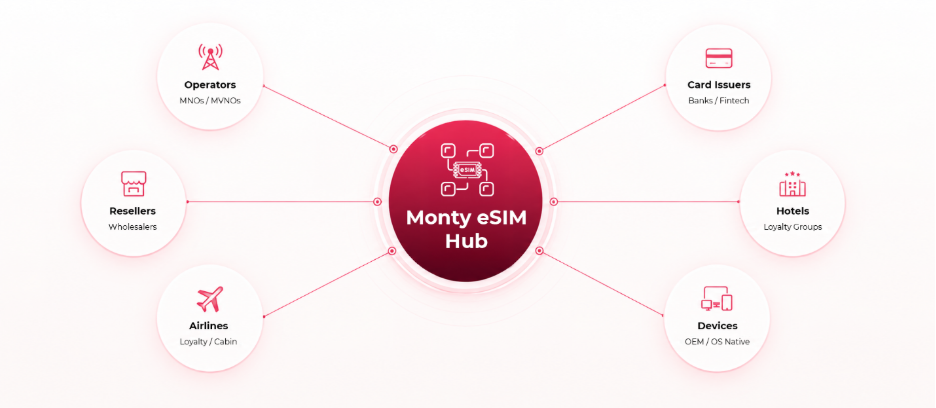
The app itself may not be the front door for much longer. As smartphones and operating systems get better at managing eSIM profiles natively, the clunky “download an app, scan a QR code, install a profile” routine starts to disappear, handled automatically by the device instead. That doesn’t kill the connectivity business, but it does shrink the app’s role as the main touchpoint with the customer, and it accelerates the advantage for whoever already has a relationship at the platform level.
This is the model behind platforms such as Monty eSIM Hub: bringing operators, connectivity suppliers, resellers, white-label partners, and embedded distribution channels together through a single integration and management layer. Instead of an airline, bank, or hotel group negotiating and provisioning separately with each connectivity supplier, the hub sits underneath as shared infrastructure, handling onboarding, provisioning, and reseller relationships across markets so partners can focus on packaging the offer rather than building the plumbing behind it.
None of this means the 85% growth figure is wrong, or that travel eSIM isn’t a real opportunity. It is. But growth in a market and value capture within that market are two different charts, and right now they’re starting to point in different directions. The operators and enablers spending 2026 fighting over app store rankings are competing for a shrinking share of a growing pie. The ones building the hub infrastructure that operators, resellers, and distribution partners plug into are setting themselves up to own the category, not just participate in it.
About the Author
Farouk Tabbal is the eSIM Product Director at Monty Mobile, where he leads the company’s eSIM product strategy spanning consumer, IoT, and roaming. Over more than a decade in telecoms, he has built deep expertise across the full eSIM stack, from Remote SIM Provisioning platform to B2B distribution and operator enablement.
At Monty Mobile, Farouk contributes to the development and expansion of the company’s eSIM platforms for operators, MVNOs and resellers across multiple regions.

Inside Telecom provides you with an extensive list of content covering all aspects of the tech industry. Keep an eye on our Telecom sections to stay informed and up-to-date with our daily articles.