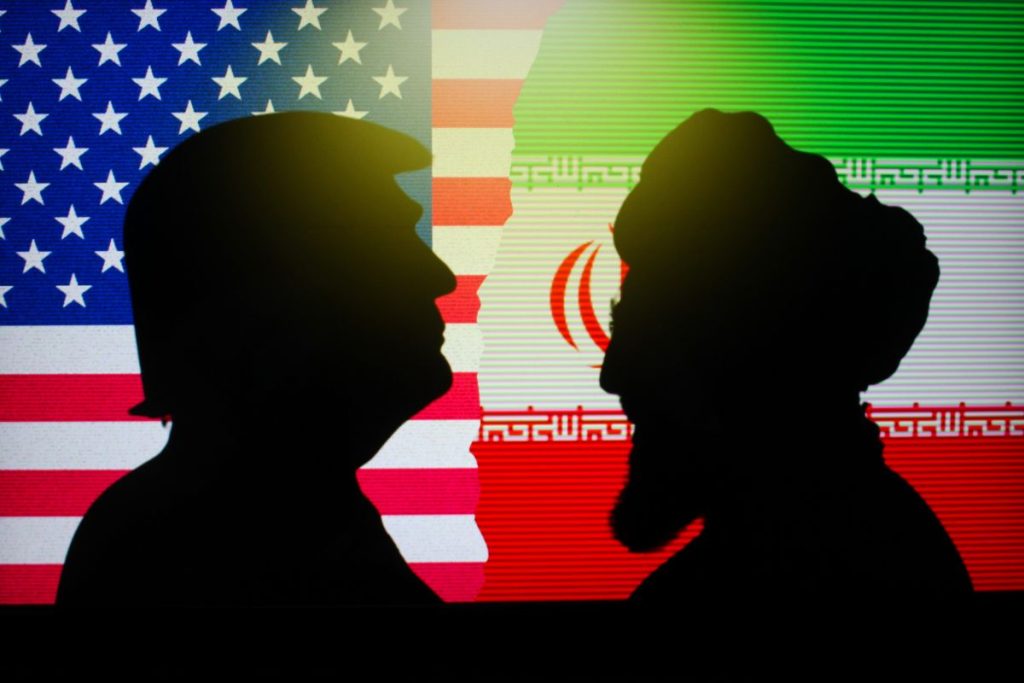
Iran is warning of “dire consequences” for any attack from the US as its naval armada advances toward the Persian Gulf. Experts, are scrutinizing whether the US is weaponized with the needed advanced electronic and cyber warfare capabilities to systematically disable, hack, or deceive Iran’s battle-hardened network of air defense sensors and radars. The US and Iran war could be looming, just around the corner.
The Islamic Republic is demonstrating that controlling information at home holds bigger value than fending off foreign hackers.
In recent years, US cyber forces have demonstrated their capabilities in infiltrating Iranian military networks, but Tehran’s complete control over internet access shows that local information management remains a decisive factor, possibly leading to US and Iran war. Iran US military networks – each in its own nature – are taking different forms but at the same time have become extremely intertwined in the region.
In June 2019, US Cyber Command was reported to have carried out a secret operation that effectively deleted the databases of the Islamic Revolutionary Guard Corps (IRGC) used to plot tanker attacks, highlighting that American code can reach deep into Iranian systems, leading to an Iran US proxy war Middle East.
Yet, while the US and Iran war can ruin networks abroad, domestically, Iranian authorities maintain a complete control over its communications by imposing a complete internet blackout.
US Iran Cyber Electronic Warfare
The US has developed a range of cyber electronic tools designed to disrupt Iran’s defenses without firing a single shot, leading to US Iran military electronic war.
The Air Force’s ‘Suter’ program is “a specialised airborne network attack system” that can hack into enemy radar networks, giving US Cyber Command Iran operations a view of what the enemy sees and potentially allowing them to take over system administrator privileges.
Similarly, the Navy is upgrading EA-18G Growlers with the AN/ALQ-249 Next Generation Jammer, which uses Active Electronically Scanned Array (AESA) technology not only to block signals, but to be able to transmit specific ‘waveforms’ that incorporate malicious data into the opponent’s radar receivers, allowing them to hack via radio waves.
The F-35 Lightning II, often described as a flying computer, can detect specific electronic ‘fingerprint’ of an Iranian radar and in return fire targeted data packets to blur or disable the processing unit.
Due to the US and Iran war,US forces also employ Digital Radio Frequency Memory (DRFM) to create ‘ghost’ fleets, tricking Iranian operators by “showing dozens of false targets,” masking real strike locations. Even Iran’s air-gapped networks, designed to prevent outside access, can be bypassed as US aircraft connect this gap by being able to fly near to insert code directly into the radar’s receiver dish.
Ultimately, US doctrine seeks “non-kinetic neutralisation,” aiming to turn “Iran’s billion-dollar air defence batteries into useless metal statues,” before a conventional US and Iran warbegins.
Iran’s Domestic Internet Shutdown
Inside Iran, citizens have been under an internet shutdown, nearly lasting as much as three weeks, leaving most people cut off from the global web. Few users managed to connect via VPNs, or proxies, but authorities block all widespread access.
Iran appears to be preparing a “tiered internet” system that would limit connectivity to a select group of approved individuals and organizations.
Earlier this week, Tehran opened a small office allowing businesspeople with identification from the Iran Chamber of Commerce to access the internet, after signing a form committing to use it for “business purposes” only.
A similar arrangement was set up for journalists by the Culture Ministry, unlike the limited permissible access for the rest of the population.
While US cyber power can disrupt Iran hacking air defense systems, perhaps US cyber power is less relevant than Iranian control of information at home while military tensions rise.
In parallel, Washington’s sharpening its tools that can silently neutralize foreign systems in preparation for potential US Iran military action. Tehran, continues to influence information control as a defensive shield, showing that the battlefield of the potentially upcoming US and Iran warmay be as much about controlling perception as it is about disrupting hardware.
Iran Axis of Resistance
The Iran Axis of Resistance, proxies like Hezbollah and the Houthis, are directly standing in the way of the US’ hegemony by simply threatening the US’ biggest ally in the Middle East, Israel.
Since taking office in his second term, President Trump made it very clear that he’s adamant to pursue escalation to dismantle the Iran Axis of Resistance network and prevent Tehran’s nuclearization, further incentivizing cyber warfare between the US and Iran.
As early as 2026, the US cyber strategy against the Iran Axis of Resistance has completely pivoted toward an aggressive cyber-first doctrine, by disrupting command and control (C2) through offensive cyber operations to sever the digital umbilical cord between Tehran and its proxies.
Inside Telecom provides you with an extensive list of content covering all aspects of the tech industry. Keep an eye on our Cybersecurity sections to stay informed and up-to-date with our daily articles.