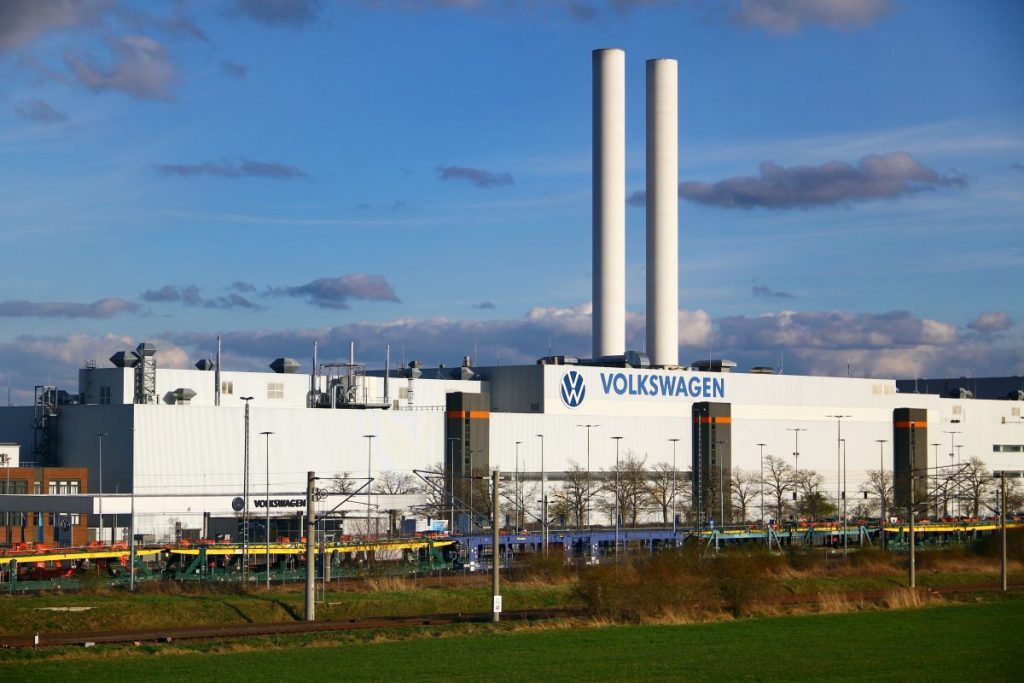
Volkswagen is negotiating to transform its doomed Osnabrück plant into a weapons factory for the Israeli Iron Dome manufacturer, Rafael, producing components to save 2,300 jobs, with legal experts warning the deal violates German and international law and requires worker approval the company hasn’t yet secured.
The planned conversion with the manufacturer of Iron Dome exposes Volkswagen’s struggles in the electric vehicle (EV) sector. With the global EV market flooded with more price-friendly Chinese competitors and consumer interest waning, the profit margins that once sustained traditional car manufacturing are shrinking. Without a change, Volkswagen’s Osnabrück plant faces closure.
The Israeli Iron Dome manufacturer deal offer comes at a time Volkswagen needs a strategic lifeline, allowing it to redirect manufacturing capabilities toward defense systems while preserving employment.
“We need to bring [new] companies to Osnabrück, not just focus on preserving what’s already here,” said mayoral candidate, Robert Alferink, acknowledging the difficult economic reality facing the industrial city.
Under German co-determination law, however, the plant’s works council must formally approve any weapons production partnership from the manufacturer of Iron Dome a vote that has not yet occurred despite months of reported negotiations.
The collaboration also serves the Iron Dome manufacturer, Rafael’s interests.
With European manufacturing capabilities that sidestep political obstacles surrounding Israeli-made products while simultaneously marketing the digital Iron Dome to NATO allies.
Computers on Wheels
Contemporary automobiles operate as mobile computing platforms, incorporating sophisticated electronics, autonomous sensors, AI, and networked capabilities.
Volkswagen’s expertise in vehicle electrification, autonomous navigation, sensor integration, and precision manufacturing can be applied to heavy-duty transport vehicles and power the Iron Dome interception systems used in modern air defense.
The Osnabrück facility was created to produce launchers, generators, and transport vehicles for the Israeli Iron Dome manufacturer and Iron Dome system.
However, manufacturer of Iron Dome wouldn’t be involved in making interceptor missiles. This separation, some legal experts contend, offers little defense against accusations of complicity.
This technological convergence between automotive and defense sectors represents what industry observers call “computers on wheels” the merger of disciplines once considered separate.
According to Euronews, “a cooperation between Volkswagen and Israeli Iron Dome manufacturer, Rafael Advanced Defense Systems would be a particularly prominent example of how the German automotive industry is increasingly looking to join forces with the booming defence sector.”
The conversion could occur within 12 to 18 months with minimal investment, preserving the plant’s specialized manufacturing capacity and all 2,300 jobs.
However, the European defense strategy reveals a critical weakness in the proposal. The Rafael Iron Dome has a 100-kilometer range makes it effective for defending confined territories like Israel against short-range projectiles, but military strategists question its value for continental European defense.
As one German defense executive told the Financial Times, “We have no need for it in Germany unless the Russians are already at the Oder river.”
Defense expert Sidharth Kaushal has argued the system is better suited for Baltic or Scandinavian border defense than protecting Western Europe from Russian ballistic missiles a geographic limitation that undermines NATO’s purported strategic rationale for the partnership.
Germany, Poland, Romania, and Sweden operate countries with Iron Dome systems, while Lithuania, Finland, Latvia, Czech Republic, and Slovakia actively evaluate purchases, suggesting European NATO allies view the system as frontier protection rather than continental defense.
Legal Violations, Potential Association to Genocide Accusations
The economic viewpoint hides a troubling legal reality with international law experts saying that the partnership violates Germany’s fundamental obligations.
According to Northwestern University’s Torsten Menge, “any military, security, or arms cooperation with a state that is actively committing genocide, is engaged in acts of ethnic cleansing, and is involved in multiple wars of aggression, violates Germany’s obligations under international law and is illegal under domestic law.”
The International Court of Justice’s 2024 advisory opinion established that third states must not render aid or assistance maintaining situations created by unlawful occupation. Germany’s Basic Law, specifically Articles 25 and 26, coupled with the War Weapons Control Act, expressly forbids arms exports that could potentially breach international law.
Legal expert Aidan Simardone emphasized that “corporations have legal personality, meaning they have rights and obligations,” and weapon exports to belligerents engaged in potential war crimes create direct corporate liability.
The historical irony cuts of the Iron Dome Israel in action . Volkswagen originated as the Nazi regime’s state-backed automaker through the 1938 KdF-Wagen program. Over 336,668 Germans invested 280 million Reichsmarks into this scheme. Receiving nothing, the plant instead produced war materiel using slave labor until 1945.
“It is a particularly cruel irony that it is now considering again to produce weaponry for a genocidal and expansionist regime,” said Menge.
Lower Saxony, controlling 12% of Volkswagen shares, would directly participate in this defense production. Before any deal proceeds, workers must vote through the co-determination process. Until that vote occurs, the proposal remains technically unauthorized and legally unapproved having the Iron Dome manufacturer, waiting.
Inside Telecom provides you with an extensive list of content covering all aspects of the tech industry. Keep an eye on our Tech sections to stay informed and up-to-date with our daily articles