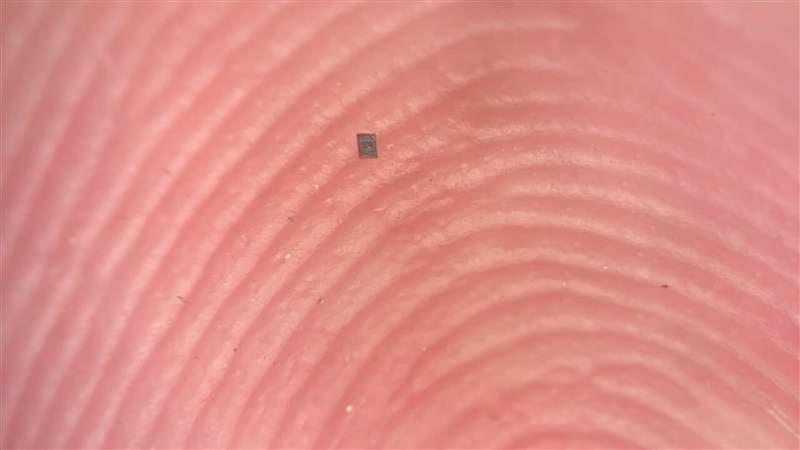
 Credit: Marc Miskin, University of Pennsylvania
 Scientists from the University of Pennsylvania and Michigan created the world’s smallest robot, fully autonomous and programmable at a microscopic scale, employing light-based computing abilities that enable microscopic robots to perform normally on their own for months.
The world’s smallest robot, and similar generations, operate in a size range just a bit larger than living cells, each smaller than a grain of salt and manufactured for just one cent. These nano micro robotic creatures open a new frontier for robotics in medicine, cellular research, and micro-manufacturing.
The technology used demonstrates the possibility for complicated machines to operate without wireless, magnets or outside control.
Other scientists believe that nano micro robotic creatures will function effectively in fluid environments that are hostile to conventional machines.
Smashing the Sub-Millimeter Barrier
These microscopic robots units are only 200 by 300 by 50 micrometers in sizes and are subject to physical forces that differ from those acting on larger-scale robots.
“We’ve made autonomous robots 10,000 times smaller,” says Marc Miskin, an Assistant Professor at Penn Engineering.
The construction of a functional programmable robot with proportions below one millimeter had long been considered impossible because of the resistance in water.
“If you’re small enough, pushing on water is like pushing through tar,” says Miskin.
Therefore, to tackle this challenge, they ditched legs and joints and focused on swimming. The proposed microrobots adopt the mechanism of creating an electric field that pushes and pulls charged particles to move around them.
This way, robots are able to move without bending their bodies. Consequently, the world’s smallest robot can turn, move in curves, reverse, and even travel in groups.
Since there are no moving parts to the design, it is very resilient. Such micro robots
are able to last for months under light that comes from a small LED.
Equipping Small Robots with a Brain
Movement is only half of this story. Each robot requires intelligence for decision making.
To make this possible, engineers incorporated computing power and memory to produce a microscopically small robot capable of thinking and acting independently.
“The key challenge for electronics, is that solar panels are tiny and produce only 75 nanowatts of power. That is over 100,000 times less power than what a smart watch consumes,” says David Blaauw.
To solve this problem, sets of special circuits have been designed to enable every programmable robot to work on very low power.
Space was also a consideration, since most of the planet’s surface is overlaid with solar panels. Then it all becomes about rewriting the software for a single command to control the movement system in microscopic robots.
The robots can sense temperatures changes and act accordingly to change their path, allowing scientists to channel this aspect to investigate how a microscopic small robot responds to cellular activity.
The information is transmitted through minute movements recorded by a microscope camera. Consequently, scientists are able to interpret signals from microrobots without manual contact.
According to the team, it’s not about building the world’s smallest humanoid robot but to demonstrate that intelligence is achievable, no matter the size.
Future models might be able to move faster and accommodate more information. For now, nano micro robotic creatures prove the advancement that robotics have reached the microscopic world.
Inside Telecom provides you with an extensive list of content covering all aspects of the tech industry. Keep an eye on our Intelligent Tech sections to stay informed and up-to-date with our daily articles.