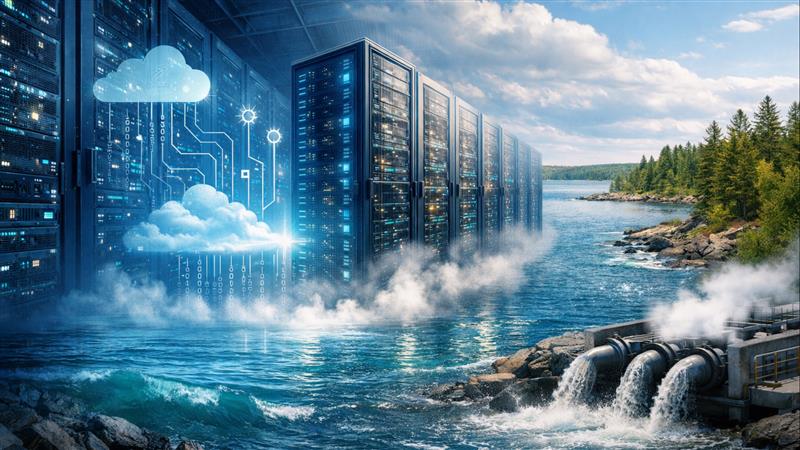
Data centers are costing the environment heavy water strain, energy demand, and data center water treatment changes, as residents near Lake Erie in Ohio raising their voices over how it is altering rural life.
Water is an essential pattern in the industry in this region, and now with advanced computing located near small towns, farmers are concerned over how these facilities work and how much they’re draining water supply.
How Do Data Centers Use Water?
The center of debate is data center water treatment.
Tom Hermes has farmed near Lake Erie for generations. When Aligned Data Centers began building NEO-01 in May 2024, he worried about water pressure and supply.
“We have city water here. That’s going to reduce the pressure if they are sucking all the water,” he says, adding “they’re not good, I know that.”
Facilities now depend highly on large volumes of water to avoid servers’ overheating, especially in AI and machine learning workloads. That’s where water cooling systems for data centers keep the heat away from servers by using chilled water circulated through pipes and cooling units.
Another approach is water cooling for data centers, due to its low cost and easier to scale than some newer technologies, even though it increases pressure on local water supplies.
According to researchers, data center water detection treatment usually monitors leaks and manages water quality; however, it does not eliminate the need for fresh water drawn from municipal systems. So, even when companies promote a closed-loop design, data center water treatment remains essential to keep systems running safely.
Water levels in Lake Erie have dropped 2-4 feet since 2019, provoking stress.
“In addition to the high volumes of water used on site for cooling, our recent research found that even more water may be consumed to generate electricity to power data centers’ energy needs,” says Kirsten James, senior program director for water at Ceres.
Facilities there rely on data center water cooling system connected to local municipal waters.
Also, data center water detection treatment provides advanced monitoring that tracks losses. But unfortunately, ecosystems still face risks.
Developed cities like Chicago, Toronto, Detroit perceive small under-sourced towns around the Great Lakes attractive to set up data center companies. A water cooled data center can use as much water as a small town, like how the proposed AI data center in Mount Pleasant, Wisconsin, could consume up to 8.4 billion gallons annually from Racine’s Lake Michigan supply.
Despite the heavy reliance, water evaporation and electricity generation still way down local resources. This makes water usage efficiency data center planning.
Between Data Center Water Consumption and Innovation
To support the facilities, municipalities claim data centers will increase tax revenue and hope to rebuild water delivery systems. Therefore, many argue that data centers bring jobs and tax revenue. Aligned, paid local taxes, and received a 15-year exemption.
“A couple of years ago, there was a water pollution issue at the site. I’m very concerned. Is this [water] going back into the lake?” said Amanda Voegle, whose workplace faces the site.
Data center water treatment holds extreme pollution concerns. Moreover, Voegle reports that they lose power weekly.
Beyond cooling, data center water use includes electricity generation to fulfill energy needs. Today, data center water cooling decisions shape regional planning, while the rising water consumption reveals the dark side of AI expansion on communities and sustainable infrastructure.
And now, for Lake Erie’s residents, data center water treatment is no longer just a technological pattern, but also an environmental and community driven one.
Inside Telecom provides you with an extensive list of content covering all aspects of the tech industry. Keep an eye on our Tech sections to stay informed and up-to-date with our daily articles.