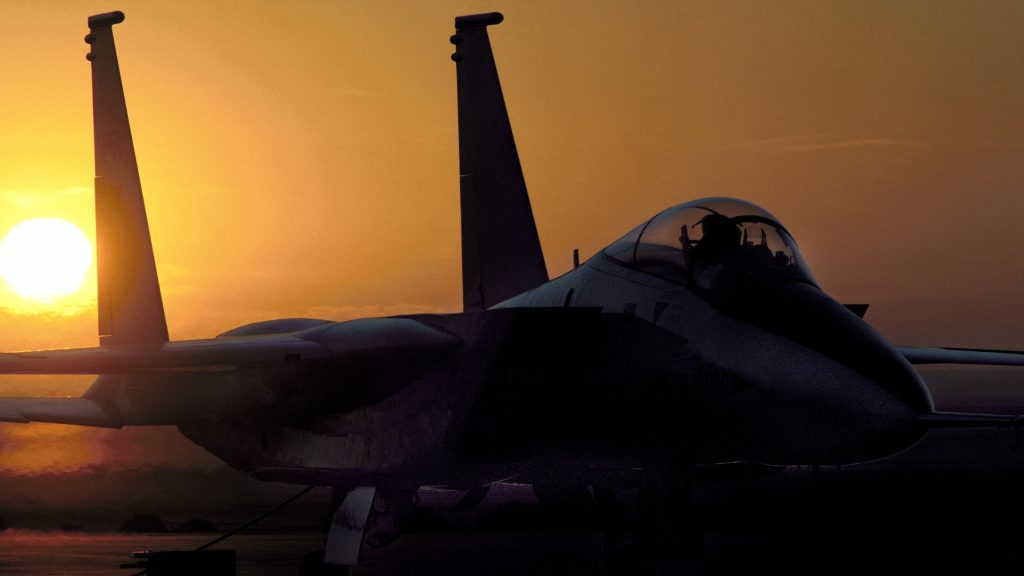
On March 31, two US Air Force EA-37B Compass Call jets arrived at RAF Mildenhall in the UK, in their first operational deployment, as electronic warfare and technological dominance enter a new phase of determining survival in modern wars.
The arrival of the Air Force EA-37B Compass Call in the UK after departing Davis-Monthan Air Force Base, marks what could be the platform’s first operational deployment as tensions escalate across the Middle East.
Tracked under callsigns AXIS41 and AXIS43, the aircraft signal more than a routine movement they show a shift in how the US Air Force projects power. Designed to replace the aging EC-130H fleet, the EA-37B merges airborne electronics attacks with intelligence, surveillance, and reconnaissance (ISR), allowing it to detect, geolocate, and disrupt hostile emitters in real time.
Unconfirmed reports suggest two EC-130H aircraft may have been damaged during an Iranian strike on Prince Sultan Air Base in Saudi Arabia, raising questions about the availability of legacy platforms. If verified, the incident would show the importance behind used more advanced airborne electronics, survivable systems like the Gulfstream G550 charter EA-37B.
Airborne Electronic Warfare System Warfare Involvement
The shift from the EC-130H to the Gulfstream G550 charter EA-37B also reflects a broader technological transformation. The introduction of BAE Systems’ SABER technology and software-defined radios allows the aircraft to adapt rapidly to evolving threats. Unlike legacy systems, which relied heavily on hardware, the EA-37B operates as a software-driven platform capable of continuous upgrades.
The Compass Call system is an airborne electronic warfare tactical attack platform designed to disrupt enemy command-and-control communications, radar, and navigation systems, ultimately limiting an adversary’s ability to coordinate operations. The function is central to US Suppression of Enemy Air Defense (SEAD) strategy, complementing platforms like the EA-18G Growler and F-16CM.
The shift from the EC-130H to the EA-37B also reflects a broader airborne electronic warfare technological transformation. The introduction of BAE Systems’ SABER technology and software-defined radios allows the aircraft to adapt rapidly to evolving threats. Unlike legacy systems, which relied heavily on hardware, the EA-37B operates as a software-driven platform capable of continuous upgrades.
The US Air Force is actively combining the EA-37B with the RC-135 Rivet Joint to bring intelligence gathering with airborne electronic warfare attack capabilities.
As Capt. Jasmine Harris explained, “The synergistic integration of Rivet Joint’s intelligence gathering with Compass Call’s electronic warfare capabilities has proven to be a gamechanger on the modern battlefield. We’re not simply flying sorties; we’re creating a new paradigm.”
Traditionally, survival in conflict depended heavily on human intelligence on the ground troop movements, reconnaissance patrols, and direct observation. Today, that model is being eclipsed by systems that can see, hear, and disrupt the enemy from hundreds of miles away.
Survival is no longer determined solely by who has better intelligence on the ground, but by who can dominate the invisible battlespace of data, signals, and connectivity. In this environment, an aircraft like the EA-37B does not just support operations; it shapes them before they begin, blinding adversaries, severing their communications, and creating confusion at every level of command.
In the Middle East, disrupted command structures and reliance on networked systems make chaos highly effective. By targeting an opponent’s “nervous system” rather than its physical assets, electronic warfare platforms neutralizes threats without direct kinetic engagement.
DO-254 Design Assurance Guidance for Airborne Electronic Hardware
As the EA-37B Compass Call transitions toward full operational capability, certification and safety standards for its mission systems become critical. DO-254 design assurance guidance controls the development of airborne electronic hardware, allowing for reliability in mission critical environments where system failure isn’t an option.
The EA-37B Compass Call mission of computers and electronic warfare suites must meet stringent certification benchmarks to operate in high-threat scenarios. Its modular open systems architecture not only enhances adaptability but also introduces complexity in validation and verification processes. Ensuring compliance with DO-254 standards is essential to guarantee that these systems perform reliably under combat conditions.
The aircraft’s smaller size, lighter weight, and lower power needs, when compared to the EC-130H, were achieved through advanced integration of hardware and software, with the presence of the Gulfstream g550 range.
This optimization lowers cooling demands and operational costs while increasing endurance, range, and Gulfstream G550 speed. It also places greater emphasis on robust design assurance to maintain system integrity.
Beyond certification, this also reinforces the broader strategic shift toward technology-driven survival. When mission success depends on Gulfstream g550 specifications software defined radios, adaptive jammers, and real-time data processing, the reliability of code and hardware becomes as critical as pilot skill or battlefield tactics.
With Initial Operational Capability expected and full fielding decisions anticipated in fiscal year 2026, the Gulfstream EA-37B may soon play an important role in ongoing war operations such as Operation Epic Fury.
The arrival of the EA-37B Compass Call not only shows a platform upgrade; but it also signals a great shift in how wars are fought.
Inside Telecom provides you with an extensive list of content covering all aspects of the tech industry. Keep an eye on our Tech sections to stay informed and up-to-date with our daily articles.