In the afternoon of March 23, Israel targeted an apartment in suburban Beirut, Hazmieh, striking a residence where a Quds Force–linked operative, Mohammad Ali Kourani was located, using a precision guided loitering munitions systems that reportedly entered from a balcony before detonating inside.
The loitering munition systems strike, described by witnesses in the same house as the target, mentioned how “precise” it was in fulfilling its assassination, in yet another notable tactical escalation, where Israel’s military operations extend from the border of South of Lebanon, into densely populated civilian areas in the capital, Beirut.
The assassination on Lebanese soil in the suburbs of Hazmieh, has focused attention on a technology that, until recently, existed primarily in arms-fair brochures and classified annexes.
The munition in question is what military experts call loitering munitions systems that are part drone, part missile, with possible AI integration. It circles. It waits. And, according to reporting on the strike, it sees.
The tactical missile system set a new first stone in news form of attacks, with a more intelligent-driven campaign, where specific individuals are tracked and targeted repeatedly, raising concerns over surveillance depth and operational reach within Lebanon’s urban core.
Kourani had reportedly arrived at the apartment only hours before the strike with his family, all of whom survived. The incident follows a previous attempt on his life weeks earlier, suggesting sustained monitoring rather than an isolated operation. With no official Lebanese coming to clarify how the tactical missile system led to the attack that happened, and the type of Unmanned Aerial Vehicles (UAV) used, attention has turned toward military technologies capable of executing such highly selective strikes.
With all the tech capabilities that are taking place, one should be reminded that the human element is as essential as the tech side.
A “Cartoon-like” Strike
The unusual nature of the strike against its precision, entry point, and confined detonation drove speculations about the type of drone used.
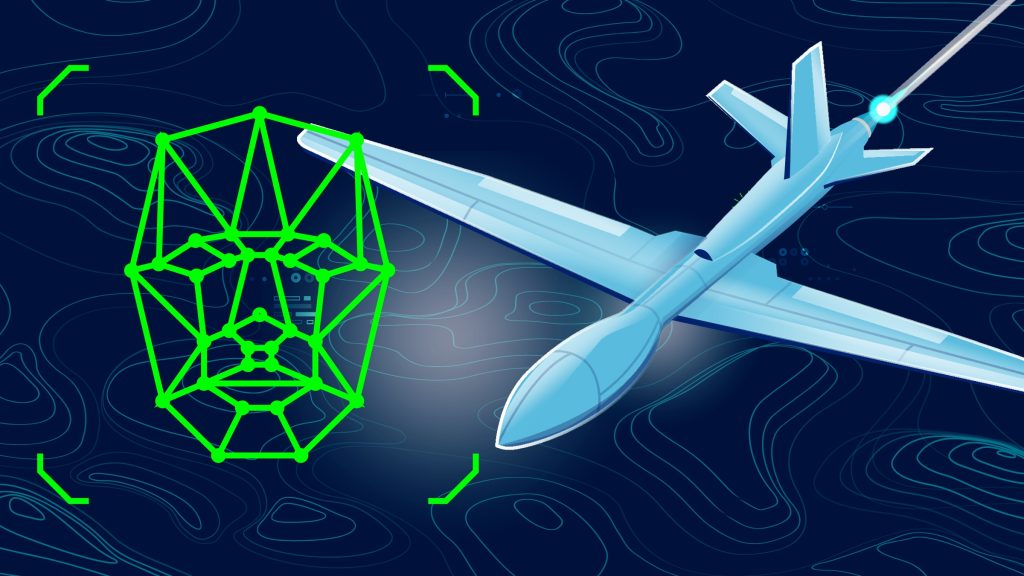
The targeting methodology to the attack is what most calls, “visual signature” targeting. The drone can identify a specific human being not just by face but by the particular rhythm of their walk, in low light, at distance. The system does not need to be told when to strike. It only needs to be shown who.
In modern warfare, such characteristics of loitering munitions systems, compact, drone-like systems designed to hover over a target before striking with pinpoint accuracy.
Witness accounts described a surreal, almost cinematic moment. It was as if the missile in the drone knocked on the door, had a cup of coffee with the residents at home, waiting for the target at home to carry out its job.
Allegedly, people said, “Regarding the assassination of Mar Takla, Hazmieh: The rocket entered the apartment from the kitchen balcony… they noticed ‘a fiery object going on in the house and went directly to the target’s face and exploded.’”
The claim remains unconfirmed, but it’s almost Tom and Jerry like imagery of an object weaving through space with intent, highlighting the eerie precision such systems can achieve.
According to research done at Inside telecom, the Switchblade family developed by AeroVironment could have been the suicide drone used in the Hazmieh hit. The two types, the Switchblade 300 and Switchblade 600.
Switchblade 300 is designed for anti-personnel missions, capable of targeting individuals, while on the other hand the Switchblade 600 is larger and is intended for vehicles and armored targets.
Switchblade missile systems are lightweight, tube launched and can remain in the air for 15 to 40 minutes, allowing operators to observe and strike when they intend.
By late 2025, such loitering munitions systems had reportedly expanded beyond US use, with at least six countries deploying them across multiple regions, including Ukraine, UK, Lithuania, New Zealand, France, and Greece, including Iran.
The Switchblade missile low acoustic signature, maneuverability, and ability to operate in tight urban environments make them particularly suited for targeted assassinations like the Hazmieh which wasn’t the first targeted assassination in Lebanon during the war that began on the 2nd of March.
The Automation of Targeted Killing
Modern systems are increasingly combining Intelligence, Surveillance, and Reconnaissance (ISR) capabilities with electro-optical sensors, encrypted navigation, and AI to identify and track targets in real time. The key advantage comes from the software.
A key enabler is M-code GPS, a military-grade upgrade that provides stronger encryption and resistance to jamming, ensuring reliable navigation even in contested environments. This allows loitering munitions systems to maintain accuracy while adapting dynamically to changes on the ground.
Jamming, the traditional recourse against drone threats, addresses the communication between operator and weapon. In this case, jamming has little purchase on a system that had, in effect, already been given its instructions on how to kill.
Unlike jamming, physical shielding assumes a threat that arrives from a known direction at a known moment. Loitering munitions systems are specifically designed to dissolve both assumptions.
AI targeting is changing strikes’ execution, with US Army programs exploring facial recognition, thermal imaging, and behavioral analysis to identify individuals under complex conditions. Switchblade loitering munitions Systems can now generate 3D facial models from low-resolution imagery, or match thermal signatures captured at night with existing databases.
A former control engineer and defense technology commentator, Solomon Oyebode, explained on Quora five years ago that such technologies “are already in practice […] we have TV Guidance that uses a picture of the target to identify it… [and] IR-based systems… with algorithms that can tell people from animals and cars.”
Another added, “Modern systems combine optical sensors, image processing, and decision algorithms to detect, track and home on targets by their visual appearance.”
In the language of military planners, the Hazmieh strike is a precision strike, possibly with a laser-guided switchblade loitering munition, a distant operator communicating with the drone, a chain of command at every link. Observing all these characteristics, the capabilities of these drones go beyond precision.
Loitering munitions systems – also called suicide drones, or Kamikaze drones – are not new. What is new is what they have learned to do on their own, possibly hinting at an AI integration enabling better algorithmic behavior.
Such loitering drones systems navigate by looking, matching what it sees against a target database loaded before launching, and reading the visual landscape the same way a seasoned surveillance operative might. It’s faster and without the inconvenience of emotional human doubt.
So, the core element it always demands is surveillance.
Last week, Hezbollah’s reported about the urging of people in the Bekaa region to dismantle their cameras because of possible spying shows their concern that civilian structures could be used to help target systems.
With the Hazmieh strike, Lebanese are witnessing the realization of a new logic of warfare with loitering munitions systems. The frontlines have become invisible, and the battlefields populated with algorithms, advanced precision instruments, and civilian structures. A single explosion is nothing but the result of a sophisticated digital tracking and targeting system.
Inside Telecom provides you with an extensive list of content covering all aspects of the tech industry. Keep an eye on our Tech sections to stay informed and up-to-date with our daily articles.