On Wednesday, Iran’s Revolutionary Guards Corps (IRCG) issued an ultimatum to Silicon Valley, threatening direct retaliatory strikes against the physical infrastructure of Google, Meta, Apple, Amazon, Palantir, Nvidia, among others, in the Middle East if the US-Israeli campaign of targeted assassinations against Iranian leadership continues, due to their role of their technology in Israel defense’s operations.
Operationally credible, the IRCG’s ultimatum crystallizes a transformation in the nature of the war where technology companies – long accustomed to portraying their platforms as neutral – now find themselves named as active combatants in a regional war they formally, and consciously, entered.
Iran’s accusation has a concrete basis, as Google and Amazon, through Project Nimbus, supply cloud infrastructure and localized server capacity to Israeli defense agencies. We’re talking about a $1.2 billion contract that placed both Big Tech giants in a heated internal revolt among their own employees.
In parallel, Microsoft and OpenAI’s Azure-integrated models are also embedded in battlefield decision-making operations, accelerating making targeting intelligence much faster, and how it’s processed and acted upon. The kill chain in the Middle East now routes through Big Tech’s commercial data centers.
As for Palantir Technologies, nowhere is that integration more visible – or more openly marketed – than at the data analytics company. The Denver-based company built its business model on precisely the kind of intelligence fusion and strike optimization we saw Israel apply, that Iran is now citing as justification for retaliation.
Palantir’s software, Maven and Lavender, acted as the spine of the operational connective tissue across the theater of war in the Middle East. Palantir’s contribution throughout the Israel-US attacks on Iran correlated data streams from disparate sources into actionable targeting packages.
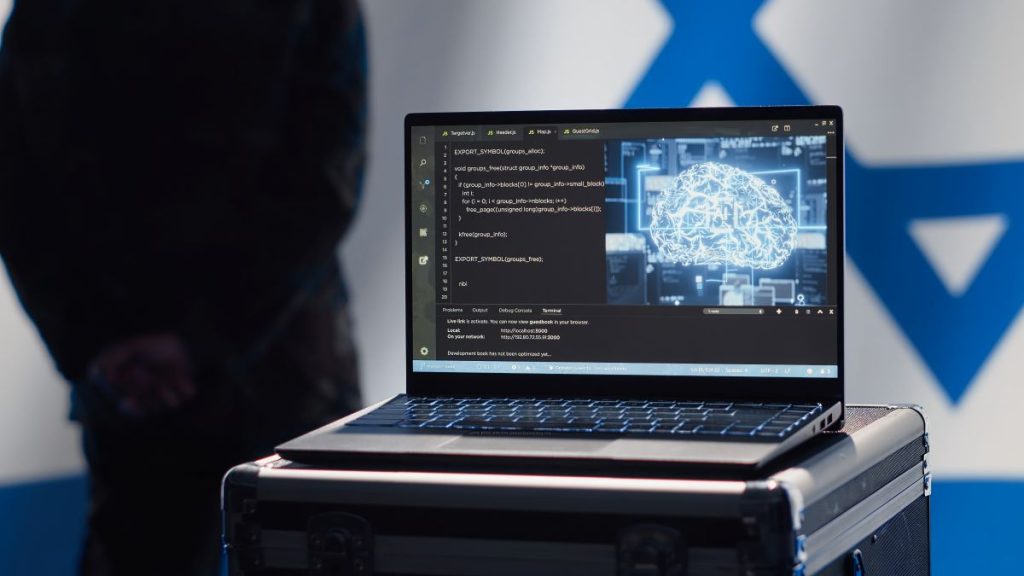
Military technology in Israel has developed to an intelligent digital brain, where Silicon Valley tech giants supply the basic digital drive for cloud computing and AI to identify, store, and execute high-stakes military operations in Iran, Lebanon, Syria, Yemen, and Gaza.
While the technology in Israel has long been a source of global innovation, the current shift toward AI-driven military operations marks a fundamental change in the nature of conflict. As Silicon Valley’s most powerful tools move from the office to the front lines, the digital systems managing the data are becoming as critical as the hardware on the ground.
This transformation begins with the massive digital infrastructure that allows for the collection and processing of millions of data points every single day.
The Architecture of an AI-Powered Battlefield
The basis of modern warfare is based on capacity to process vast amounts of information. The military is able to get this through the Google Israel deal, also known as Project Nimbus.
The $1.2 billion contract, shared with Amazon, provides the endless storage needed for petabytes of surveillance data. The Amazon cloud Israel servers act as a massive digital library, storing everything from satellite imagery to intercepted communications collected across the region.
This enables the military to automate the identification and prioritization of the targets, something that was not possible on the scale that the military desired. According to internal reports, Google employees have reportedly assisted Israel’s military in accessing the company’s AI tools, further blurring the line between commercial software and combat.
The Azure cloud Israel enables the military to immediately transcribe and translate audio messages, cross-checking them against internal data to identify the location.
From Data Storage to Lethal Execution
Once the data is stored, the focus shifts to identifying individuals. The OpenAI Israel collaboration has seen a significant spike in the use of advanced models provided through Microsoft’s Azure platform.
The connection between ChatGPT and Israel highlights how commercial tools, originally built for civilian tasks, are now being adapted for national security use cases. These models help analyze the emotional tone of communications and search for specific patterns within massive text troves.
The technology in Israel is then optimized for the final strike by Palantir. Known as the most transparent partner in these operations, Palantir’s software helps determine the most effective time for an execution.
This deep connection within the Israel Silicon Valley ecosystem has raised concerns about the ‘human in the loop.’ One intelligence officer noted the speed of the system, stating that while it used to take a team of 20 people a day to approve a single strike, the military is now approving hundreds a week with the help of AI.
Ethical Ripples and the Human Cost
The rapid growth of technology in Israel has caused a stir within the global headquarters of these firms. Many see the Israel Google deal as a turning point in how private companies participate in warfare.
As the Israel Silicon Valley ties strengthen, employees have voiced fears over the ethical implications of their work.
“It seemed to be more and more obvious that we are literally just trying to design something where we won’t have to care about how our clients are using it, and if they’re using it unfairly or unethically,” former Google software engineer Emaan Haseem, who was fired after protesting the war, remarked.
Despite the OpenAI Israel collaboration and other partnerships, the risk of machine errors – mistranslations- remains a haunting reality.
In some cases, the system misidentified a list of high school students as potential militants because of a label on an Excel spreadsheet. Ultimately, the technology in Israel continues to reshape the rules of engagement.
As the Israel Silicon Valley becomes more embedded in military strategy, the line between a software company and a defense contractor continues to blur, proving that code can be just as impactful as any physical weapon.
Inside Telecom provides you with an extensive list of content covering all aspects of the tech industry. Keep an eye on our Tech sections to stay informed and up-to-date with our daily articles.