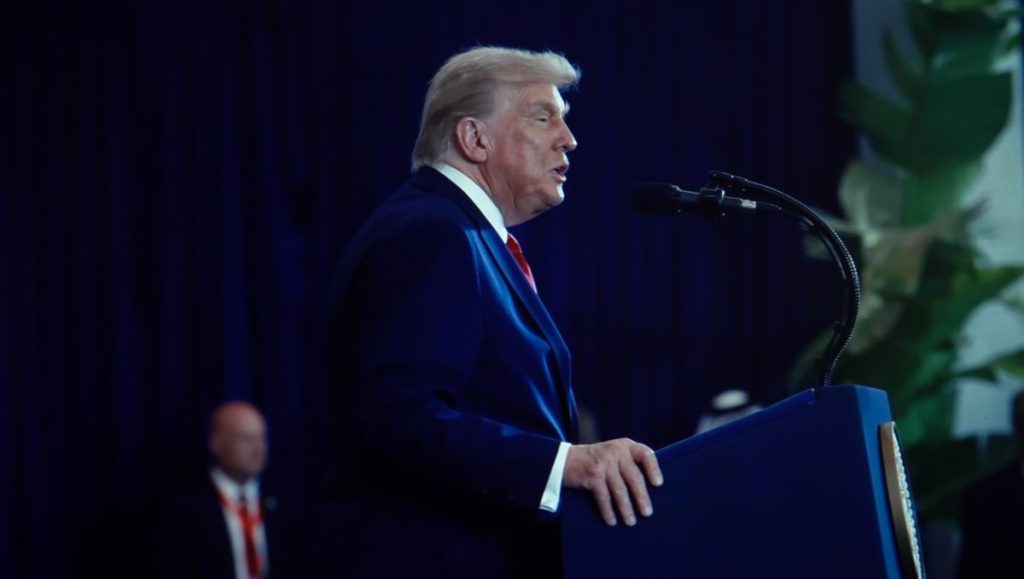
In the past, the Middle East has been redrawn by oil, by war, by the drafting table for diplomacy of distant powers with proximate interest. Now, the region’s redrawing is done in server racks and semiconductor agreements between the US and the Gulf Council Cooperation (GCC). The architect of the AI-driven GCC operations is, improbably enough, President Donald Trump.
Last spring, the Trump visit to Middle East specifically to Riyadh with some of Silicon Valley’s most important executives to secure multibillion-dollar deals to boost AI-driven GCC operations.
The deals finalized in the wake of the second Trump administration’s Riyadh engagement not the matters of historic realignment.
Data centers, energy contracts, sovereign wealth commitments became the language of the visit. The main tone was US-KSA corporations, with a strategic architecture of Saudi Arabia and the United Arab Emirates (UAE) becoming the hardware and energy corridor through which the next-generation of American AI will flow.
President Donald Trump’s Gulf AI Fortress was designed as much to contain any Iranian technological ambition as to advance the US and GCC’s quarterly earnings.
Less than a year later, on March 1st, drones and a plethora of missile strikes attributed to the Iranian Revolutionary Guard Corps (IRGC) hit Amazon Web Services (AWS) data centers in the UAE and Bahrain, disrupting cloud infrastructure and push regional wars into the digital domain.
These hits were the very first kinetic military strikes on a hyperscale American cloud provider, targeting the UAE’s ME-CENTRAL-1 and Bahrain’s ME-SOUTH-1 regions, causing failures in multiple availability zones, affecting agentic AI in GCC ecosystem.
The IRGC strikes on Gulf territories effectively bypassed standard redundancy models, knocked services for major regional banks, such as Abu Dhabi Commercial Bank (ADCB) and Emirates NBD – one of the largest banking groups in the Middle East in terms of assets.
Analysts warn that while the region’s ambitions remain intact, the war has introduced a new layer of geopolitical hurdles that could affect also the flow of Saudi AI investment in the region.
President Trump’s logic is not hard to follow. AI-driven GCC operations for Silicon Valley means delivering to the Big Tech executives what AI infrastructure desperately needs in almost embarrassing abundance: land, money, energy, and a monarchy class whose appetite to be relevant in the eyes of the US in the post-oil century has made it a remarkable willing partner for Washington.
President Trump’s view of the Iranian war frames AI-driven GCC operations as a new theater of warfare. By traditional combat, power now moves to those controlling data processing and decision systems to define targets, launch cyberattacks and set the global narrative.
When AI Ambitions Collide with War
Trump’s 2025 Middle East AI tour was designed to position the Gulf as a global AI powerhouse. Flanked by figures such as Sam Altman and Andy Jassy, the Trump praised a region “forging a future where the Middle East is defined by commerce, not chaos.”
The Trump and Middle East AI strategy trip resulted in sweeping agreements, where Saudi Arabia AI efforts mean putting tens of billions toward infrastructure, while the AI UAE vision secured a deal to build one of the largest data center complexes outside the US.
Microsoft, Google, and Nvidia also expanded their regional footprint, drawn by cheap energy and vast land with two critical components for powering AI systems.
Research firm Gartner projected that Middle East technology spending would hit $155 billion by 2025, with data center investments surging nearly 70% year-over-year (YoY). The Gulf’s strategy was crystal clear, which is to leverage oil wealth to dominate the next technological frontier.
Iran’s warnings about targeting “enemy technological infrastructure” have become a reality. Amazon has acknowledged disruptions to its operations in Bahrain, following similar attacks that occurred in the not taking into consideration the UAE AI investment.
These incidents highlight a vulnerability previously overlooked physical attacks on AI and GCC digital infrastructure.
“The war is leaving data center investment up in the air,” said Ginger Matchett of the Atlantic Council. “Protection of data centers to date has largely focused on preventing cyberattacks, not drone or missile attacks physically damaging the infrastructure.”
A New Kind of War, a New Kind of Risk
The escalation shows a bigger transformation in modern GCC tech wars. Data centers seen once as neutral commercial assets are now strategic targets. These infrastructures pinpoint everything, from the engines of finance to the frameworks of national defense. Consequently, they represent crucial battlegrounds in both economic and military rivalries.
Beyond direct attacks, the GCC tech wars is a threat to essential resources that sustain Middle East AI operations. Data centers require large amounts of electricity and water, making them dependent on stable energy supplies and desalination plants both of which are vulnerable in a prolonged war.
“They’re very resolute that the show is going to go on,” said Marc Einstein of Counterpoint Research. “The future is still very bright for AI in the region, but timelines may have been impacted.”
Matt Garman, head of AWS, said he remains “as bullish as I ever have” on Middle East investments. Ultimately, the AI-driven GCC operations will depend on the duration of the war, and as things progress, projects may be delayed. A prolonged war will force US giants to retreat to the drawing board.
“If it’s elongated, they’re going to have to go to the drawing board, delay plans and look to curtail other plans… because this was never on the roadmap,” said Wedbush analyst, Dan Ives.
What is crystal clear, however, is that the GCC generative AI in data analytics market race is no longer just about innovation or economic diversification. It is unfolding at the intersection of geopolitics, Middle East AI infrastructure, and digital power where the next phase of global competition may be decided not only on the battlefield, but inside the servers that run the modern world.
Inside Telecom provides you with an extensive list of content covering all aspects of the tech industry. Keep an eye on our Intelligent Tech sections to stay informed and up-to-date with our daily articles.