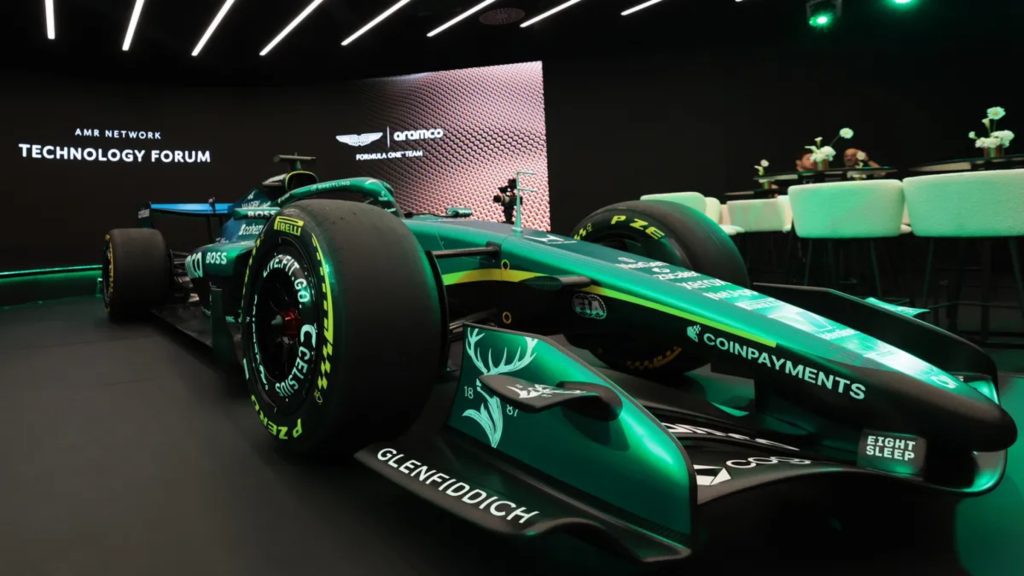
On July 3, ahead of the British Grand Prix, Aston Martin hosted a Technology Forum at Silverstone, demonstrating F1 technology and how AI, cloud computing, and data partners are helping the team improve race decisions, car development, and human performance.
The event showed how fast Formula 1 is becoming a technology race as much as a sporting one. Aston Martin used its home Grand Prix weekend to bring partners closer to its team, while explaining how digital tools are now shaping decisions inside the factory and at the circuit.
AI Moves Deeper into F1 Race Decisions
Aston Martin brought together 10 partners at its AMR Technology Campus, including CoreWeave, Zscaler, Cohere, ServiceNow, Cognizant, Cognition, NetApp, Xerox, Arm and Eight Sleep. The forum also marked the launch of the AMR Network, a platform built to connect the team’s partners around business, technology, and new ideas.
The team has spent millions on its Silverstone campus, including a modern simulator and wind tunnel. These tools create huge volumes of data, and F1 technology is now needed to process that information quickly enough to support the car’s development.
“Most people think of AI as pattern recognition combined with an internet search,” Aston Martin team boss Adrian Newey said ahead of the forum. “What we’re doing is using AI and machine learning in very specialized roles that don’t rely on the internet at all.”
The AI use in Formula 1 at Aston Martin is focused on the team’s own data, including wind tunnel results, CFD information and track performance. Before a race weekend, Aston Martin can simulate between 10,000 and 100,000 race scenarios.
Each car can produce 50 billion sensor data points during a weekend, while around 1.5TB of data moves between the track and Mission Control at Silverstone.
This is where F1 cloud solutions become important. The team needs fast data transfer, storage, and processing with very little delay, because strategy calls can change within seconds during a race.
Cloud Partners Build the New Racing Network
The wider AI in Formula One story is not only about the car. It is also about how teams manage people, systems, security, and operations. Aston Martin’s partner network shows how Formula 1 teams are becoming technology platforms.
Arm supports the silicon layer, CoreWeave provides computing power, NetApp moves and stores data, Cohere supports sovereign AI, and Zscaler strengthens cyber protection. ServiceNow, Xerox, Cognizant, and Cognition also support different parts of the team’s digital structure.
For Aston Martin, F1 cloud solutions are part of the same performance chain as aerodynamics and race strategy. A delay in data, a weak system, or a missed pattern can affect how quickly engineers react.
“In technology, you talk about AI in terms of with AI. We can outsource intelligence, [but] we can’t outsource the experience,” Aston Martin’s Commercial Technology Ambassador Eric Ernst said. “The experience is still with the team, the people.”
He said AI gives the team cognitive scalability, helping people do more work without replacing their knowledge. That point also reflects the wider growth of Formula one technology, where digital systems support human judgement rather than remove it.
The fan side is also changing. On March 3, salesforce and Formula 1 launched an AI fan agent on F1.com to help fans understand the new 2026 regulations. The move showed how technology in Formula one is expanding from the garage to the global audience.
The Formula one AI strategy now reaches performance, operations and fan engagement. For Aston Martin, the next race will not be won by data alone, but by how quickly people and machines can turn that data into better decisions.
The team’s work with Eight Sleep also shows how AI in Formula one is moving into recovery. Rafael Oliveira, vice president of international marketing and partnerships at Eight Sleep, said over 70% of the grid uses our product.
With more races, travel and pressure, recovery has become part of F1 technology. Eight Sleep says its system can improve deep sleep and overall sleep quality by adjusting temperature and tracking rest.
The second AI use in Formula 1 is machines helping teams prepare the car, but they also help protect the people behind it.
Aston Martin showed at Silverstone that F1 cloud solutions and AI are no longer side tools. They are becoming part of the sport’s engine, making F1 technology a race of data, speed and human experience.
Inside Telecom provides you with an extensive list of content covering all aspects of the tech industry. Keep an eye on our Intelligent Tech sections to stay informed and up-to-date with our daily articles.