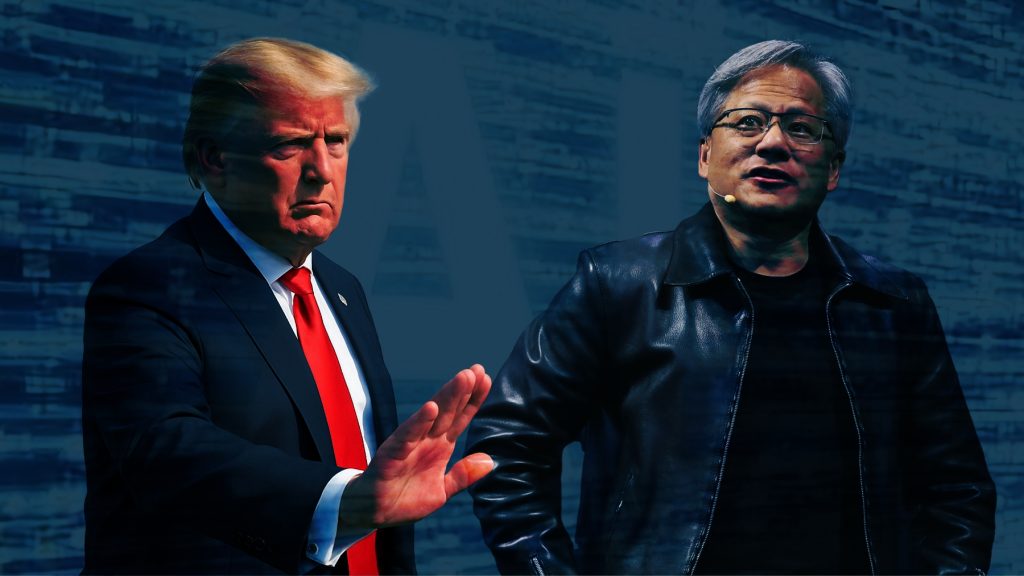
On September 14, Nvidia CEO Jensen Huang took a phone call from President Donald Trump onstage at the All-In Summit in Los Angeles, in which the two chiefs dismissed calls from competitor AI executives on AI slowdown, hours before a broad selloff in chip stocks dragged Wall Street lower.
Huang, appearing at the conference alongside venture capitalists, including Chamath Palihapitiya, Jason Calacanis, and White House advisers David Sacks and David Friedberg, put President Trump on speakerphone for the audience, after he called him directly on his cell.
The exchange followed an onstage discussion of Anthropic CEO, Dario Amodei’s public call to “slow the frontier” of AI capability improvements, a stance that OpenAI Sam Altman and xAI Elon Musk chiefs have also voiced support for in recent days.
Huang’s response
Huang’s stance in front of industry leaders puts his Tech Giant Nvidia firmly against an AI slowdown. Inevitably, turning the safety debate into a question about computing demand.
A Safety Debate Meets a Hardware Economy
For Nvidia, AI slowing down is also a business question. Its chips sit at the center of the infrastructure boom. Slower model development could weaken demand for data centers, larger clusters, and hardware upgrades.
“They’re just playing right in the hands of a lot of people that don’t want to see it happen,” President Trump told Huang over the phone, adding, “That could be political people. It could also be China. And we’re not going to let that happen. It’s a hoax.”
Huang replied, “You’re right. We’re not going to let that happen, sir.”
The Nvidia CEO response to the President drew applause from the crowd.
The interaction – which might have been intentional, staged, and not organic at all – matters because AI progress is tied to computing, and the stock market. Models need processors, memory, networking and electricity, so the faster frontier systems advance, the stronger the case for companies to keep buying newer hardware.
The onstage moment bulldozed the stage as Wall Street registered a sharper reaction to safety warning from AI industry chiefs than the President and Huang’s public bravado suggested, demonstrated how sensitive that model is.
On Monday, US stocks fell broadly, with Nvidia shares dropping 3.4%, Micron Technology falling more than 5%, and Broadcom and Advanced Micro Devices each declining more than 4%.
The reaction does not prove an AI slowdown is on the door, but caution influences investor’s expectations.
An AI investment slowdown would spread beyond model developers. Chipmakers, cloud providers, data-center builders and energy companies have expanded around rising demand.
President Trump, in the same call, acknowledged public unease over the speed of AI infrastructure buildout, saying, “We have to be a little bit careful… We have to do things and we have to do them prudently, but that doesn’t mean we’re going to stop at an industry.”
On the same day, the Philadelphia Semiconductor Index tumbled 5.9%, by extension, trimming its gain for the year to 57%. Investors were also at unease by the benchmark 10-year Treasury yield briefly topping 5% for the first time since 2023 ahead of a Federal Reserve meeting – where markets were pricing in a roughly 90% chance of a rate move.
If spending decreases, the industry will face a challenge to prove its infrastructure can create lasting value. The President framed the issue through the AI race between US and China.
Speed, in this view, becomes a national strategy, and the US AI race gives Nvidia’s position a heftier weight in the global competition.
When advanced chips become strategic assets, calling for limitations is seen as a competitiveness risk, even when they come from big companies building frontier models.
Competition Growing Beneath Nvidia
On another note, Samsung’s backing of startup Euclyd shows another path. Its $231million round supports an inference system using a different architecture from Graphics Processing Units (GPUs).
A global AI slowdown may not stop chip innovation; but it could redirect investment toward efficiency. Euclyd argues that AI progress depends on better infrastructure.
“AI is becoming a foundation of economic growth, scientific discovery and national competitiveness, but its potential will remain constrained unless we fundamentally change the infrastructure beneath it,” said CEO, Bernardo Kastrup.
If AI slowing down means fewer training runs and more efficient inference, Nvidia could face pressure from systems using less energy and costing less. Euclyd plans to sell hardware and license its technology, with systems targeted for 2028.
That makes resistance to an AI slowdown more complicated than a defense of innovation. Nvidia may believe development benefits the economy, but its business also benefits when AI companies feel pressure to buy more compute before rivals do.
Supporters of the slowdown challenge the assumptions behind the AI race between US and China. Amodei has argued that chip controls and limits on model distillation will eventually slow Chinese capabilities while giving US developers bonus time to improve safety without surrendering their lead.
Is the US winning the AI race?
The question cannot be answered by chip spending alone. Leadership depends on energy, efficient systems, public trust, and whether communities accept the data centers required to keep expanding AI infrastructure.
“We have to do things and we have to do them prudently, but that doesn’t mean we’re going to stop an industry,” President Trump told Huang.
At the end, the deeper issue remains whether technological progress requires permanent urgency and endless computing demand.
Inside Telecom provides you with an extensive list of content covering all aspects of the tech industry. Keep an eye on our Intelligent Tech sections to stay informed and up-to-date with our daily articles.