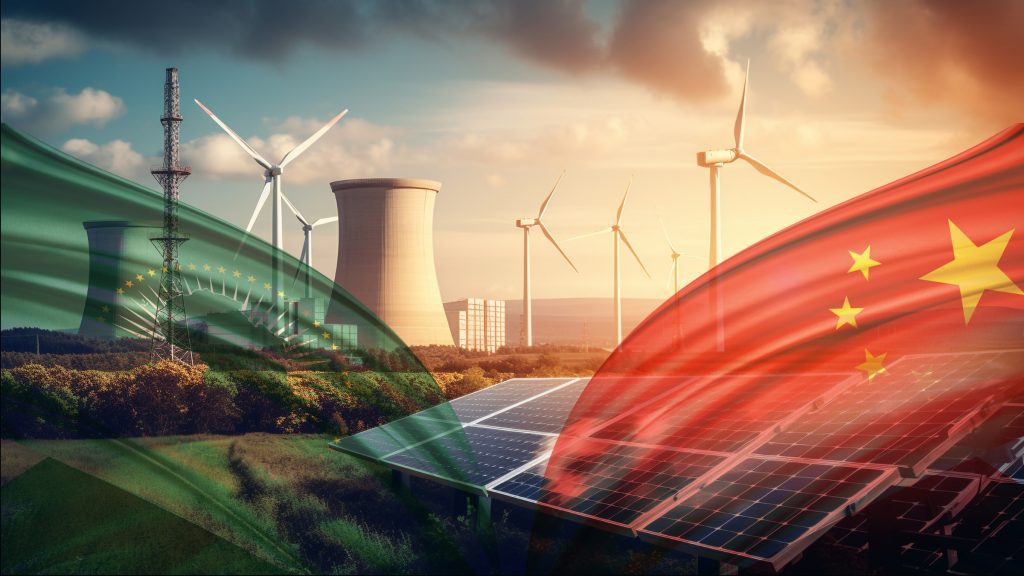
On May 1, Beijing activated a zero-tariff policy covering 53 African countries, making it the most visible marker of a much broader recalibration that most definitely should not be misread as retreat of any China investments in Africa.
Since its 2018 peak, direct China investments in Africa for traditional infrastructure has dropped by 67% – collapse in capital deployment that highlight both the debt sustainability fears that soured recipient governments on megaproject arrangements.
It’s also Beijing’s own reassessment of where its comparative advantage now lies. The time of Chinese-financed African megaprojects is quietly closing. In its place, Africa will witness megaprojects’ replacement with smaller, cleaner, and considerably more strategic projects.
And the answer for all that is, simply put, clean technology.
Last autumn, Chinese companies and officials and business leaders from 16 African countries met in Beijing to increase the flow of China investments in Africa in renewable energy and digital infrastructure. Projects ranging from solar systems to electric mobility are reshaping China’s long-term economic and strategic engagement across Africa.
The continent will experience – if not already – a shift in the China in Africa strategy, moving from massive infrastructure lending toward more selective partnerships on renewable energy, technology transfer, and local skills development.
Previously, China’s investment in Africa centered on railways, highways and state loans. Now, the new phase prioritizes clean energy, vocational training, and digital systems.
Through the South-South Cooperation Renewables Center, China is accelerating exports of off-grid solar systems, clean cooking infrastructure, and electric vehicle (EV) into markets where grid access remains unreliable and internal combustion alternatives are losing ground to economic rather than ideology.
China’s relationship with Africa is shaped by the continent’s energy demand, China’s domestic economic slowdown, African markets’ growing debt, and the geopolitical competition from the US and Gulf-backed investment initiatives in the African continent.
Build Fewer Bridges. More Solar Panels. Same Ambitions.
When it comes to Africa, Beijing’s logic is very simple. By embedding Chinese clean-tech hardware into Africa’s energy transition at the infrastructure layer, Beijing secures a plethora of services that are later molded into partnerships between China and the African continent.
China’s Investment in Africa helps Beijing secure supplier relationships, manufacturing dependencies, and simultaneously, political goodwill. All that, at a mere fraction of the balance sheet exposure that stadium construction and railway financing once required.
Renewable energy is now the strongest pillar of most China investments in Africa. Chinese companies and industry groups are promoting off-grid solar, battery storage, clean cooking technology and electric transport to countries struggling with energy shortages and power infrastructure.
At the Beijing exhibition, African officials were introduced to projects involving solar-powered agriculture, vehicle-to-grid models and distributed power networks designed for local market conditions.
China’s relationship with Africa with efforts are being coordinated through programs such as the South-South Cooperation Renewables Centre and the China-Africa Renewable Energy Partnership, which aim to connect the demand in China Africa cooperation manufacturing and technical expertise.
“Africa doesn’t need to follow the same path of polluting first then cleaning up later. It can skip that stage, leapfrogging directly to distributed solar and energy storage,” said Li Dan, secretary-general of the China Renewable Energy Industries Association.
Slower economic growth and oversee debt concerns have made Beijing cautious about large-scale lending abroad. Instead of funding giant infrastructure Africa and China trade projects, Chinese companies are now focusing more on smaller, commercially sustainable opportunities.
“Plugging these energy gaps will be critical. Why not prioritize renewables, clean energy technology, as well as climate-friendly infrastructure, given their increasingly competitive price points?” said Rugare Mukanganga, an analyst at Development Reimagined.
The strategy also involves improving communication between China investments in Africa. Chinese companies have often struggled to understand local regulations, financing systems and consumer demand across African markets.
In response, China Africa cooperation groups are creating investment bulletins, policy trackers and business exchange programs for countries including Kenya, Rwanda and Ethiopia.
At the same time, African governments and businesses are learning more about China’s renewable energy ecosystem and manufacturing capabilities, especially in solar where Chinese suppliers already dominate many African markets.
From Infrastructure Lending to Selective Cooperation
For the first time in 2026, African countries are sending more money to Chinese creditors than they are receiving in the new loans. It’s a net reversal that reframes the entirety of China strategic reset as a portfolio management instead of a generosity.
Beijing is not expanding its African exposure but rather restructuring it toward higher returns and lower risks.
The China Africa cooperation has changed significantly since its investment peak around 2018. However, foreign direct into the Africa China investment later dropped sharply as Beijing faced mounting economic pressure at home.
Debt risks are also becoming a growing concern for China.
Repayment pressures in countries like Zambia and Ethiopia on infrastructure projects have made Chinese lenders more cautious on extending new loans. Simultaneously, US and Europeans countries, as well as Gulf investors are increasing competition by offering alternative financing models for infrastructure development.
Still, China investments in Africa dominate the continent’s tech and infrastructure sectors, maintaining major roles in telecommunications and connectivity. Huawei’s extensive construction of 4G networks specifically gives Beijing a powerful influence over the continent’s digital expansion.
The zero-measure tariff measures extended for 20 non-least-developed countries – with sufficient economic complexity to negotiate from a position of strength – the arrangement is not permanent. It’s only a two-year preferential rate, extended while Beijing concludes an Economic Partnership with Shared Development agreement with each government.
But the most influential integration birthed from the China relations with Africa is not happening above ground, but below it.
Africa is rich in natural resources, and its reserve of lithium, cobalt, manganese, and rare earth elements are the missing elements in China’s battery supply chain that currently controls processing but not all of its feedstock.
Beijing’s energy pivot is strategically calculated to fit the gaps in China’s supply chain hold, and its green pivot is less an act of climate solidarity than it is vertical integration strategy.
Financing renewable energy projects in Africa is still difficult due to currency instability and weak investment environments.
“High costs of capital get in the way of many growth opportunities across the continent,” Mukanganga said.
As for Beiing’s efforts, the results are already visible. Large solar installations in South Africa, for example, and EV conversion in Namibia are already establishing China’s clean-tech as the continental standard.
The China and Africa relationship is embedding hardware, software, and maintenance dependencies before European or American alternative have achieved meaningful scale in the continent.
China investments in Africa are therefore not disappearing but evolving.
Inside Telecom provides you with an extensive list of content covering all aspects of the tech industry. Keep an eye on our Tech sections to stay informed and up-to-date with our daily articles.
