
Almost two-thirds of organizations in a survey by digital managed service provider, Logicalis, lack mature around-the-clock security operations. Almost three-quarters aren’t using automated threat intelligence rigorously, even as AI shortens the time between a software flaw being found and exploited.
On October 1, Logicalis published “Closing the Security Maturity Gap” study based on 357 IT responses and security professionals across Europe, the Middle East and Africa (EMEA), and Asia Pacific.
Logicalis’ study suggests the real weakness is no longer access to security technology, but the ability to connect it into a working operational model, showing enterprise cyber readiness trailing security investment, as automated threat intelligence became more valuable for organizations trying to respond at machine speed.
It measures maturity in six areas: ownership, 24/7 response, visibility, detection, incident readiness, and access to outside expertise.
What the Study Found
Companies are spending more on cybersecurity capabilities. Yet, investment isn’t automatically translating into faster detection, stronger after-hours response, or better recovery.
The clearest weakness appears outside working hours.
- Staffing and Ownership
About 41% of the study’s respondents have a security function separate from IT, and another 24% have dedicated security leadership that overlaps with IT. Some 36% still manage security mainly through IT teams, and 26% have no dedicated security teams.
Only 28% have ten or more security professionals, while 39% say they handle daily security well but struggle with emerging threats. Just 34 say they are fully resourced and proactive.
- 24/7 Response
Some 36% run fully operational 24/7 security operations with dedicated staff. Of the remaining 64%, only 17% rely on rotating on-call teams and 31% monitor outside business hours but have limited ability to respond.
16% don’t monitor or respond after hours.
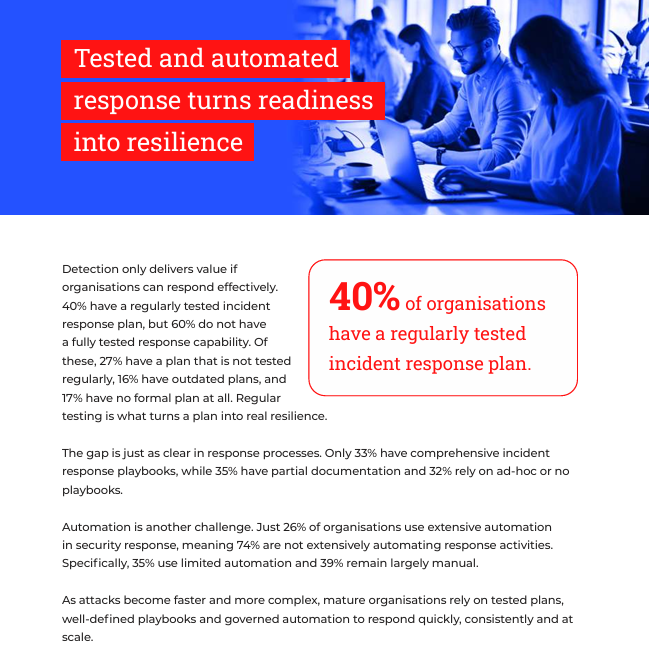
Beyond organizations using extensive security automation, 35% use limited automation in response activities, while 39% remain largely manual.
Incident response planning is similarly uneven. Some 27% have plans that are not regularly tested, and another 16% rely on outdated plans. Effective automated threat intelligence therefore has limited value if organizations have not established what should happen after a threat is confirmed.
Response speed also depends on knowing what needs to be protected. Stronger telemetry integration can help connect security activity to assets, ownership and business risk.
- Visibility
Some 45% of organizations keep asset inventories manually, and 14% have only partial visibility, and 8% keep no inventory whatsoever. Only 1% have comprehensive automated inventories.
For monitoring, 33% use centralized security information and event management (SIEM) or extended detection and response (XDR) platforms with automated correlation.
Another 27% have such tools with limited visibility, 24% collect logs but can’t correlate them effectively, and 14% rely on locally-stored logs.
SIEM automation helps security teams process large volumes of events without requiring analysts to examine every signal manually. Adoption of XDR automation shortens the path between identifying suspicious behavior and acting, but automation still needs clear rules and human oversight.
Visibility gaps extend across cloud services, Software as a Service (SaaS) platforms, remote endpoints, and third-party infrastructure. Better cloud security telemetry can give analysts a more continuous picture of activity across environments that traditional asset lists struggle to capture.
This is where log correlation tools become important: raw events have little operational value if relationships between them cannot be identified quickly.
Overall, 65% lack fully integrated and automated security telemetry. Improved telemetry integration could connect endpoint, identity, network and application signals, allowing teams to build context around an incident rather than investigating isolated alerts.
- Detection and Response
Some 40% use live automated threat intelligence platform of some kind, while 12% have no threat intelligence capability.
For detection, 28% use A-driven behavioral tools and 45% combine signature-based and anomaly detection. Under that umbrella, only 28% are confident in telling real threats from false positives.
On response, 40% have a regularly tested incident response plan and 17% have no formal plan. Just 33% have comprehensive playbooks, and 26% use extensive automation in security responses.
- Ransomware Preparedness
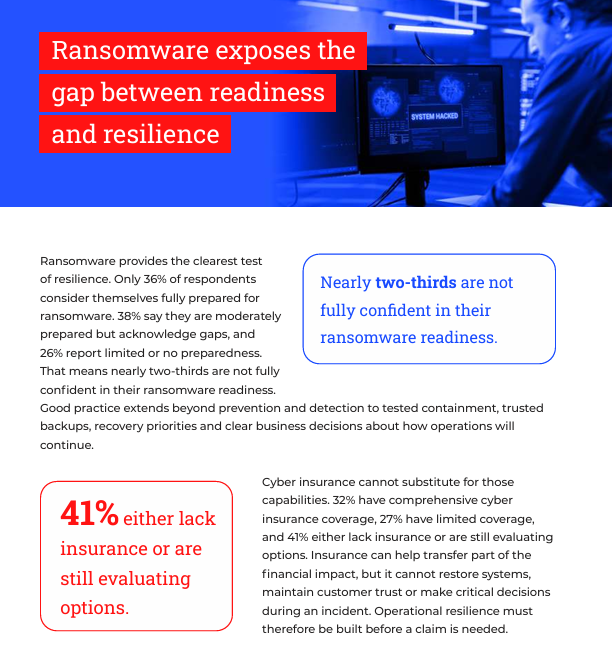
Only 36% consider themselves fully prepared, and 38% say they are moderately prepared with gaps, and 26% report limited or no preparedness.
On insurance, 32% have comprehensive cyber coverage, 27% have limited coverage, and 41% either have none, or are still evaluating their options.
Against ransomware, better XDR automation can support faster containment, but recovery still depends on tested procedures, trusted backups, and clear business decisions.
The problem becomes sharper as AI reduces the time between vulnerability discovery and exploitation. Automated threat intelligence alone cannot compensate for response processes that remain slow or dependent on manual decisions.
An automated threat intelligence platform can enrich alerts, but it cannot solve fragmented operations by itself. Log correlation tools can reduce some of the noise by connecting related events, but poorly integrated systems can still overwhelm analysts with separate warnings about what is effectively the same attack.
The role of automated telemetry is therefore not simply producing more security data. Its value lies in continuously giving analysts enough context to decide which signals require immediate investigation.
Security Maturity Depends on Connection
According to the Logicalis findings, cyber maturity cannot be measured by budget size or product count. More SIEM automation may improve detection of workflows, but adding another security layer without fixing the operating model creates another isolated source of information.
Similarly, an automated threat intelligence solution is most useful when intelligence feeds directly into detection, prioritization and response rather than sitting in a separate dashboard that analysts must interpret manually.
“The organizations closing the security maturity gap are not necessarily those investing the most, but those connecting people, processes and technology into a coordinated operating model,” said Artur Martins, Chief Information Security Officer (CISO) at Logicalis Portugal.
Martins’ argument shifts the discussion from cyber spending toward the quality of execution.
That distinction matters as automated threat intelligence pushes defense closer to machine speed. Modern security is no longer about accumulating standalone software. Tested processes, skilled people, and tools combining network telemetry and automated responses must work as parts of the same operating system.
The real advantage, then and now, is coordination.
Organizations capable of connecting security data, decision-making, and response will be better positioned to keep pace with AI-enabled attacks than those relying on investment alone. Modern cyber resilience comes from an adaptive operating model in which technology accelerates human judgement instead of adding more noise.
Inside Telecom provides you with an extensive list of content covering all aspects of the tech industry. Keep an eye on our Intelligent Tech sections to stay informed and up-to-date with our daily articles.
