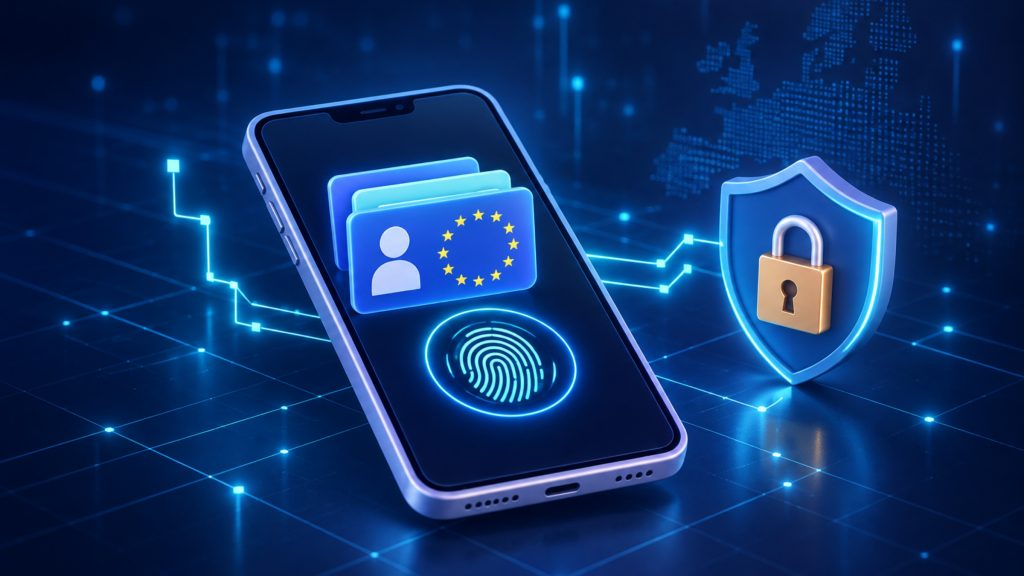
On September 16, the EU set a deadline by December 24, for member states to offer a certified European digital ID wallet, giving citizens an advanced way to store credentials, verify identity, access services, and share personal data securely online.
The suggested system wants to make identification easier without replacing paper documents. Despite the governments’ preparations for their apps, usual questions around privacy, cybersecurity and whether every country will be technically ready remain a center of concern.
One Wallet, Multiple Digital Credentials
The European digital ID wallet is being developed under the updated eIDAS framework. Each member state must provide at least one wallet using shared technical rules for cross-border use.
With an EU digital wallet, one can hold national ID information, driving licenses, university diplomas, health insurance records, and bank related credentials. The wallet supports electronic signatures for banking, jobs, and university enrollment abroad.
Additionally, a key part of the system is data minimization. The EU digital ID wallet should let users prove a fact without showing an entire identity document. For example, someone could confirm they are above the required age without revealing their full date of birth.
The EU digital identity wallets also use safeguards including selective disclosure, and issuer blindness. These are designed to limit tracking and stop organizations from building profiles around wallet use.
Thomas Lohninger, executive director of digital rights group epicenter.works, said users must remain in control.
“People should have the right to say no, to not share any information or to share it only selectively,” said Lohninger.
A digital ID wallet EU system is also expected to include a privacy dashboard showing which services accessed a user’s information. The wallet remains optional, and physical documents will continue to be valid.
The first EU digital wallet pilots involved hundreds of organizations and tested thousands of cross-border interactions. The trials examined whether credentials could be exchanged securely between different national systems.
The wider digital credentials wallet model could also reduce repeated document uploads. Verified information can instead come from trusted issuers and be shared digitally only when a service needs it.
Are EU Governments Facing Uneven Challenges?
The main challenge is whether the European digital ID wallet will launch evenly across the bloc. Interoperability depends on countries following the same standards and making compatible systems available at roughly the same time.
Only a small number of countries have reached advanced rollout stages.
Italy digital ID wallet program is among the most developed, with the country reporting millions of monthly users, while other governments are still testing systems or working through legislation. Germany is expected to launch after the EU deadline, while the Netherlands has also postponed its rollout.
That could make the EU digital ID wallet experience uneven at first, especially when citizens use credentials across borders. The second-generation using EU digital identity wallets will also see an impact on businesses.
Service providers will need systems that can request and verify standardized credentials without collecting more personal information than necessary. Meanwhile, private associations like banks face earlier compliance pressure because identity checks are linked to anti-money-laundering rules.
For a digital ID wallet EU deployment to work, banks must connect existing verification tools with the new credential infrastructure. Privacy groups, including European Digital Rights (EDRi), have warned that some draft rules could weaken safeguards, particularly if facial recognition becomes more widely required.
The debate shows that the European digital ID wallet is also a test of digital identity governance.
Centralization brings another technical concern. A digital ID wallet Europe model could place many important credentials on one device, making encryption, secure recovery and device protection essential if a phone is lost, stolen, or compromised.
“If you put all your eggs in the same basket, you hope that basket never breaks,” Lohninger described the risk simply.
The EU wants the European digital ID wallet to make identification easier across borders; therefore, its success will depend on whether governments can make the technology secure, private, and simple enough for citizens to trust.
Inside Telecom provides you with an extensive list of content covering all aspects of the tech industry. Keep an eye on our Intelligent Tech sections to stay informed and up-to-date with our daily articles.