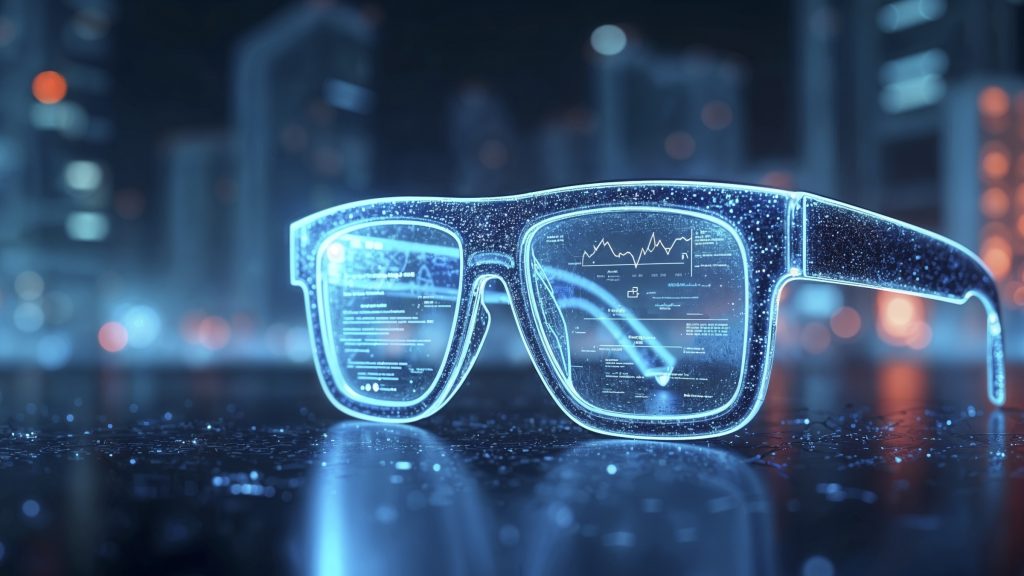
Israeli deep-tech startup, EyeJets, is developing screenless augmented reality smart glasses technology that projects images directly onto the retina, as global technology companies pivot toward eyewear as the next big computing platform beyond smartphones and virtual-reality headsets.
Consumer electronics companies reassess the limits of headsets and experiment with lighter, mixed-reality devices designed for everyday use. Investments accelerating, augmented reality smart glasses are appearing as a focal point for companies developing smart consumer wearables.
Big Tech giants, Meta, Apple and Google invest heavily in AR smart glasses and AI smart glasses. Most recent models still rely on lens-based displays, constrained by power consumption, weight and field of view, limiting the appeal of lightweight AR glasses for continuous use.
Retina projection and medical monitoring
Israel’s EyeJets is pursuing a different technical path from most of the industry, reshaping expectations for optical AR glasses and connected AR glasses. Instead of projecting images onto lenses, its system delivers visual information directly to the retina while continuously tracking eye movement, a requirement for keeping image stability as the eyes constantly move. This approach positions eyewear as more than display wearable tech, integrating visual computing with health data.
“Diabetes, hypertension, glaucoma and high cholesterol levels are just some of the conditions our technology can detect and monitor,” said EyeJets co-founder and chief executive, Edu Strul.
Because the retina is the only place in the human body where blood vessels can be seen directly, EyeJets’ technology continuously scans them for subtle changes. The capability expands the scope of biometric smart glasses, allowing early detection and diagnosis of disease.
“Many diseases cause measurable changes in blood vessels, so continuous monitoring enables early detection and diagnosis,” Strul said, adding that such tracking could reduce the need for repeated blood tests.
By combining tracking technology with spectroscopy, the system can identify substances within blood vessels themselves and monitor disease progression in real time, reinforcing the medical potential of biometric smart glasses.
Smart glasses gain strategic importance
EyeJets’ research coincides with industry shifts toward augmented reality smart glasses after years of uneven adoption of virtual reality headsets. Unlike headsets, smart glasses overlay digital information while users are still aware of their surroundings, making AI smart glasses and AR smart glasses more suitable for everyday use.
Major technology companies increasingly view eyewear as a potential successor to smartphones, and augmented reality smart glasses are moving from speculative prototypes toward a significant role in both consumer technology, signaling a broader redefinition of biometric smart glasses in daily life.
Inside Telecom provides you with an extensive list of content covering all aspects of the tech industry. Keep an eye on our Intelligent Tech sections to stay informed and up-to-date with our daily articles.