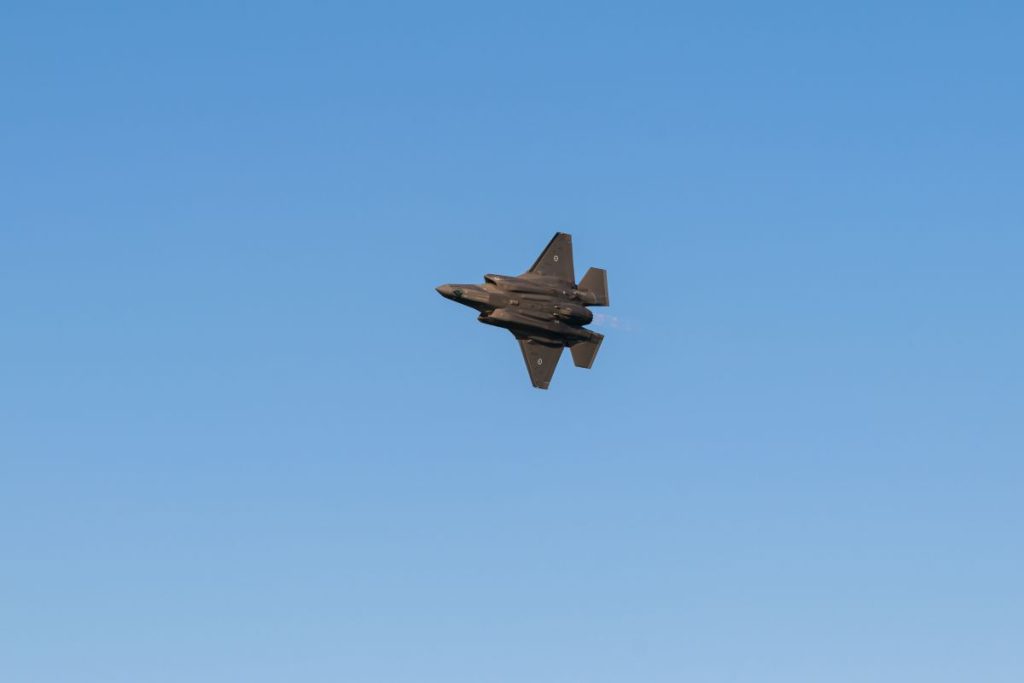
As war changes the Middle East game, Lockheed Martin’s aircraft is proving its dominance through successful combat missions, while simultaneously sparking a global debate over the delayed F-35 TR-3 Upgrade, American ‘kill switches,’ and the true meaning of national sovereignty.
The jet is much more than a fighter; it is a flying supercomputer. In the heat of recent operations, such as ‘Midnight Hammer’ and ‘Epic Fury,’ the Martin F-35 Combat performance acted as a high-tech vacuum, sucking up data from the battlefield to sharpen its own senses.
For manufacturers, these wars serve as a vital testing ground. Every mission provides data that helps engineers understand how to better train the aircraft’s AI and sensors.
This constant evolution is what keeps the jet ahead of its rivals, yet it also creates a complex web of dependency between the US and the nations that use the products.
A Technical Nightmare
While the jet thrives in battle, its internal military software is a battleground of its own. Experts who have worked on simulation projects point out that the jet’s greatest strength is also its biggest flaw: it was designed to be three different airplanes at once.
This created a tightly integrated system where a minor change for the Navy’s carrier version could accidentally break a feature for the Air Force’s model, further complicating the F-35 TR-3 Upgrade.
Technically, the jet is specifically designed to be unstably unflyable in the air with software to compensate. This instability allows for incredible agility, but it means the plane literally cannot stay in the sky without its fighter avionics working perfectly.
However, developing that code is a slow, bureaucratic process. Developers often work in high-security rooms without internet access, sometimes forced to use basic tools like Notepad.
As one former insider noted, the military software is subject to extreme requirements above most other projects. Because the hardware must be made in the US and survive radiation, the chips inside are often decades behind consumer tech.
“You can find Arduinos with more processing power,” one Reddit user shared, highlighting the massive hurdle of running advanced AI on 80386 chips from the mid-80s.
This highlights why the F-35 TR-3 upgrade has been such a massive undertaking for the engineering teams.
Sovereignty and the Jailbreak Debate
This technical lag has fueled a mid-life crisis for the fleet. The latest software shift was meant to provide computational horsepower for the long-awaited F-35 Block 4 Capabilities.
Instead, a Pentagon report found that updates have stagnated, describing the new military avionics as predominantly unusable due to stability problems.
For international partners, this reliance on American-made military software feels risky. Dutch State Secretary for Defense, Gijs Tuinman, recently stirred controversy by suggesting a radical backup plan.
“If, despite everything, you still want to upgrade… you can jailbreak an F-35 just like an iPhone,” Tuinman said.
His comments reflect a growing fear that a lack of progress on the F-35 TR-3 upgrade could leave allies vulnerable. However, countries like Switzerland are standing their ground regarding their military avionics systems.
A report by Switzerland’s Federal Department of Defense recently clarified that a ‘remote control’ or ‘blocking’ of the F-35A jets is not possible, insisting they can operate their fleet autonomously, independently, and at any time.
Even as Europe becomes more crowded with these jets to access the F-35 Block 4 Capabilities, the debate remains: is the jet a tool of national defense, or a digital tether to Washington?
As Tuinman admitted, despite the drama surrounding the F-35 TR-3 Upgrade, in its current state, it is still a better aircraft than other types of fighter jets.
Inside Telecom provides you with an extensive list of content covering all aspects of the tech industry. Keep an eye on our Tech sections to stay informed and up-to-date with our daily articles.