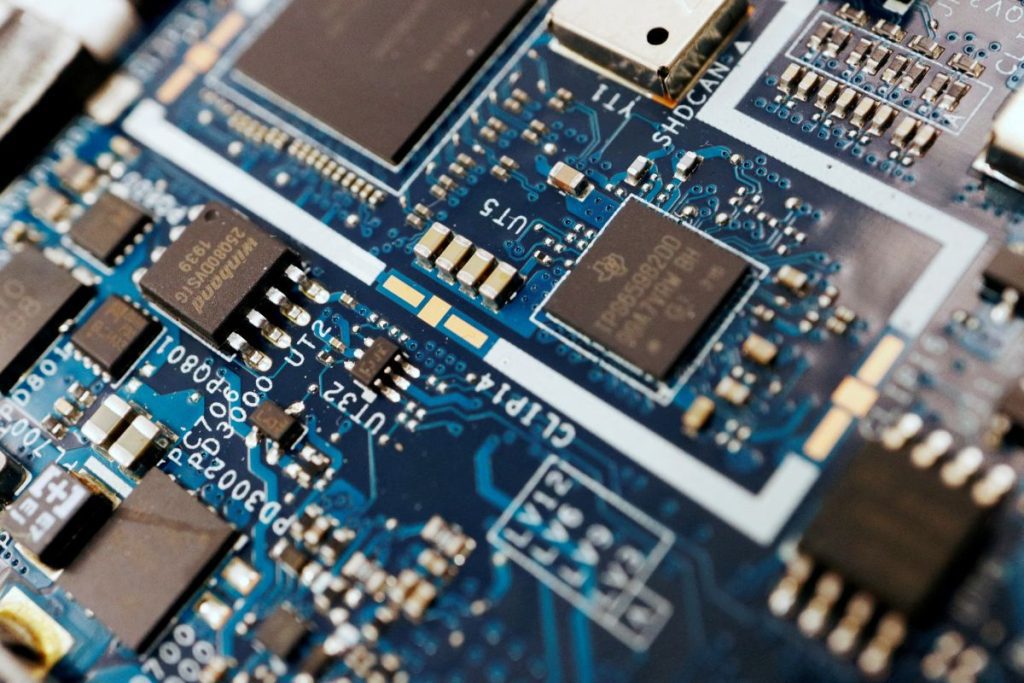
 Credits: Reuters
 Taiwan aims to build a “democratic” high-tech supply chain with the United States and form a strategic AI partnership under the new tariffs deal it sealed with Washington last week, Taipei’s top negotiator in the talks said on Tuesday.
U.S. President Donald Trump has pushed the major producer of semiconductors, which runs a large trade surplus with the United States, to invest more in the U.S., specifically in chips that power AI.
Under the terms of the long-negotiated deal, chipmakers like TSMC that expand U.S. production will incur a lower tariff on semiconductors or related manufacturing equipment and products they import into the U.S. and will be able to import some items duty-free. Broad tariffs that apply to most other Taiwanese exports to the U.S. will fall from 20% to 15%.
Taiwan companies will also invest $250 billion to boost production of semiconductors, energy and artificial intelligence in the U.S., while Taiwan will also guarantee an additional $250 billion in credit to facilitate further investment.
Speaking to reporters in Taipei, Vice Premier Cheng Li-chiun said the deal was not about hollowing out Taiwan’s chip industry, which is so important for the economy it is widely referred to as the “sacred mountain protecting the country”.
“This is not supply-chain relocation; rather, it is support for Taiwan’s high-tech industries to extend their strength abroad – through addition, and even multiplication – to expand a strong international footprint in the United States,” she said.
CHIPMAKER INVESTMENTS
Under the agreement, chipmakers that expand in the U.S. will be able to import up to 2.5 times their new capacity of semiconductors and wafers with no extra tariffs during an approved construction period. Preferential treatment would apply to chips that exceed that quota.
Cheng said Taiwan has secured preferential treatment in advance under any future Section 232 measures on semiconductors, which is an ongoing U.S. national security investigation into imports of key products like chips and pharmaceuticals.
“As for what the actual Section 232 semiconductor tariff will be in the future, (U.S. Commerce) Secretary Lutnick recently mentioned a possible rate of 100%, but this remains undecided,” Cheng said.
“Regardless, under any future tariff scenario, we have ensured that the U.S. will grant Taiwan the most favourable treatment: zero tariffs within the quota and preferential tariffs even outside the quota.”
In an interview with CNBC last week, U.S. Commerce Secretary Howard Lutnick said that if companies do not build in the U.S., a tariff would likely be 100%.
“In the past we said, ‘Taiwan can help’,” Cheng added, referring to Taiwan’s past efforts to help the international community during the COVID pandemic and other crises.
“We hope in the future it will be “Taiwan-U.S. can lead,’ with the two sides joining forces and, under the wave of AI, working together to build a high-tech supply chain for the democratic camp. This is our strategic objective.”
The U.S. is Taiwan’s most important backer and arms supplier, despite the lack of formal diplomatic ties. Beijing claims the democratically governed island as its own and has not ruled out the use of force to achieve its goals.
(Reporting by Wen-Yee Lee and Ben Blanchard; Editing by Jacqueline Wong, Kate Mayberry and Thomas Derpinghaus)
Inside Telecom provides you with an extensive list of content covering all aspects of the Tech industry. Keep an eye on our News section to stay informed and updated with our daily articles.