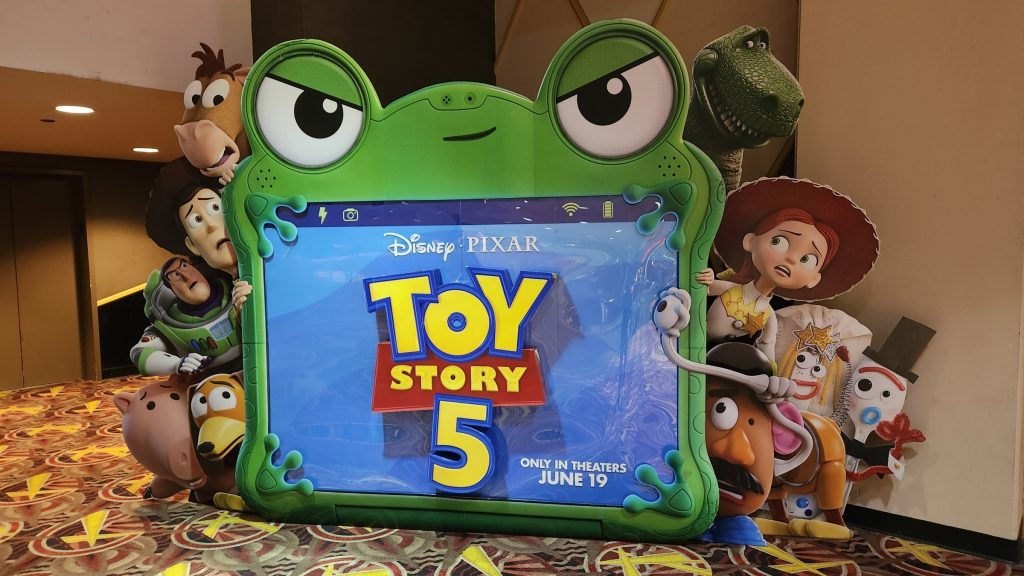
In the latest edition of the blockbuster franchise, Toy Story technology becomes part of Woody, Buzz Lightyear, Jessie, and Bonnie’s toys’ new challenge as tablets enter children’s playrooms, integrating digital devices into childhood perception, by competing with traditional toys, imagination, and face-to-face juvenile connections.
Toy Story 5 emphasizes Bonnie’s tablet, mirroring a broader concern among families, educators, and child development experts. As children spend more time with digital devices, in 2026 Toy Story 5 uses its familiar characters to explore whether screens are replacing the toys and face-to-face play that help children grow.
Screens Challenge Toys’ World
The 2026 Toy Story 5 has always centered on friendship, growing up, and the emotional power of play.
In its fifth installment, the story adds a timely concern, children’s growing use of tablets, phones, computers, and televisions, still making it a timeless movie but with rebranded name to it, Toy Story technology.
Toy Story technology begins with Jessie and Bullseye discovering discarded toys in a neighbor’s garden. The toys warn that “the age of toys is over,” as children across the street appear absorbed by screens. Bonnie, however, still finds joy in her toys, creating imaginary worlds that reflect the kind of play researchers say supports healthy development.
Child psychologists say imaginative, face-to-face play helps children develop communication, co-operation and problem-solving skills. Playing interactively with children also supports emotional development and helps children develop better relationships.
Still, Toy Story 5 shows a reality families already face. In a research paper titled “Discontinuation of Classic Toy Play vs. Digital Play Among 8–10-Year-Old Children: A Systematic Scoping Review” Toy Story technology indicated that many young children exceed recommended screen time limits, while children around Bonnie’s age may spend an average of four hours a day on screens.
This is a big tech and toys change from earlier in childhood practices, where screen time was more about watching television and videos.
Too much passive screen time can affect language, learning, and peer relationships, especially when it takes the place of active play. But the dilemma cannot be simplified into the mere categorization of good toys and bad technology.
Digital Play Not Always the Enemy
Explaining it in the movie, Toy Story 5 toys vs tech, digital elements still can be a form of play depending on how children use technology. A child creating digital art, solving puzzles, or using an educational app is having a different experience from a child passively watching videos for hours.
Researchers say that traditional play often encourages imagination and fantasy, while tablet play may encourage exploration, problem-solving, and skill-building. Both are important for development, but in different ways.
Toy Story 5 shows this tension through Bonnie’s tablet.
First, the device seems to offer connections with other children. However, it slowly takes over her play without providing much meaningful interaction.
The Toy Story technology film suggests that simply being near other children while using screens does not automatically create real friendship or social connection.
This is where adult guidance is important. When children actively and with support use digital tools, they can support learning and collaboration. They can also help some neurodivergent or marginalized children connect in less pressured environments and find others with shared interest.
However, imaginative play is still important. One study mentioned in the support article found that children who played with dolls had better social understanding than children who played with tablets. This suggests that toys can help children to learn empathy, perspective taking, and emotional awareness.
The main lesson from both articles is that families do not need to completely remove technology. Instead, parents can create a balance by modeling good habits, screen-free times, and ensuring kids have space for physical, outdoor, creative, and peer play.
As the original article notes, “there is no real replacement for connecting with each other in real life.”
Toy Story 5 Tech may turn the tablet into a dramatic challenge for Bonnie’s toys, but the bigger message is about balance.
The future of childhood does not have to mean choosing between toys and tablets. It means protecting the benefits of imagination while helping children use technology in ways that support learning, creativity, and genuine connection, and this is perhaps what Toy Story 5 tech touched on.
Inside Telecom provides you with an extensive list of content covering all aspects of the tech industry. Keep an eye on our Impact section to stay informed and up-to-date with our daily articles.
