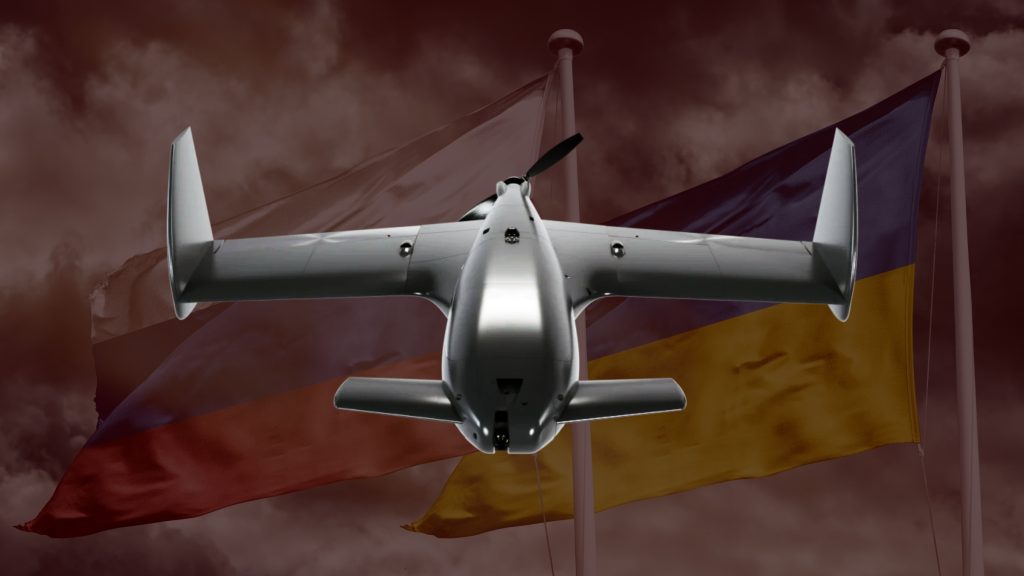
 APUS-1 interceptor. (Source: Defender Media)
 On July 6, Ukrainian defense company, Dark River unveiled the APUS-1 interceptor drone in Ukraine, a fixed-wing UAV built to destroy Russia’s Shahed-type munitions and reconnaissance drones through high-speed flight, live targeting, direct impact, or onboard detonation.
Ukraine’s building smaller and faster air defense tools in response to Russia’s heavy drone use. Instead of depending only on costly missiles, local companies are developing Ukraine interceptor drones that can move quickly, launch from the field, and protect troops and infrastructure from incoming aerial threats.
UAV Built to Chase Drone Threats
The APUS-1 is a fixed-wing interceptor drone that hunts and destroys airborne targets before reaching Ukrainian positions. Its main targets are Shahed-type loitering munitions and reconnaissance drones. Russia uses reconnaissance drones for intelligence, guided attacks, and long-distance strikes.
According to Defender Media, the aircraft can destroy a target in two ways:
- hitting the enemy drone directly through kinetic impact,
- Using an onboard warhead module to explode near the target.
The system gives operators added flexibility during fast air defense missions, especially when the target is moving across difficult or contested airspace.
Ukraine interceptor drones show how its defense sector is adapting to a war where drones are used every day. Small systems like APUS-1 can help fill the gap between electronic warfare, gun-based defenses, and more expensive missile systems.
The APUS-1 has a cruising speed of 140 kilometers per hour and can reach a top speed of 320 kilometers per hour. Its operational range is up to 50 kilometers, while its flight endurance can reach 50 minutes.
The interceptor drone can carry a payload of up to 1.5 kilograms and is launched by a catapult system.
Dark River says the system needs only two operators and can be prepared for launch in less than five minutes. This makes the interceptor drone easier to use close to the front line, where crews often need to move fast and avoid long setup times. Its stated operational ceiling reaches 4,500 meters.
The wider use of Ukrainian drones has changed how air defense is planned on the battlefield. These systems are not only used for attacks or surveillance anymore; they are increasingly being shaped into tools that can defend airspace from other drones.
Real-Time Targeting and GPS-Independent Flight
The APUS-1 uses a digital video transmission channel and a daytime optical camera, allowing operators to see the target area and guide the aircraft when manual control is needed.
The interceptor drone also supports autonomous navigation without relying fully on GPS, which is important because electronic warfare is active across many parts of Ukraine.
GPS signals can be jammed, blocked, or misled, which can make normal drone operations harder. A Ukraine interceptor drone that can keep flying without full GPS support has a better chance of completing its mission in contested conditions.
The aircraft can also receive real-time target coordinates from radar stations or other surveillance systems. Meaning, it can work as part of a wider defense network. When a sensor detects an incoming drone, operators can send the APUS-1 toward the threat quickly, reducing the time between detection and response.
The idea of a Ukrainian drone hunting Russian drones will deliver a major shift in the current war between Russia and Ukraine. Drones are no longer weapons or cameras in the sky.
They are now being used to stop other drones, creating a fast-moving layer of air defense that depends on sensors, software, and quick decision-making.
If the APUS-1 does not find its target, or if a mission is stopped, it can return to its launch area. A self-destruct option is also available if needed. This matters in active combat zones, where armed aircraft must be controlled carefully to reduce risk to friendly forces and civilians
The APUS-1 is currently going through Ukraine’s official codification process, which is required before wider military procurement. It is also listed on the Brave1 Market, the government’s defense technology platform, at around $3,300, or UAH 140,000.
That price point could become part of the debate around Ukraine interceptor drones effectiveness, as defenders try to stop low-cost Russian drones without using expensive missiles for every threat. A cheaper interceptor drone may give Ukraine more options during large drone attacks.
Dark River says the APUS-1 is already being used by 10 Ukrainian military units. Its development also comes as other Ukrainian companies build layered counter-drone systems, including automated platforms that can detect, track, and engage FPV drones with limited operator input.
The progress of the Ukraine interceptor drone reflects military technology under battlefield pressure. For Ukraine, the APUS-1 is not just another interceptor drone. It is part of a broader move toward mobile, lower-cost, and technology-driven air defense.
Inside Telecom provides you with an extensive list of content covering all aspects of the tech industry. Keep an eye on our Tech sections to stay informed and up-to-date with our daily articles.
