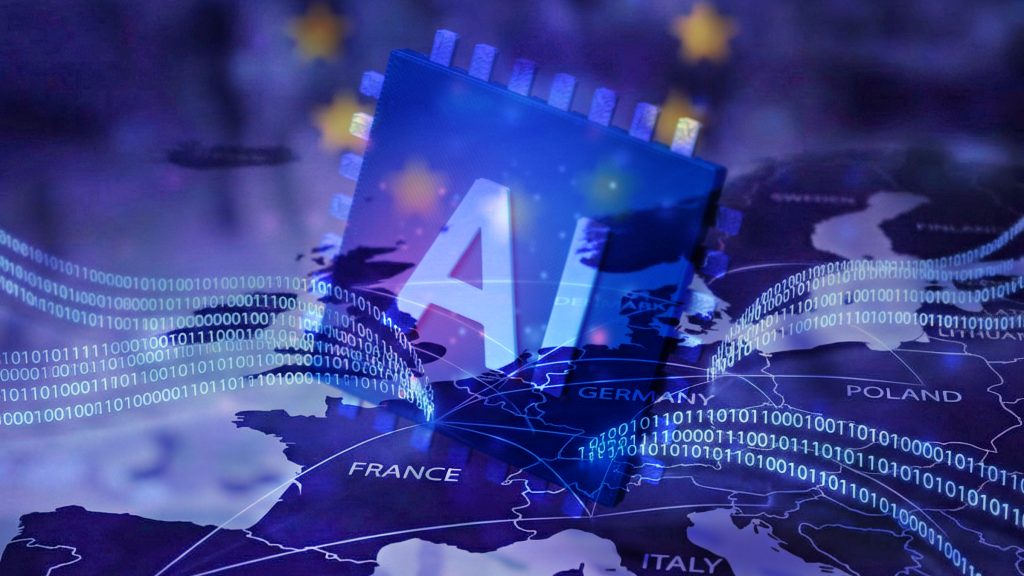
Germany, France, UK, and Ukraine are each accelerating their integration of machine learning systems into frontline command frameworks, with the convergence driven by operational necessity, with EU countries military AI adoption becoming the precondition for military might as the continent braces itself for war.
EU countries military AI adoption is no longer just about battlefield speed, but about whether democracies can protect themselves with sovereign technology while keeping soldiers, human judgment, and political responsibility at the center of every life-or-death decision.
Ultra-modern electronic warfare moves at a speed that human cognition, unaided, cannot match. The algorithms are not replacing human battlefield judgement, but the precondition for exercising that judgment in time.
AI’s no longer a battlefield by-stander, waiting for an initiation for tomorrow’s wars, it’s already moving into drones, planning systems, strike networks, and command tools across military in Europe.
It’s no longer whether the European defense tech hub can catch up, but if the military in Europe can do so without handing moral responsibility to machines. And as things stand right now, the EU’s defense readiness roadmap has a root problem, embedded in its specifications.
The EU defence spending is now under the Brussels wing, spending billions on sovereign defense AI. Simultaneously, Brussels wants to ensure it never fires autonomously, forcing Europe to decide whether its AI investments will protect soldiers or push war deeper into automation.
Clearly, there is contradictory tension between those two commitments, and in retrospect, it’s the defining stress test for the modernization of European military strength. Europe does not have a clean engineering solution for that problem.
Machines Aren’t Meant to Replace Soldiers
Speaking to the X25 cohort at École Polytechnique, European AI defense vanguard Helsing Chief Scientific Officer, Antoine Bordes, highlighted technology’s value in data processing and threat valuation. But he didn’t stop there.
Bordes also said that the final authorization to execute kinetic strikes should always be anchored in human hands. The Helsing executive drew the line that the defense industry’s most important customers are being asked to respect, by Brussels.
“The speed brought about by technology is dizzying, and we must be careful,” warned Bordes.
In the European defense tech hub, AI is for data processing, threat evaluation, and decision support. Human authorization, without exception, is exclusively for kinetic strikes. And this is non-negotiable for Europe.
EU countries military AI adoption cannot depend on outside powers for military AI, but it also cannot let speed become an excuse to remove ethical judgment from life-or-death choices.
“AI facilitates rapid data processing, comparisons, deductions, and so on, which is very useful in many sectors, including defence. But it is merely an aid. The tool should not be the one to make the decision to open fire. That must remain in human hands.
As engineers, we can create interfaces that set limits and require the input of several military experts to validate a decision,” Bordes added.
The new EU countries military AI adoption doctrine has a flagship, and it’s the Highly Automated Swarm of Affordable ISR Long-Endurance Unmanned Aerial Vehicles (UAV) for Force Protection (ALTISS) project. Funded through the European Defense Fund.
ALTISS is the sovereign swarm drone initiative, expressing Europe’s human-in-the-loop philosophy applied to autonomous military hardware, and that includes drones. Its architecture deliberately excludes:
- No fire-and-forget autonomy
- No opaque targeting logic
- No kill decisions executed without human authorization
What remains is the AI being applied to mission planning, intelligence geolocations, and task allocation. It compresses the processing timelines to milliseconds, so a single operator can maintain oversight of an entire multi-UAV swarm without defeating the system’s purpose.
Germany, France, Ukraine, and the UK are already leading European military strength integration. Germany and Ukraine have launched the “Brave Germany” program, which includes around 5,000 joint AI-enabled medium-range strike drones. Germany has also worked with Helsing on AI for future fighter systems, Eurofighter electronic warfare, and loitering munitions.
The UK is building the Asgard program, a digital reconnaissance and strike network linking sensors, decision tools, and weapons. France, meanwhile, is pushing for sovereign European military strength, including cooperation with Mistral, as it tries to avoid a defense future written in Washington, Silicon Valley, or any other foreign power center.
European Defense Tech Wants Its Own Battlefield Brain
Battlefield European military strength is not only about faster drones or smarter maps. It’s about who owns the code, who controls the data, and whose values sit inside the system when pressure hits.
Finland’s Patria and NestAI are moving in the same direction, building Europe’s strongest military for unmanned systems that can respond to changing battlefield conditions.
NestAI founder and chairman Peter Sarlin said European military strength defense forces require battlefield AI that can “evolve after deployment,” adding that it “needs to be built in Europe, by Europeans, for European operational requirements.”
Ukraine is already showing why speed matters. Its Delta battle management system uses EU defence policy to combine trackers, radars, satellite data, and digital maps to help commanders understand the battlefield.
EU countries military AI adoption is also being used for intelligence, air strike analysis, situational awareness, and drone operations. But even there, the most sensitive point remains the same. Automation may help soldiers act faster, but a human must remain responsible for the strike.
If it moves too slowly, it risks dependency. If it moves too fast, it risks building systems that outrun democratic control. The answer is not an army without humans, but an army where humans are better protected, informed, and fully accountable.
For engineers, that means building limits into the system. For soldiers, it means keeping strategy and judgment in human hands. For European military readiness concerns, it means treating AI as shields for its democracies, not shortcuts around them.
Inside Telecom provides you with an extensive list of content covering all aspects of the tech industry. Keep an eye on our Algorithmic Warfare sections to stay informed and up-to-date with our daily articles.
